The Question Behind the Object
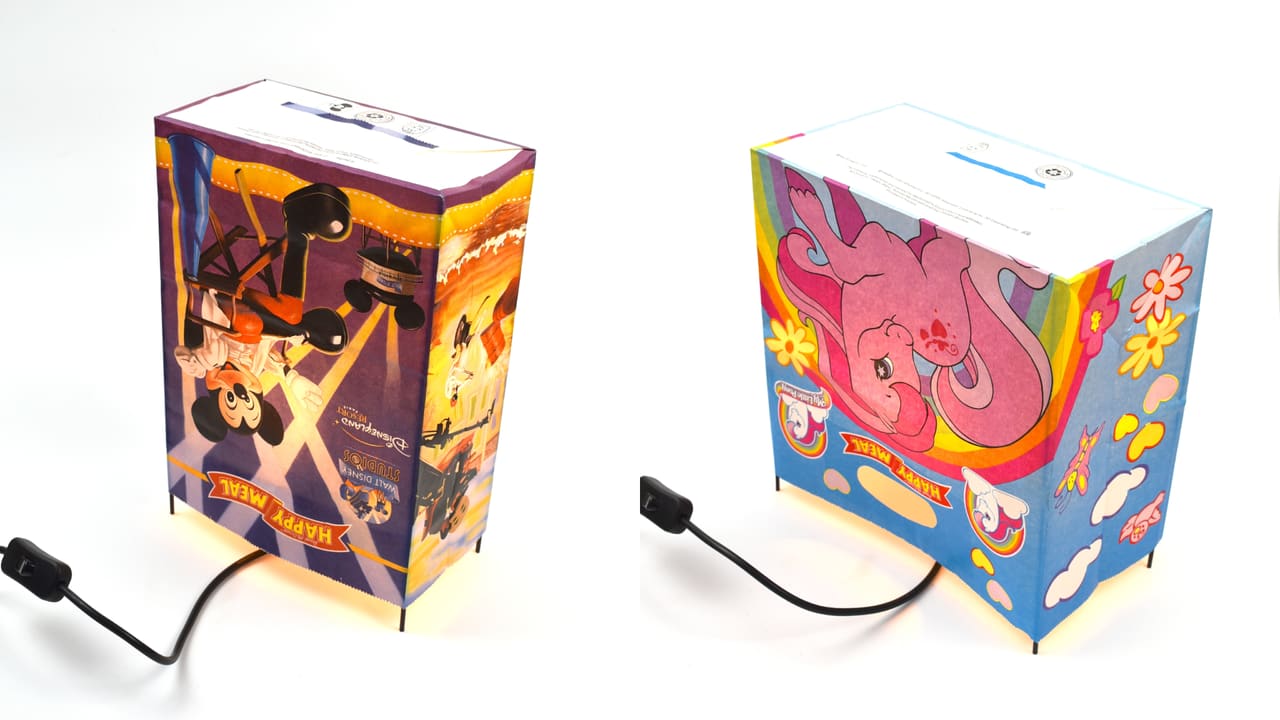
What separates a carefully crafted design object from a mass-produced commodity? It's a question that has animated debates in architecture and design circles for decades, and it's the exact provocation driving Benjamin Slinger's latest body of work. The British visual artist has spent the past three decades collecting paper bags from McDonald's and Burger King, not out of hoarding instinct but with an eye toward materiality and cultural resonance. The result is a series of wire-frame lamps that function as lighting, sculpture, and social commentary all at once.
At World Archi Design, we've been tracking how contemporary practitioners interrogate the boundaries between high and low culture, and Slinger's approach offers a particularly pointed example. By substituting traditional washi paper with fast-food packaging, he creates objects that are simultaneously nostalgic and critical, beautiful and confrontational.
Noguchi's Shadow and Corporate Graphic Language
The formal language of the lamps draws directly from Isamu Noguchi's Akari series, those delicate paper lanterns that have become synonymous with mid-century modernist restraint. Noguchi's originals, crafted from mulberry bark and bamboo ribbing, embodied a philosophy of light as sculptural material, a dematerialization of form that honored Japanese craft traditions while speaking to Western minimalism.
Slinger retains the wire-frame structure and the diffused glow, but the materiality tells a different story. Where Noguchi's lanterns evoke serenity and handcraft, Slinger's versions are loud with branding, the bold reds and yellows of multinational corporations demanding attention even in repose. The graphic identities that once sold burgers now become the skin of the lamp, their logos and taglines frozen in a new context.
This substitution is more than aesthetic provocation. It's a tectonic shift in meaning. The same structural logic that elevated Noguchi's work into the canon of design now supports imagery associated with convenience, consumption, and childhood nostalgia. The juxtaposition forces a reconsideration of what we value and why.
Cultural Artifact as Functional Design
The lamps are fully functional, wired and ready to illuminate a room. But their utility is almost secondary to their role as cultural artifacts. Each bag in the series represents a moment in branding history, a snapshot of evolving graphic design strategies, typeface choices, and marketing campaigns. Viewed collectively, they document shifts in popular culture over three decades, from the neon exuberance of the 1990s to the flattened, health-conscious messaging of more recent years.
This archival dimension aligns the work with practices we've seen in adaptive reuse and material salvage within architecture, where the patina of time and the traces of use become integral to the object's identity. Slinger isn't simply repurposing waste; he's curating it, selecting bags that carry specific visual and temporal markers, then re-contextualizing them within a form that has its own design pedigree.
The lamps sit somewhere between Duchamp's readymades and the more recent material investigations of Studio Swine or Formafantasma, where everyday detritus is elevated through craft and conceptual framing. But unlike those precedents, which often strip away branding to focus on material properties, Slinger foregrounds the corporate imagery, making it the subject rather than the substrate.
The Edition as Market Critique
Slinger is releasing an initial edition of fifty lamps across three sizes and more than twenty-five individual designs. Each is stamped, numbered, and signed, a gesture that borrows from fine art's edition logic and applies it to what is, at its core, a design object made from trash. The move is as much about market mechanics as it is about form.
By imposing scarcity on something derived from ubiquitous materials, Slinger highlights the arbitrary nature of value in both the art and design markets. A McDonald's bag, mass-produced by the millions, becomes singular through the artist's intervention. The question of how certain objects acquire cultural authority, how they cross the threshold from disposable to collectible, is embedded in the very structure of the project.
We've seen similar strategies in architecture, where limited-edition furniture by name architects commands prices far beyond the cost of materials and labor, the signature becoming a form of value in itself. Slinger's lamps make that process explicit and slightly absurd, asking whether the aura of the handmade can be transferred to something born from industrial food packaging.
Nostalgia and the Consumerist Everyday
There's an undeniable nostalgic pull to the work, especially for millennials who grew up with these logos as constants in the visual landscape. The bright graphics and familiar typefaces trigger sense memories of childhood Happy Meals and late-night drive-throughs, moments of comfort wrapped in paper and grease. Slinger taps into that affective register without indulging in sentimentality.
Instead, the lamps function as mirrors, reflecting back the extent to which corporate imagery has colonized personal memory. The brands that once represented treats or transgressions now appear as relics, their power diminished but their presence undeniable. This is consumerist archaeology, the excavation of a recent past that feels both immediate and strangely distant.
In this sense, the work shares territory with the vernacular studies that have gained traction in architectural discourse, the attention to roadside signage, commercial strips, and the designed environments of everyday capitalism. Slinger's lamps are the domestic counterpart to that larger landscape, portable fragments of a branded world brought indoors and made intimate.
The Exhibition Context and Beyond
The series launches with a three-day exhibition in London, a brief window that emphasizes the lamps' status as limited objects rather than mass-market goods. The physical presentation allows viewers to encounter the works in space, to see how the light interacts with the printed surfaces, how the wire frames cast shadows, how the scale and proportion relate to the body.
After the exhibition, the lamps will be available through the artist's online platform, a distribution model that collapses the distinction between gallery and store, between art object and purchasable design. It's a fitting strategy for a project that interrogates those very boundaries, refusing to settle comfortably in any single category.
Slinger's broader practice, which spans sculpture, painting, and writing, often engages with design history and socio-economic systems, but this project feels particularly urgent. In an era when sustainability and waste are central concerns in architecture and design, the lamps offer a pointed commentary on disposability and longevity, on what we throw away and what we choose to preserve.
What Endures
The lamps will outlast the meals they once contained, their materiality transformed from ephemeral packaging to durable object. But the question Slinger poses, how something of value is produced and who gets to decide, remains open. The work doesn't offer answers so much as it holds the tension, letting the viewer sit with the discomfort of recognizing how deeply consumerist imagery is woven into the fabric of daily life.
In a design landscape increasingly concerned with authenticity, craft, and ethical production, Slinger's lamps are a provocation. They suggest that the line between trash and treasure, between mass consumption and quality design, is thinner and more permeable than we might like to admit. And in doing so, they invite us to reconsider not just the objects we surround ourselves with, but the systems of value that give those objects meaning.
Credit: the artist
Save this story. A free account keeps your reading list and the 07:00 email in one place.
CREATE FREE ACCOUNT →SIGN IN