A Third of Life, Reconsidered
Consider the arithmetic of an average working life: roughly one-third asleep, one-third at work, and what remains scattered across family, leisure, and the thousand small rituals that make up a life. That middle third, the one spent in factories, offices, and workshops, often receives the least aesthetic attention. New Balance, the American footwear manufacturer, has recently challenged that calculus at its Flimby facility in Cumbria, where approximately 300 employees now have access to a purpose-built garden designed exclusively for their use.
The project, named the Flimby Garden, sits adjacent to the production floor where the brand's UK-made trainers are assembled. It represents a particular kind of spatial intervention: not a public amenity, not a marketing gesture, but a dedicated landscape for the people who operate the machinery and stitch the uppers.
The Unlikely Landscape Architect
The designer behind the space is Bleue Wickham-Burnham, founder of London jewellery brand Bleue Burnham. His selection for a landscape commission might initially appear incongruous. Yet the trajectory makes sense when you trace the horticultural thread running through his metalwork, where botanical forms and natural motifs have long served as primary inspiration. Wickham-Burnham cultivated his gardening interest during his teenage years in East Sussex, and the practice has quietly informed his design vocabulary ever since.
The collaboration emerged from an existing dialogue between Wickham-Burnham and New Balance about potential projects. During those conversations, his parallel passion for garden design surfaced, and the brand offered him the opportunity to translate that enthusiasm into a professional commission. For a designer whose primary medium is precious metal, the shift to living plant material and topography represented both an expansion and a return to first principles.
Planting Philosophy and Precedent
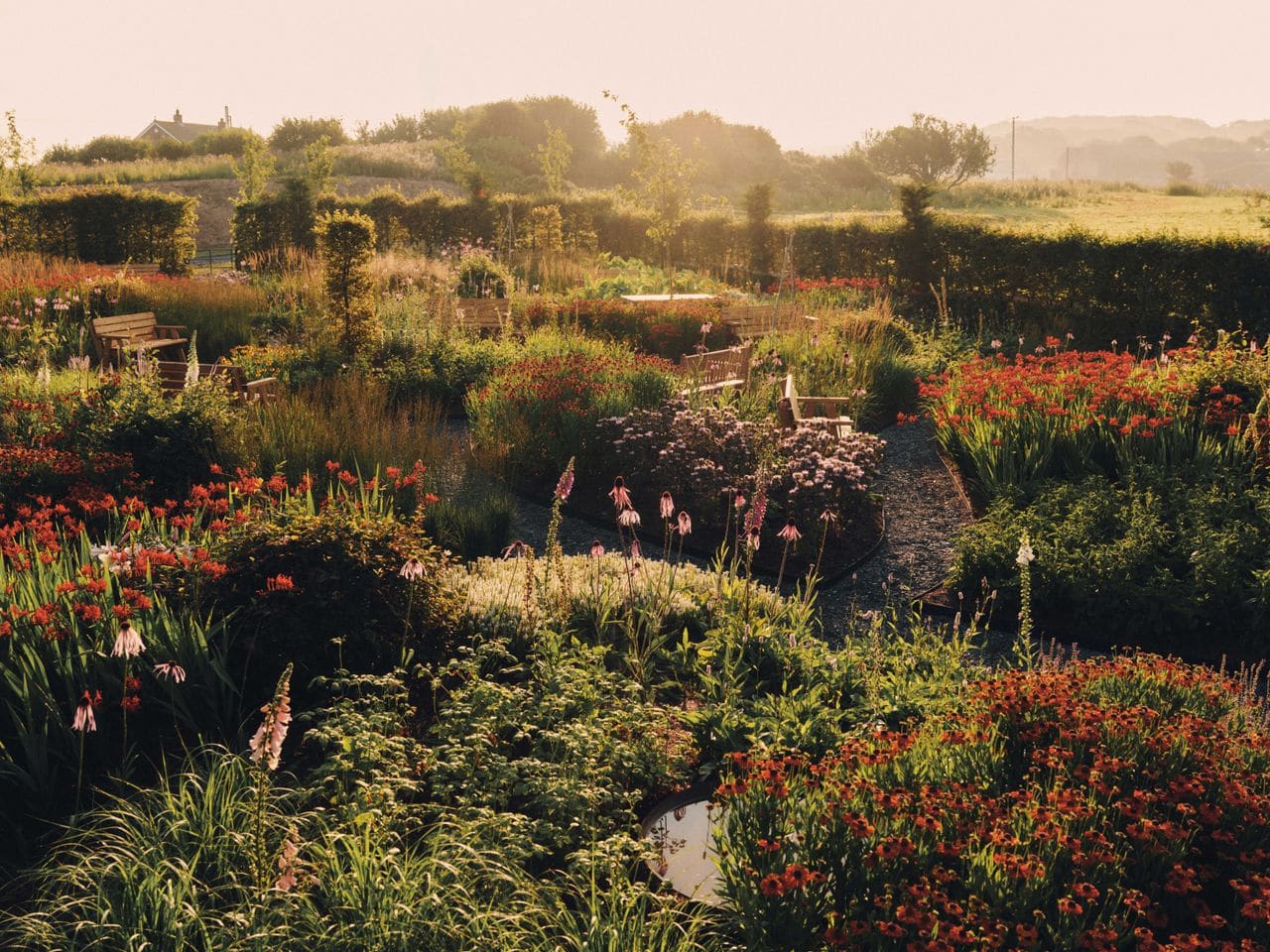
The Flimby Garden draws on multiple horticultural lineages. Wickham-Burnham looked to the bold, massed plantings of the New Perennial movement, particularly the work of Piet Oudolf, whose layered meadow-like compositions have redefined public planting over the past two decades. He also studied the cottage garden tradition exemplified by Great Dixter and Sissinghurst, where informal abundance and seasonal succession create constantly shifting compositions.
Additional references include pre-Raphaelite floral imagery and 17th-century topiary, resulting in a palette that mixes roses, peonies, anemones, foxgloves, and lilies. The planting scheme favours perennials and self-seeding varieties, ensuring the garden will evolve and densify over time with minimal intervention.
The spatial layout responds to the surrounding Lake District topography, incorporating gently undulating flower beds, small water features, and flowering cherry trees. Seating areas and communal gathering points are distributed throughout, allowing for both solitary retreat and group interaction. Custom-designed bird boxes, rendered in multiple colours, punctuate the space and have already attracted local wildlife, including a family of stoats that have become regular visitors.
Biophilic Design and Worker Wellbeing
The garden functions as a practical application of biophilic design principles, which posit that human wellbeing is enhanced by connection to natural systems. A growing body of research supports the premise that green spaces within workplace environments can reduce stress, improve cognitive function, and increase both creativity and productivity. While such studies are often cited to justify corporate amenity budgets, the Flimby Garden operates at a different scale and intent, it is not a rooftop terrace for client meetings or a branded green wall in a reception area, but a dedicated restorative space for the people who make the products.
New Balance remains one of the few global footwear brands to maintain domestic manufacturing in both the UK and the United States. That operational choice carries implications beyond supply chain logistics; it represents a commitment to skilled labour, regional economies, and the social infrastructure of production. The garden extends that commitment into the spatial realm, acknowledging that craftsmanship is not solely a matter of technique and materials, but also of the conditions under which makers work.
Some factory employees participated in the planting process, contributing their labour to the construction of a space designed for their own use. That participatory dimension shifts the garden from amenity to commons, a shared resource built and maintained collectively.
Film, Collaboration, and the Monty Don Cameo
To document the project's development, New Balance and Wickham-Burnham produced a film tracing the garden from initial concept through to completion. The production includes an appearance by Monty Don, the broadcaster and gardener whose long tenure on the BBC's Gardeners' World has made him a household figure in British horticulture. For Wickham-Burnham, who grew up watching the programme, the encounter carried particular weight. He has noted that meeting one's heroes often results in disappointment, but in this instance, the experience confirmed rather than undermined his admiration.
The film functions as both documentation and promotional material, situating the garden within a broader narrative about craft, care, and the conditions of production. It is a relatively rare instance of a brand choosing to foreground not the product itself, but the infrastructure and environment that support its making.
Horticulture as Organisational Value
The Flimby Garden can be read as a signal of shifting priorities within industrial design and workplace planning. Where previous generations of factory design emphasised efficiency, throughput, and ergonomic optimisation, contemporary approaches increasingly incorporate wellbeing, environmental quality, and aesthetic experience. This is not purely altruistic; research consistently demonstrates that improved working conditions correlate with reduced turnover, higher morale, and better output quality.
Yet the garden also functions symbolically, as a statement about what a manufacturing company values and how it understands its relationship to its workforce. In an industry where offshoring and automation have steadily eroded domestic production jobs, the decision to invest in a dedicated landscape for workers is a counternarrative, one that treats people not as interchangeable labour units but as individuals whose daily experience matters.
Wickham-Burnham has described the project as an exploration of how his design philosophy could extend into garden design, creating a space that is playful yet encourages pause, connection, and moments of joy throughout the working day. That language, pause, connection, joy, is rarely associated with factory floors, and its application here suggests a broader rethinking of what workplace environments can and should offer.
The Garden as Legacy Infrastructure
Gardens are time-based works. Unlike architecture, which achieves its final form upon completion, a planted landscape is always in flux, shaped by seasonal cycles, weather, soil chemistry, and the incremental growth of living organisms. The Flimby Garden will look different in five years, and different again in ten, as perennials mature, shrubs expand, and the tree canopy thickens.
That temporal dimension aligns with New Balance's emphasis on legacy and continuity. The brand's commitment to domestic manufacturing is itself a long-term proposition, one that resists the short-term financial logic that has driven much of the industry offshore. The garden reinforces that commitment, offering a tangible, lived benefit that will compound over time as the planting matures and the space becomes more deeply embedded in the daily rhythms of the factory.
It also establishes a precedent. If a mid-sized footwear factory in Cumbria can commission a dedicated restorative landscape for its workers, what prevents other manufacturers from doing the same? The question is not rhetorical; it points to a broader conversation about how we value the places where things are made and the people who make them.
At World Archi Design, we have long argued that the most significant design interventions are often the most site-specific and socially embedded. The Flimby Garden is not a spectacle; it will never appear on a tourist itinerary or feature in a glossy monograph. But for the 300-odd people who work at the New Balance factory, it represents something more valuable: a daily opportunity to step outside, breathe, and spend a few minutes surrounded by roses, peonies, and the sound of birdsong. That may not revolutionise industrial design, but it is a start.
Credit: New Balance
Save this story. A free account keeps your reading list and the 07:00 email in one place.
CREATE FREE ACCOUNT →SIGN IN