Reading as Return to Nature
Libraries have long borrowed metaphors from nature: branches of knowledge, roots of inquiry, seeds of thought. Yet how often do these institutions materialize those metaphors in their spatial form? Studio Hinge's recent cultural interior in Mumbai pushes past the figurative, crafting a library that doesn't just reference the natural world but attempts to inhabit its logic. Lead architect Pravir Sethi and his team have designed a 4,500-square-foot space completed in 2023 that positions reading not as an act of isolation within sterile stacks, but as a communal experience beneath an architectural canopy.
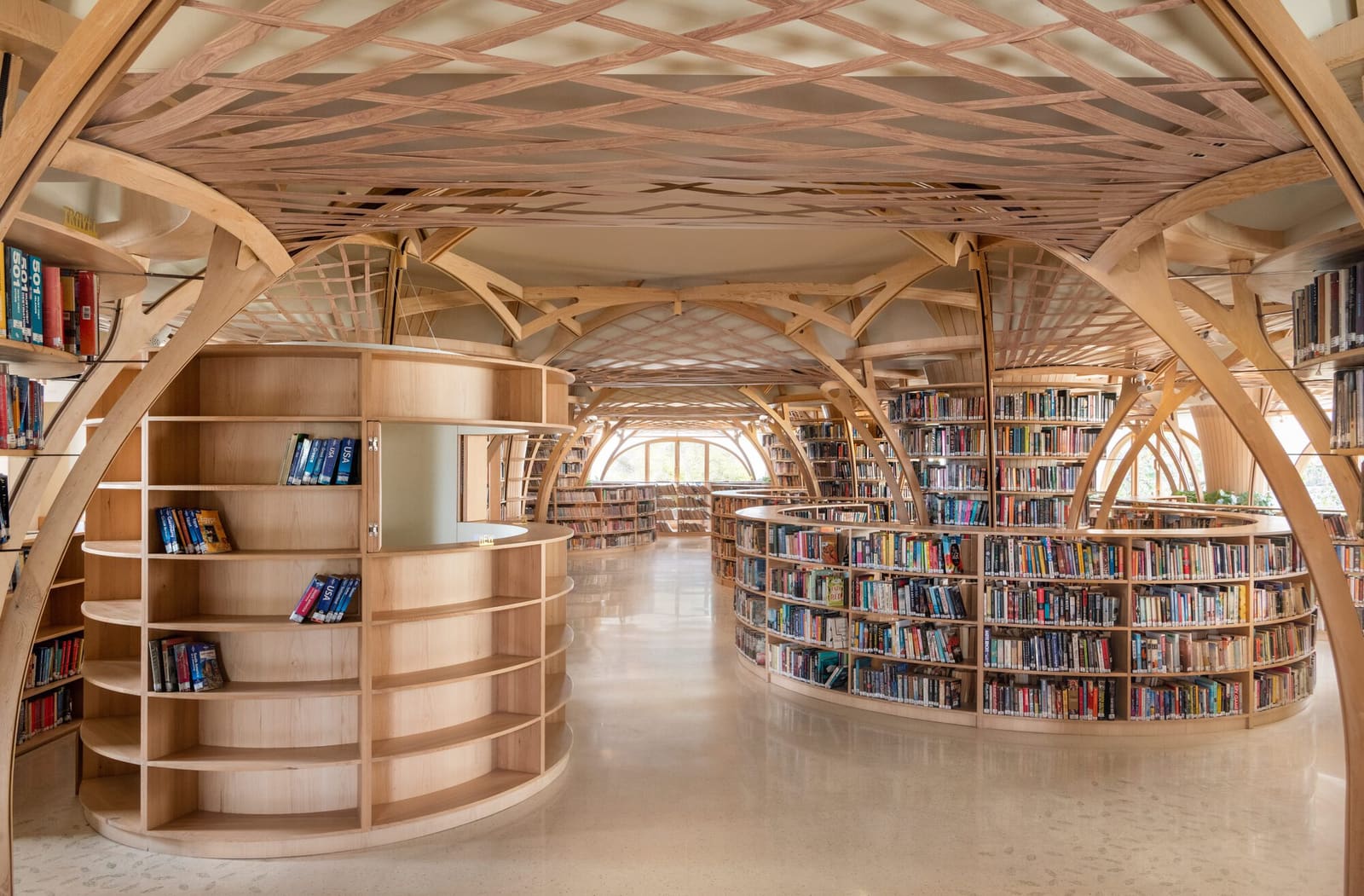
The project's conceptual anchor is straightforward: the library sits adjacent to a tree-lined street, and the design team sought to carry that foliage-dappled atmosphere indoors. What makes the work notable is not the metaphor itself, which is hardly new, but the rigor with which the studio pursues it. This is not a space where a few potted plants and timber finishes are meant to conjure "nature." Instead, the interior assembles a coherent spatial language around the idea of sheltering beneath branches, with overhead elements that modulate light and create zones of enclosure without rigid walls.
Canopy as Organizing Principle
At World Archi Design, we've been tracking the resurgence of biophilic strategies in institutional interiors, particularly in contexts where density and urban pressure make direct access to greenery scarce. Studio Hinge's approach here is less about importing nature than about borrowing its spatial qualities: the dappled light beneath a tree, the way branches create pockets of semi-privacy, the sense of gathering in a clearing.
The design employs overhead elements that function both as structure and as visual metaphor. These components modulate the ceiling plane, creating a rhythm that echoes the irregular spacing of tree limbs. The result is a reading environment where light filters unevenly, where some zones feel sheltered and others more open, much as one might experience moving through a grove. The design team, including Chintan Zalavadiya, has calibrated the spacing and materiality of these overhead elements to avoid the trap of literalism; this is not a theme-park forest but an abstraction that retains enough legibility to be read as canopy without descending into mimicry.
Material and Light
The choice of materials reinforces the conceptual framework without becoming didactic. Timber plays a central role, though not in the heavy, rusticated manner one might expect from a nature-themed space. Instead, the wood is deployed with a lightness that allows it to read as structural skeleton rather than mass. The grain and warmth of the material provide a counterpoint to the concrete and masonry typical of Mumbai's dense urban fabric, but the detailing is precise enough that the space retains a contemporary legibility.
Lighting design is critical here. Natural light enters the space in ways that are deliberately uneven, filtered through the overhead canopy elements to create pools and gradients rather than uniform illumination. This strategy has precedent in the work of architects like Alvar Aalto, whose libraries often used ceiling articulation to shape light, or more recently in the reading rooms designed by Steven Holl, where light is treated as a material that can be sculpted. Studio Hinge's version is more intimate in scale but shares that commitment to using light as an active participant in the spatial experience.
Social Space and Knowledge Exchange
The library's ambition extends beyond atmospheric effects. By organizing the space around a central gathering zone rather than rigid rows of shelving, the design encourages a different mode of use. Reading becomes a shared activity, visible to others, rather than a solitary retreat. This shift has implications for how knowledge is understood within the space: not as something accessed in private isolation but as part of a communal ecosystem.
This is where the forest metaphor gains traction beyond aesthetics. Forests are not collections of individual trees but interdependent systems. Studio Hinge's spatial organization suggests a similar understanding of knowledge: books and readers exist in relation to one another, with the architecture providing the framework for that exchange. The lack of tall, opaque partitions means sightlines remain open, and the overhead canopy elements define zones without severing them from the larger whole.
There is a risk in this approach. Open-plan libraries can become noisy, and the absence of acoustic separation can undermine concentration. The design mitigates this through careful zoning and the use of materials that absorb rather than reflect sound, but the success of the space will ultimately depend on how it is inhabited. A library that privileges community over isolation requires a cultural shift in how patrons use the space, and architecture can only go so far in shaping behavior.
Context and Precedent
Mumbai's urban density makes projects like this one particularly resonant. The city's public and semi-public interiors often struggle to provide respite from the intensity of the street, and green space is a scarce commodity. A library that manages to evoke the experience of sitting beneath trees without requiring actual trees becomes a pragmatic as well as poetic gesture.
The project can be situated within a broader lineage of libraries that resist the monumental reading room in favor of more intimate, domestically scaled environments. Gunnar Asplund's Stockholm Public Library, with its rotunda and peripheral alcoves, comes to mind, as does Jørn Utzon's unrealized library designs, which often featured modular, pavilion-like spaces. More recently, the work of practices like SANAA and Sou Fujimoto has explored libraries as permeable, garden-like environments where boundaries between inside and outside, reading and gathering, are deliberately blurred.
Studio Hinge's contribution is to distill these ideas into a relatively modest footprint. At 4,500 square feet, this is not a grand civic monument but a neighborhood-scale intervention. That scale allows for a level of material intimacy and spatial nuance that larger projects often sacrifice. The canopy elements, for instance, can be read individually rather than dissolving into an undifferentiated ceiling plane, and the proportions of the space allow for a direct, almost tactile relationship between the architecture and its users.
Forward Questions
The project raises questions worth carrying forward. As libraries continue to evolve beyond their role as book repositories into community hubs and maker spaces, what spatial models best support that transformation? Studio Hinge's forest metaphor offers one answer: a flexible, non-hierarchical environment where knowledge is understood as something shared rather than stored. But the metaphor also has limits. Forests are wild, libraries are curated. The tension between these two conditions, between the organic and the organized, is perhaps where the real design challenge lies.
Another question concerns replicability. The adjacent street's tree canopy provided a clear conceptual anchor for this project, but how might the approach translate to other contexts? The strength of the design is its specificity, its attentiveness to the particular qualities of its site and surroundings. That specificity may be difficult to generalize, though the underlying principle, using architecture to evoke natural systems rather than merely representing them, remains broadly applicable.
What Studio Hinge has achieved in Mumbai is a library that asks its users to reconsider what knowledge spaces can be. By turning to the street's trees for formal and spatial cues, the practice has produced an interior that feels less like a repository and more like a gathering place. Whether that shift represents a viable model for other cultural institutions remains to be seen, but the project demonstrates that even modest interventions, carefully considered, can expand the language of institutional design.
Credit: Saurabh Suryan
Save this story. A free account keeps your reading list and the 07:00 email in one place.
CREATE FREE ACCOUNT →SIGN IN