The Archive Lives in the High Street
There is a particular kind of design courage required to encode community history into a product destined for mass distribution. Yinka Ilori MBE, whose practice oscillates between art installation and functional object, has spent the last year doing exactly that. His forty-piece range for Dunelm launched this July, spanning furniture, bedding, lighting, rugs, and soft furnishings. The price spectrum is deliberately broad: a cotton jacquard hand towel opens at nine pounds; a king-size boucle ottoman bed closes at seven hundred ninety-nine. This is not luxury design slumming it in the high street. It is an exercise in how far pattern language can travel when freed from the gallery.
Ilori's visual vocabulary has always leaned into saturation and geometry. His recent London exhibition explored joy as resistance; his Milan collaboration with Veuve Clicquot turned champagne service into a chromatic event. Here, that sensibility is compressed into domestic scale. The question is whether the work retains its conceptual density when it moves from installation to inventory.
Leicester as Palimpsest
The collection's conceptual anchor is Leicester, specifically the city's role as a textile hub shaped by successive waves of migration throughout the twentieth century. Dunelm began as a market stall there in the late 1970s, a detail that resonated with Ilori, who grew up around his parents' supermarket in north London. What interested him was not nostalgia but structural similarity: how small-scale commerce becomes a site of community formation.
Many pieces in the range reference national flowers from India, Pakistan, and other countries whose diasporas shaped Leicester's garment industry. The 'Net Floral' duvet cover set, priced from sixteen pounds, reworks the British net curtain, that ubiquitous signifier of postwar domesticity, by overlaying it with floral motifs drawn from South Asian textile traditions. It is a quiet subversion: the curtain as filter becomes the curtain as declaration. The 'Gerbera' cushion, at twenty-six pounds, pairs crewel wool embroidery with a geometric floral that reads as both folk art and Op Art, depending on viewing distance.
This is not the first time contemporary design has mined migrant labour histories for material. What distinguishes Ilori's approach is the refusal to aestheticize hardship. The patterns are celebratory, not elegiac. They acknowledge origin without performing it.
Objects That Demand Engagement
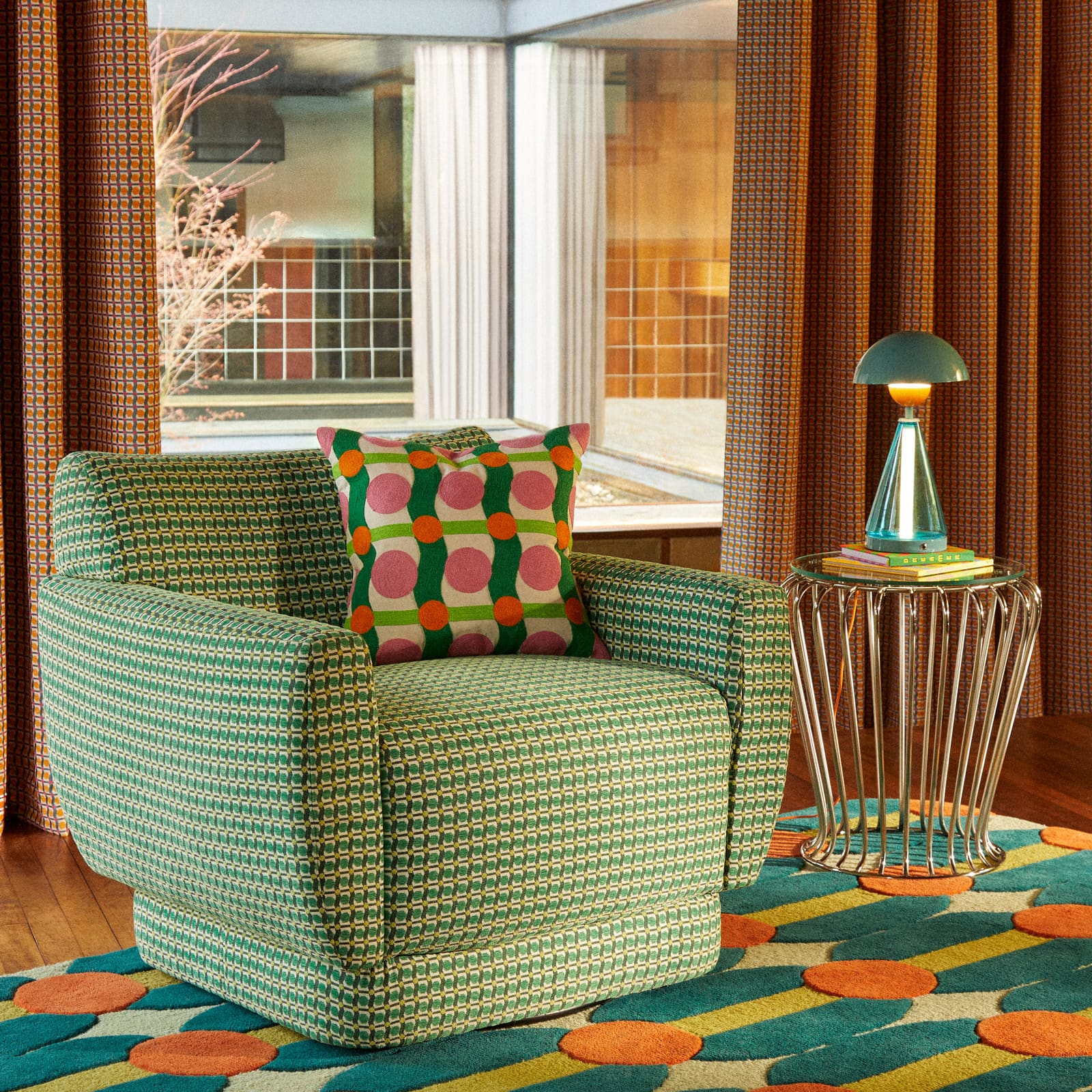
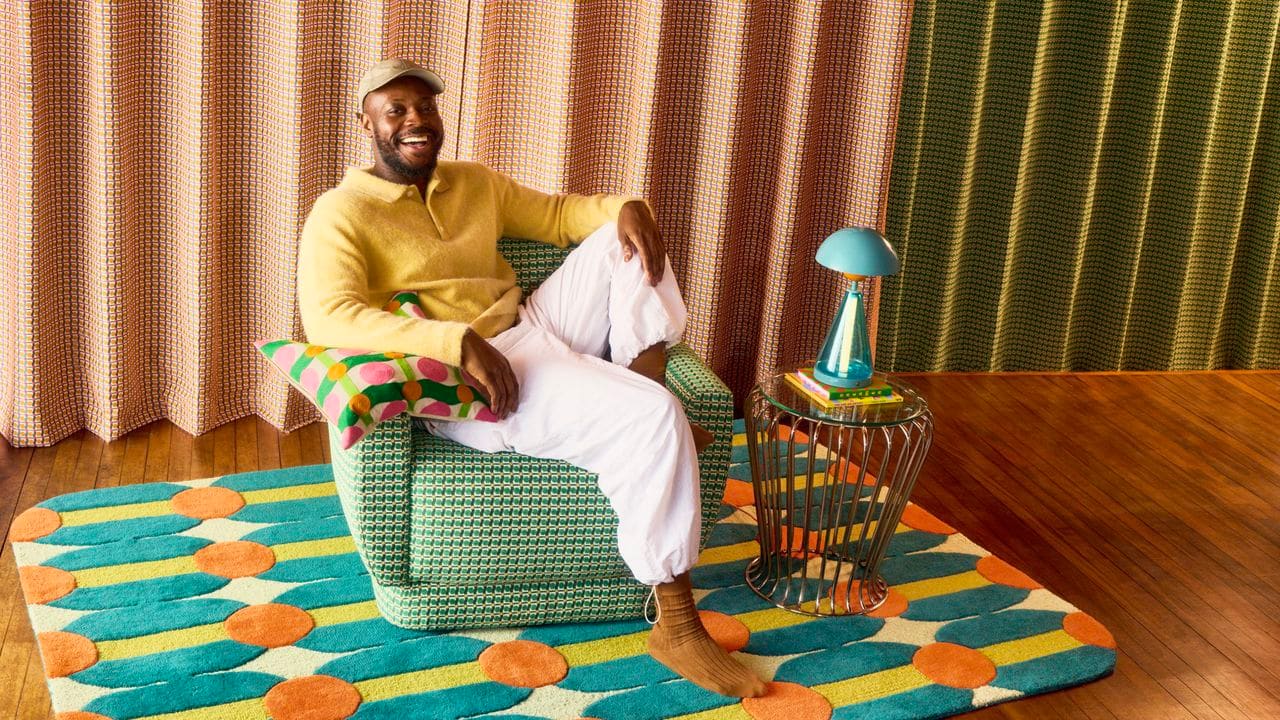
At World Archi Design, we have tracked Ilori's trajectory from upcycled chair projects to large-scale public commissions. His furniture has always operated at the intersection of sculpture and utility. The 'Sweet Flows' swivel chair, priced at two hundred ninety-nine pounds, is a case study in that tension. Its upholstery is a riot of pattern, the kind of maximalism that typically gets relegated to accent pieces. Here, it is the anchor. Ilori describes it as something that makes you want to smile immediately, a piece of art that also happens to be comfortable. The claim is not hyperbolic. The chair's silhouette is restrained enough to hold the pattern without collapsing into kitsch.
The 'Bell LED' lamp, sixty-five pounds, channels a different lineage. Ilori cites the 1970s and 1980s, but there is also an Art Deco formalism in the way the shade flares. It is playful without being juvenile, a distinction that eludes much of contemporary lighting design. The lamp works as both task light and ambient glow, a flexibility that suggests careful attention to lumens and diffusion.
The 'Kaleidoscope' floral round rug, starting at one hundred thirty-five pounds, is handmade in 100 per cent wool with a bobbled, textured finish. It is one of the few pieces in the collection that foregrounds craft technique as content. The rug's construction is visible, almost pedagogical. You can read the labour in it.
Furniture as Social Contract
The 'Half-Log' sideboard, at five hundred ninety-nine pounds, brings sculptural ambition to storage. Its form splits a cylindrical volume lengthwise, creating a silhouette that is both familiar and estranging. The oak finish is warm, the chrome legs cool, a material contrast that prevents the piece from reading as too earnest. It is the kind of sideboard that can hold books, dinnerware, or nothing at all without losing coherence.
This range of typologies, from towels to beds, raises a question that much high-low collaboration avoids: what is the unit of design thinking when you are working across such disparate scales and price points? For Ilori, the answer seems to be pattern as container. Every piece, regardless of function or cost, carries the same underlying narrative about migration, labour, and domestic space. The pattern is not decoration. It is the argument.
Accessibility Without Dilution
Dunelm is the UK's largest homeware retailer, a scale that brings both opportunity and risk. The opportunity is reach: these pieces will appear in homes that might never encounter Ilori's work otherwise. The risk is dilution, the flattening that often occurs when a singular design voice enters mass production. The collection navigates this by maintaining material integrity. The wool rug is wool. The crewel embroidery is crewel. There are no shortcuts masquerading as efficiency.
The campaign itself extends this logic. Rather than hiring models, Dunelm photographed its own employees, a decision that aligns with the collection's emphasis on community as subject rather than backdrop. It is a small gesture, but it shifts the visual rhetoric away from aspiration and toward recognition.
Ilori and Dunelm both position the collaboration around a shared belief that design quality should not be gatekept. This is a familiar refrain in contemporary design discourse, often invoked but rarely executed with specificity. What makes this collection credible is its refusal to equate accessibility with simplification. The storytelling is dense. The patterns are complex. The price points are varied. None of these elements are compromised in service of the others.
What the Collection Leaves Open
There are precedents for this kind of work. Ilori's practice has always been in conversation with designers like Lina Bo Bardi, who understood furniture as a site of social negotiation, and contemporary peers like Ini Archibong and Tiffany Loy, who centre diasporic experience in their material explorations. What this Dunelm range adds to that lineage is proof of concept at retail scale. It demonstrates that mass production does not require the erasure of particularity.
The collection also leaves questions unresolved, deliberately so. How do these pieces perform over time? Does the pattern language remain legible after years of domestic use, or does it fade into background? Can a sideboard or a duvet cover sustain the weight of historical reference, or does that narrative require continual reinforcement through external text?
These are not criticisms. They are the productive tensions that make the work worth examining. Ilori has built a career on objects that insist on being read, not just used. This collection extends that insistence into the most ordinary spaces of daily life. Whether that insistence can survive the rhythms of the everyday is the experiment. The collection is now available for purchase, and the experiment is underway.
Photo: Yinka Ilori and Dunelm
Save this story. A free account keeps your reading list and the 07:00 email in one place.
CREATE FREE ACCOUNT →SIGN IN