A Site Where History Cannot Be Erased
There are places where soil remembers. In Skellefteå, a city in northern Sweden, the Scharin industrial site spent over a century absorbing toxic emissions from pulp production. Seventeen years of remediation work followed, removing layers of chemical contamination before the land could be reclaimed as public space. This history is the kind that cities often try to bury beneath lawns and pathways, but Stockholm-based artists Bigert & Bergström have chosen a different approach: they have built a monument to contradiction.
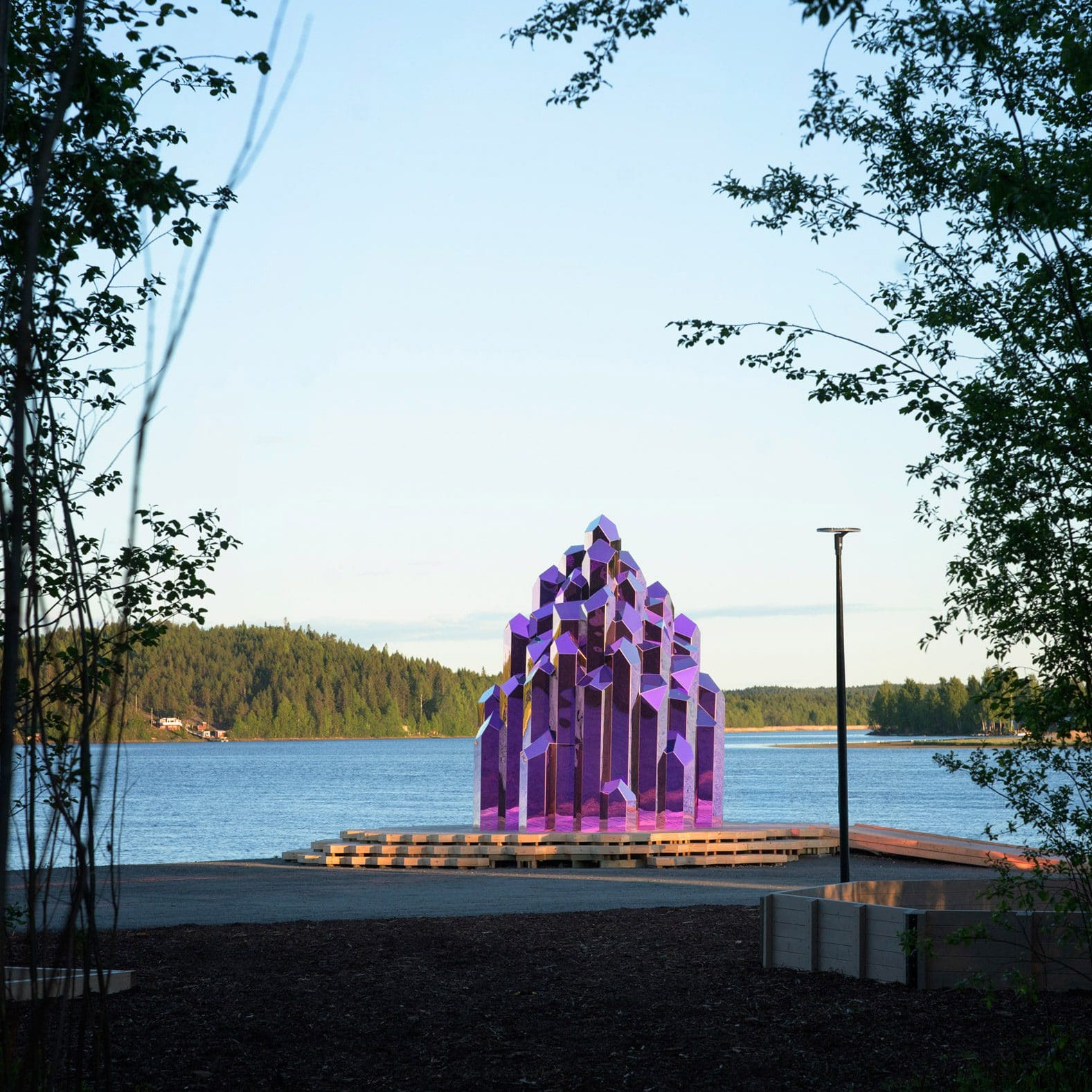
The Lithium Crystal Sauna, completed as the first permanent structure within WasteLand Climate Action Park, does not attempt to erase what came before. Instead, it translates industrial legacy and the paradoxes of contemporary energy policy into a faceted pink form that reflects both river and forest, a landscape profoundly altered by human activity.
Crystalline Form as Critical Material
The structure comprises approximately 280 faceted prisms, each digitally designed and fabricated using CNC machinery and laser cutting. The asymmetry is deliberate, the four-degree backward lean suggesting something that has pushed itself up from below, rather than been placed on the surface. This is not ornamentation for its own sake; the form references an enlarged lithium crystal, the mineral now synonymous with battery technology and the promise of a fossil-fuel-free future.
Lithium occupies an uncomfortable position in the cultural imagination. It powers electric vehicles and stores renewable energy, yet its extraction often creates environmental damage comparable to the industries it is meant to replace. Bigert & Bergström have long been interested in material contradictions, and here they have chosen a mineral that embodies the tension between aspiration and consequence. The sauna becomes a functional critique, a place to sweat and think simultaneously.
The cladding itself is a technical achievement: pink titanium-coated mirrored stainless steel, created by evaporating titanium and condensing it onto the steel surface within a vacuum chamber. The result is a reflective skin that changes with its surroundings, capturing the return of vegetation to a once-poisoned site while also mirroring the industrial infrastructure that remains nearby.
A Heater That References Deep Time
Inside, the spatial experience shifts dramatically. Where the exterior is all reflection and angularity, the interior is carved from heat-resistant wood veneer over a spruce structural frame. The sensation is cave-like, an intentional reference to early human shelter-making and the primal relationship between warmth and survival.
The custom-built heater at the center of the space is as conceptually loaded as the exterior form. Bigert & Bergström designed it to operate on stored green electricity, including power drawn from standalone batteries or electric vehicles. The heating element holds 260 kilograms of olivine stones within a metal cage, clad in black flint sourced from Normandy's coast. The artists describe its form as a deliberate echo of the 2.5-million-year-old stone chopper, one of humanity's earliest tools.
This juxtaposition of ancient and contemporary technology is characteristic of the duo's work. They have consistently explored how material culture shapes human behavior and belief systems. Here, the heater functions as both furnace and artifact, a reminder that the energy transition is not a break from history but another chapter in a much longer story of resource extraction and transformation.
Social Space, Not Just Sculptural Object
The interior accommodates up to twelve people on handmade alder benches arranged in a circle around the heater. A glazed door frames views over the Skellefte River, connecting the enclosed warmth of the sauna to the wider landscape. The flooring uses local heartwood pine, chosen for its naturally high resin content, which allows it to resist moisture and decay without chemical treatment. This material choice is both practical and symbolic, a nod to vernacular building traditions that worked with, rather than against, the properties of available resources.
Bigert & Bergström have described the project as a social and performative artwork, a place where conventional hierarchies dissolve in the heat. The sauna tradition in Scandinavia has always carried this democratic quality, a space where bodies are equally vulnerable and conversation flows more freely. By situating this particular sauna on a site marked by environmental harm, the artists invite a specific kind of dialogue, one that acknowledges both damage and repair, both technological optimism and its ecological costs.
The hexagonal wooden deck that supports the structure is made from the same local pine, grounding the crystalline form in regional material culture. This detail matters; it signals that the project is not simply an imported art object but an attempt to engage with local building practices and environmental conditions.
Precedent and Context
Bigert & Bergström's approach recalls the work of other artists and architects who have used functional structures to interrogate ecological and industrial themes. Olafur Eliasson's Ice Watch installations brought glacial ice into urban centers to make climate change visceral; here, the mechanism is inverted, creating a heated interior that references both ancient shelter and future energy systems.
The choice of a sauna as the typology also connects to a broader Scandinavian tradition of using thermal architecture as a site for social and political experimentation. We have seen this in projects like Raumlabor's mobile saunas, which activate public spaces through temporary interventions, and in the work of Finnish architects who treat the sauna as a laboratory for material research and spatial intimacy.
What distinguishes the Lithium Crystal Sauna is its willingness to hold multiple meanings simultaneously. It is a functional public amenity, a sculptural landmark, a material experiment, and a critique of energy policy. The pink mirrored surface ensures it will be photographed and circulated as an image, but the real work happens inside, in the heat and conversation that unfold over time.
Remediation as Ongoing Practice
The WasteLand Climate Action Park project represents a broader shift in how cities approach contaminated sites. Rather than sealing them off or attempting to return them to a pre-industrial state, there is growing interest in creating spaces that acknowledge damage while enabling new uses. This is remediation as ongoing practice, not one-time fix.
Bigert & Bergström's sauna participates in this process by making the site's history legible. The reflective cladding does not hide the surrounding landscape; it amplifies it, forcing visitors to see both forest and infrastructure, both recovery and remnants. The lithium reference ensures that conversations about energy and extraction are built into the experience of the space.
This is architecture as pedagogy, but without the didacticism that often accompanies environmentally themed projects. There are no plaques explaining the correct interpretation, no prescribed emotional response. Instead, the project offers heat, reflection, and a place to gather, trusting that meaning will emerge through use.
What Endures
Public saunas are not new to Sweden, but few carry the symbolic weight of this one. By anchoring a recreational structure on a remediated industrial site and cladding it in a material that references the next wave of resource extraction, Bigert & Bergström have created a space that refuses easy optimism. The lithium crystal form is beautiful, but its beauty is inseparable from the environmental costs that lithium mining entails.
This is the kind of complexity that architecture needs to hold more often. We are living through a moment when every material choice, every energy source, every construction method carries ecological implications. The Lithium Crystal Sauna does not resolve these tensions; it makes them visible and invites people to sit with them, literally and figuratively.
As cities continue to grapple with the legacies of industrialization and the uncertainties of the energy transition, projects like this offer a model for how public space can be both functional and reflective, both locally rooted and globally aware. The pink crystal rising from the Skellefteå site is not an answer, but it is asking the right questions.
Save this story. A free account keeps your reading list and the 07:00 email in one place.
CREATE FREE ACCOUNT →SIGN IN