The Designer's Advantage
There exists a particular species of dinner party that unfolds with the precision of choreography yet feels utterly unstudied. The guest list balances familiarity with novelty. The menu honors tradition without becoming staid. The table itself becomes a stage where material choices speak as loudly as conversation. This caliber of hosting demands more than good taste; it requires the spatial intelligence and material literacy that designers spend careers refining.
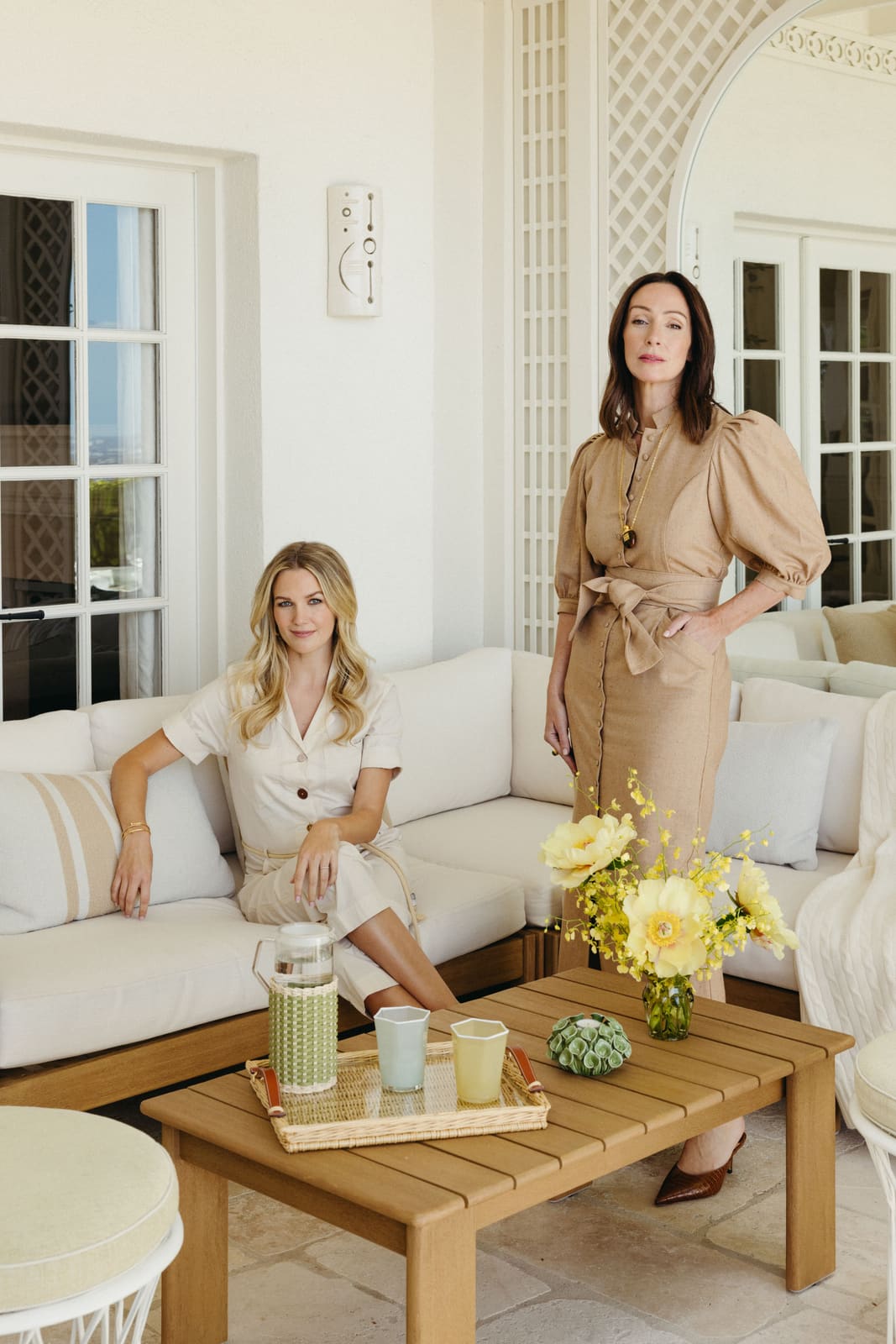
Cosima Swayze and Zoë de Givenchy, both practitioners in the realm of tableware, recently orchestrated such an evening on Swayze's Los Angeles patio. The setting offered sweeping valley views, a backdrop that framed the gathering without overwhelming it. Their collaboration drew from disparate geographic and culinary traditions: English Sunday roast conventions, French summer simplicity, and the relaxed cadence of Southern California entertaining. What emerged was neither fusion nor pastiche but a thoughtful synthesis that honored each influence while remaining legible as a coherent whole.
The exercise revealed something essential about design thinking applied to hospitality. When your professional life revolves around how people interact with objects at the table, the act of hosting becomes an extension of practice. Every decision, from utensil placement to the arc of the evening's progression, carries intentionality.
Heritage as Framework
Swayze's approach centers on the Sunday roast, a ritual embedded in English domestic life. The format is structured yet generous: a central protein, seasonal vegetables, shared accompaniment. It is food that demands presence, both in preparation and consumption. Her adaptation for Los Angeles involved retaining that structural integrity while adjusting for climate and context. Heavier elements recede; brighter notes come forward. The essence remains.
De Givenchy's contribution leaned into French vernacular cooking, specifically the kind of dishes that populate family recipe collections rather than restaurant menus. Ratatouille and roast chicken, she noted, represent a particular strain of French hospitality: unpretentious, technically sound, and confident enough to let ingredients speak without embellishment. This is not the cuisine of performance but of continuity, food that generations have refined into reliable excellence.
The intersection of these traditions created a menu that felt both specific and expansive. Charcuterie provided textural and flavor contrast, a casual element that invited grazing and movement. The meal's architecture balanced sit-down formality with the ease of self-service, allowing guests to modulate their own experience within a thoughtfully constructed framework.
Spatial Choreography and the Seating Calculus
Among designers, the conviction that seating arrangements matter borders on doctrine. Swayze and de Givenchy both articulate this principle with clarity: a considered seating plan is not about control but about generosity. The host who thinks through adjacencies and sightlines creates conditions for connection that guests cannot engineer for themselves.
Their method involves layering known relationships with strategic introductions. Place a guest beside someone familiar, then balance that comfort with a new acquaintance who shares an interest or sensibility. The goal is not forced networking but organic discovery. De Givenchy adds a spatial dimension: couples need not sit together, but they should maintain visual contact, a subtle acknowledgment that intimacy and autonomy can coexist within the same gathering.
The designers also share a particular aversion: guests who rearrange place cards. The objection is not about rigidity but about intention undermined. A seating plan represents hours of thought distilled into a diagram. To disregard it is to reject the host's primary tool for shaping the evening's social architecture.
Material Vocabulary and the Language of Objects
For practitioners whose work lives at the intersection of craft and utility, the objects on the table carry meaning beyond function. De Givenchy's bamboo-motif plates and Swayze's linens were not merely decorative choices but statements about material culture and design lineage. Bamboo, with its associations to both Asian craft traditions and mid-century California design, operates as a cultural hinge. Linens, meanwhile, invoke European domesticity while accommodating the informality of outdoor dining.
The selection of glassware, serving vessels, and flatware followed a similar logic. Each piece contributed to a cumulative aesthetic that felt curated without being precious. The table became a cabinet of curiosities in miniature, every object offering a small entry point for conversation or contemplation.
This approach reflects a broader philosophy within contemporary design: that everyday rituals deserve the same attention we lavish on exceptional moments. The dinner table, revisited nightly across a lifetime, becomes a site of accumulated meaning. Designers who work in this space understand that their objects participate in memory-making, that a particular glass or plate can anchor entire evenings in recollection.
Temporal Architecture and the Evening's Progression
Hospitality operates in time as much as space. The evening's structure, from arrival through departure, requires as much design consideration as the table itself. Swayze and de Givenchy's shared framework begins with a signature cocktail, a unifying gesture that establishes tone and creates initial common ground. Blood orange margaritas, for instance, signal both festivity and specificity, a drink with enough character to be memorable but not so eccentric as to alienate.
The transition from cocktails to wine marks a shift from reception to meal, from standing to seated, from mingling to focused conversation. The availability of red, white, and occasionally rosé accommodates varying preferences while maintaining cohesion. The fully stocked bar operates as insurance, a quiet assurance that no guest's request will go unmet.
Music functions as temporal scaffolding, shaping mood across the evening's arc. De Givenchy maintains multiple playlists calibrated to house, season, and occasion. A 1960s and '70s Los Angeles playlist evokes a particular strand of West Coast optimism; a Saint Tropez surfer vibe channels Mediterranean ease. Swayze defaults to Stan Getz radio, that quintessential mid-century modern soundtrack, but remains open to guests' contributions, allowing the evening's sonic landscape to evolve organically.
The after-party, whether on the patio or elsewhere, represents the evening's third act. If the seating plan succeeds, new connections have formed; the initial social architecture has given way to self-organizing clusters. Swayze's ideal outcome includes friends disappearing into the garden, evidence that the framework she built has enabled genuine intimacy.
The Calculus of Arrival and Departure
Timing, both designers insist, carries social weight. Early arrival ranks among their primary hosting grievances. The request for 7:30 drinks and 8:00 dinner is not arbitrary; it represents the host's final preparation window. To arrive early is to intrude on that liminal space where private chaos resolves into public welcome. De Givenchy's advice, to wait in the car if necessary, acknowledges the social contract: punctuality demonstrates respect, but so does allowing the host to complete their work unseen.
The question of cleanup reveals divergent philosophies. De Givenchy insists on same-night dish duty, even if delegated. A clean kitchen the following morning, as Swayze notes, transforms the hangover from burden to victory lap. The spotless space becomes evidence of a successful evening, the material aftermath managed and contained.
Hostess gifts, meanwhile, require their own calculus. Both designers favor wine or luxury bath products, items useful but not presumptuous. Flowers, while appreciated, introduce logistical complications on the day itself. De Givenchy's practice of sending arrangements the following day, informed by her now-clearer sense of the host's aesthetic, reflects a designer's instinct: better to respond to what you've learned than to guess in advance.
Precedents and Influences
The kind of hosting Swayze and de Givenchy practice has deep roots in both European and American domestic traditions. The English country house weekend, with its orchestrated meals and strategic guest pairings, provides one template. French salon culture, where conversation was cultivated as an art form and hostesses wielded considerable social power, offers another. Mid-century California entertaining, epitomized by figures like Frances and Michael Lappen or Eames-era gatherings, introduced a more relaxed vocabulary while retaining underlying structure.
Contemporary practitioners continue this lineage. Designers like Martino Gamper, whose work explores the social dimensions of furniture and tableware, or Formafantasma's investigations into craft and materiality, share the conviction that domestic rituals merit serious design attention. The table becomes a laboratory for testing how objects shape interaction, how spatial arrangements influence connection.
The Argument for Intentionality
What distinguishes this approach from generic entertaining advice is the application of design methodology to every dimension of the gathering. Swayze and de Givenchy do not merely set a pretty table; they construct an experience with the same rigor they bring to product development. The guest list is a brief. The seating chart is a plan. The menu is a material palette. The evening's progression is a narrative arc.
This level of intentionality can feel, to the uninitiated, like overengineering. Why not simply gather friends, open wine, and see what happens? The counterargument lies in the outcome: evenings where conversation flows easily, where strangers become friends, where the table feels like a temporary utopia. Such results rarely emerge from chance. They are built, piece by piece, by hosts who understand that generosity and control are not opposites but partners in creating conditions for genuine connection.
The dinner party, in this frame, becomes a minor but meaningful design challenge. It operates at human scale, with immediate feedback. Success is measurable in laughter, in lingering departures, in follow-up texts the next day. For designers whose work often unfolds across years and involves countless intermediaries, hosting offers the satisfaction of direct authorship. You conceive, execute, and witness the result within hours.
Material Culture and Everyday Luxury
The objects that populate these gatherings, from bamboo flatware to hand-painted ceramics, participate in a larger conversation about material culture and value. In an era of mass production and algorithmic recommendation, the curated table represents a quiet form of resistance. Each piece carries provenance, whether through maker, material, or technique. The table becomes an argument for slowness, for objects chosen with care and used repeatedly rather than discarded after a single event.
This philosophy aligns with broader movements within contemporary design toward sustainability and craft revival. Designers increasingly position their work against the churn of trend cycles, advocating instead for pieces that accumulate meaning through use. The dinner table, revisited weekly or monthly across decades, offers an ideal context for this approach. A set of plates or glasses becomes a through-line in family history, present at countless meals and their attendant milestones.
Swayze's linens and de Givenchy's tableware embody this ethos. They are designed not for novelty but for longevity, objects that improve with age and use. The patina of time, rather than diminishing value, enhances it. This represents a fundamentally different relationship to material goods, one rooted in stewardship rather than consumption.
Looking Forward
As hospitality continues its post-pandemic recalibration, the dinner party has re-emerged as a focal point of domestic life. The designers' approach offers a model that balances formality with ease, tradition with innovation. It suggests that hosting at its best is neither casual nor stuffy but intentional, a practice that rewards study and iteration.
The principles they articulate, seating charts, temporal structure, material thoughtfulness, translate across contexts and scales. A weeknight meal for four can benefit from the same attention to detail as a formal dinner for twelve. The tools remain constant: observation, empathy, and a willingness to orchestrate experience while leaving room for spontaneity.
In this sense, the tableware designer's dinner party is less a rarefied event than a demonstration of possibilities available to anyone willing to bring design thinking to domestic ritual. The table, reimagined as a site of careful construction and generous welcome, becomes a space where objects, people, and ideas converge in temporary but meaningful assembly.
Credit: Emily Ferretti
Save this story. A free account keeps your reading list and the 07:00 email in one place.
CREATE FREE ACCOUNT →SIGN IN