The Architecture of Authority
There is something revealing about the way institutions choose to house themselves. A bank wants granite and columns; a tech startup craves exposed brick and ping-pong tables. In the case of the British Broadcasting Corporation during its formative years, the question was more complicated: how do you build a home for something as intangible as radio waves?
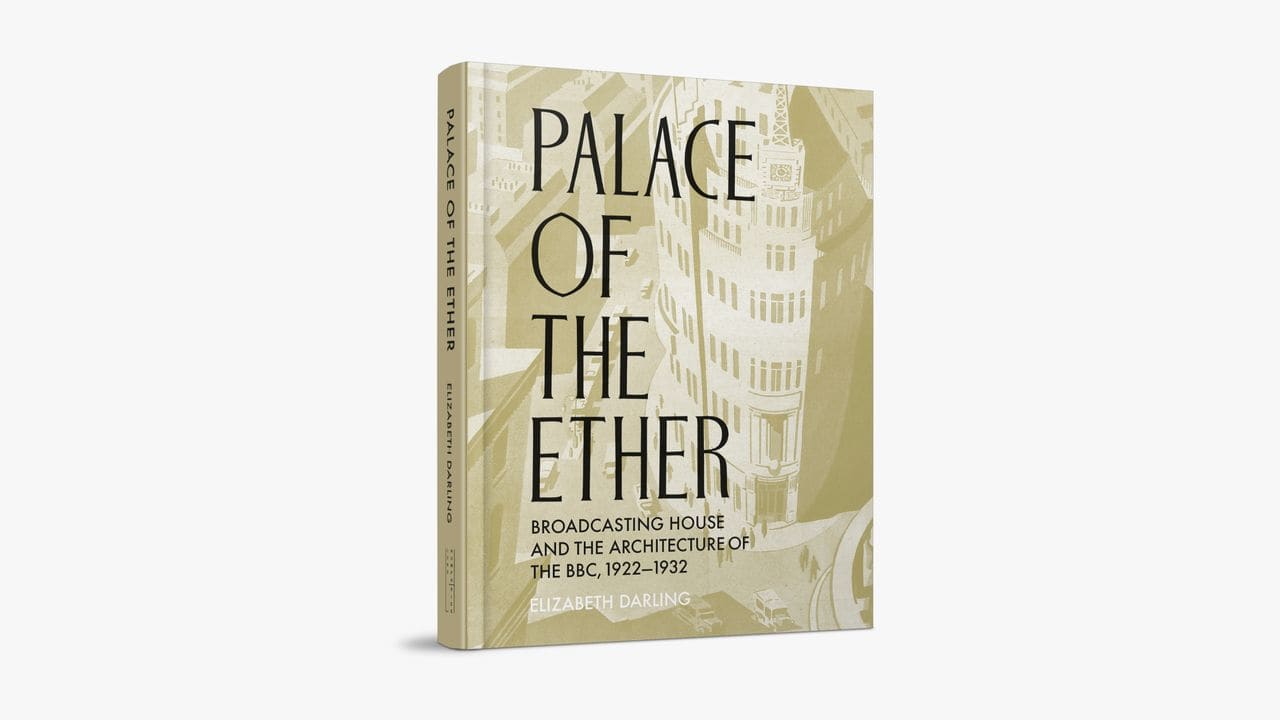
Elizabeth Darling's Palace of the Ether: Broadcasting House and the Architecture of the BBC, 1922-1932 examines exactly this puzzle. The book chronicles the transformation of an entity that began in 1922 as the British Broadcasting Company, operating from a patchwork of rented rooms across London, into the chartered Corporation of 1927 that would commission one of the capital's most distinctive buildings. When the BBC received its Royal Charter, the search for a permanent site began almost immediately. The result, opening in May 1932 at the junction of Langham Place and Portland Place, was Val Myer's Broadcasting House, a structure that has never quite fit into neat architectural categories.
Between Tradition and the Machine Age
Myer's design presents a curious hybrid. The building's curved façade, clad in Portland stone and adorned with sculptural reliefs articulating the broadcaster's mission, reads more as civic monument than machine for working in. Within the canon of interwar modernism, Broadcasting House has often occupied an awkward position. It lacks the uncompromising geometry of the International Style, the stripped functionalism that architects like Erich Mendelsohn and Serge Chermayeff would demonstrate at the De La Warr Pavilion just three years later. To purists, Myer's approach seemed diluted, a compromise that gestured toward modernity without fully committing.
Yet this reading, Darling suggests, misses the point. The BBC was not building a manifesto in concrete; it was constructing an institution that needed to project both authority and accessibility. The Portland stone exterior signaled permanence and public trust. The question of modernity, it turned out, would be answered inside.
Studios as Laboratories
The real architectural innovation at Broadcasting House happened in the studios themselves. Darling devotes substantial attention to the interior commissions given to Raymond McGrath, Edward Maufe, Wells Coates, and Chermayeff. These designers approached the challenge with genuine inventiveness, treating broadcast spaces as opportunities to explore contemporary materials and spatial concepts.
McGrath's Studio BB, designated for dance bands and chamber music, employed sleek surfaces and integrated lighting. Maufe's Studio 3E, designed specifically for religious broadcasting, balanced acoustic requirements with a sense of contemplative atmosphere. The interiors utilized modern furnishings and industrial materials, cork, acoustic tiles, tubular steel, creating environments that felt synchronized with the technological nature of the work being done within them.
Chermayeff and his collaborators earned praise for this synthesis. Here was modernism in service of function, spaces where form genuinely followed the demands of microphone placement, sound isolation, and the strange new choreography of live broadcasting. The Dramatic Control Panel, a technological innovation that allowed producers to switch between multiple studios during a single production, became both a tool and a symbol of the BBC's ambition.
The Paradox of Progress
Yet as Darling documents, many of these pioneering interiors proved surprisingly ephemeral. Broadcasting technology evolved rapidly, and spaces designed for the equipment of 1932 were obsolete within years. Wartime bombing destroyed some studios entirely. Others were simply gutted and rebuilt as technical requirements changed. The very modernity that made these rooms exciting also made them disposable.
More intriguingly, the BBC never fully committed to a single aesthetic approach. While McGrath and Coates were creating stripped-down, forward-looking studios, other rooms at Broadcasting House featured traditional appointments: fireplaces, heavy drapes, shelves of leather-bound volumes. Studio 3D, designed by Dorothy Warren for spoken-word broadcasts, embraced a more conservative idiom. This was not inconsistency so much as strategic flexibility. Different programs required different atmospheres, and the BBC understood that not every broadcast needed to announce its modernity.
Building an Identity
What emerges from Darling's research is a portrait of an organization using architecture to construct not just a headquarters but a public persona. Broadcasting House was extensively photographed, featured in promotional materials, and woven into the BBC's self-presentation. The building became shorthand for the institution itself, a physical anchor for something that existed primarily as voices in the ether.
This was deliberate. The BBC in the late 1920s was working to establish its authority as a national broadcaster, to position itself as both educator and entertainer, highbrow and accessible. The architecture needed to reflect that duality: modern enough to seem forward-thinking, traditional enough to feel trustworthy. Myer's exterior and the varied interior approaches achieved this balance, even if it frustrated critics looking for ideological purity.
At World Archi Design, we have long been interested in how institutions use built form to communicate purpose. Broadcasting House represents a particularly complex example, a building that had to embody the ephemeral, to give physical presence to electromagnetic waves and spoken words. The tension between the monument outside and the rapidly evolving technical spaces inside reflects a fundamental challenge: how do you build for permanence when your medium is in constant flux?
A Story Still Unfolding
Darling's book is dense with archival material, rich in detail about procurement processes, design debates, and the personalities involved. It is a scholarly work, more interested in nuance than narrative sweep. For readers willing to engage with its depth, the reward is a textured understanding of a pivotal moment in both broadcasting and architectural history.
The story, of course, continues. Broadcasting House remains the BBC's symbolic center, even as the organization faces contemporary challenges to its authority and relevance. The building has been expanded, renovated, and adapted repeatedly since 1932. Yet Myer's curved facade endures, and the idea of a broadcaster having a physical home, a place from which it speaks to the nation, persists.
Whether architecture can still perform that symbolic function in an age of streaming and decentralized media is an open question. But in the decade that Darling examines, between 1922 and 1932, the BBC managed to translate the intangible into stone and steel, creating a palace for something that existed only in the air. That achievement, whatever its stylistic compromises, remains worth studying.
Credit: Lund Humphries
Save this story. A free account keeps your reading list and the 07:00 email in one place.
CREATE FREE ACCOUNT →SIGN IN