The Spatial Logic of Flow
We tend to measure architectural significance by how long a structure stands. Durability becomes a proxy for importance, solidity for cultural value. Yet some of the world's most sophisticated settlement systems took shape in environments where survival depended less on resisting change than on channeling it. The oases scattered across North African and Arabian deserts functioned as nodes within circulation networks that predated the cities themselves. Caravans, pilgrims, herders, and traders moved through these territories along routes defined by water access, seasonal pasture, and strategic exchange points. What we call an oasis was rarely a terminus. It was a junction where one leg of a journey ended and another could begin, sustained by wells, palm groves, and marketplaces calibrated to accommodate transience.
Archaeological research continues to complicate the notion that deserts served merely as barriers between civilizations. Al Ain occupied a critical position linking Oman, the Gulf region, and Mesopotamian trade corridors. The walled oases of northern Arabia operated as interconnected stations enabling commerce across immense distances. Fertility mattered, certainly, but location within regional exchange systems mattered just as much. These settlements emerged where routes converged, not simply where water happened to surface. The desert was already a landscape of movement before it became a landscape of cities.
Infrastructure Before Architecture
If mobility created the demand for oasis settlements, hydrology determined their form. The foundational structures were not buildings but water distribution systems: aflaj channels in Al Ain, qanat networks across broader regions, springs managed through collective governance. These gravity-fed conduits organized the possibility of habitation from the subsurface upward. They dictated where agriculture could take root, where dwellings could cluster, and how communities might expand over generations without exhausting their resource base. Palm groves provided shade and structured microclimates; irrigation channels doubled as circulation corridors; agricultural plots formed the spatial armature around which social life coalesced. Buildings came later, emerging from the hydro-logic that already organized the ground.
Contemporary conservation increasingly works from this understanding. Efforts at AlUla extend beyond stabilizing historic masonry. The Royal Commission for AlUla has prioritized reviving ancient irrigation infrastructure, rehabilitating agricultural landscapes, and reconnecting ecological systems that sustained human presence for centuries. The approach treats the entire oasis as an artifact, not just the structures within it. A similar philosophy guided the Bled el Abar collective's restoration of Bir Ettin in southern Tunisia. On the surface, the project repaired a single neglected well. Functionally, it reinstated a critical waypoint within pastoral migration circuits, shortening the distance between reliable water sources and enabling nomadic communities to sustain mobility patterns that had begun to fray. Fixing infrastructure restored relationships between people, territory, and livelihood that transcended the well itself.
Urban Form as Interface
Only after these hydrological and ecological systems stabilized did recognizable urban typologies emerge. Streets, caravanserais, courtyard houses, and mosques developed to accommodate continuous flows of travelers alongside permanent residents. AlUla Old Town exemplifies this duality. Its compact alleys, shaded passages, and dense fabric were organized around commerce, pilgrimage, and hospitality rather than exclusively residential occupation. The settlement functioned as an interface, allowing goods, ideas, and cultures to circulate efficiently while maintaining climatic responsiveness. Siwa Oasis in Egypt developed similar spatial characteristics: tightly clustered construction, shared public spaces, and interconnected pathways that supported both everyday life and long-distance exchange. These were not fortified cities resisting the outside world but porous settlements calibrated to mediate between mobility and stability.
The Mysk Al Badayer Retreat outside Dubai offers a contemporary interpretation of this logic. Rather than imposing a sealed enclave on the desert, the project engages the landscape as a participant in spatial experience. Visitors encounter architecture that frames rather than excludes the surrounding terrain, echoing the way historic oasis settlements negotiated between shelter and openness.
Belonging Without Permanence
Oasis urbanism also complicates modern assumptions about belonging. Contemporary cities often equate belonging with permanence: property ownership, fixed addresses, continuous occupation. Desert societies demonstrate another mode. Communities returned seasonally to the same water sources, tended shared landscapes, traded in common marketplaces, and collectively maintained irrigation systems without requiring year-round residence from all participants. Belonging emerged through repeated use, stewardship, and mutual dependence rather than uninterrupted presence. Water governance demanded cooperation across social groups; trade required trust between transient merchants and settled inhabitants. Much of the architecture existed not in individual buildings but in systems of collective management.
The Bir Ettin restoration makes this relationship legible. The project mattered because it reactivated a cultural landscape, not merely a structure. Repairing the well shortened pastoral routes, restored water access, and reconnected grazing territories that had gradually become inaccessible. Heritage, in this reading, is conserved not by freezing a historic artifact in time but by maintaining the practices and networks that gave it meaning. The project suggests that architecture can preserve patterns of movement as effectively as it preserves material fabric.
Conservation as Reactivation
International heritage practice increasingly reflects this shift. UNESCO now designates many oasis environments as living cultural landscapes where water management, agriculture, ecology, and settlement form an indivisible system. Conservation has begun to move away from isolating monuments toward sustaining functioning environmental systems that continue to support communities. Restoring irrigation channels, cultivating palm groves, rehabilitating springs, and strengthening traditional water governance are now understood as architectural interventions. The work acknowledges that these settlements have always depended less on individual structures than on the relationships connecting landscape, infrastructure, and society.
Lina Ghotmeh's AlUla Immersive Living Project engages this sensibility by proposing architecture that integrates with rather than dominates its site. The design prioritizes landscape continuity and ecological reciprocity, drawing on vernacular strategies without replicating historic forms. Similarly, KWY.studio's visitor center for Desert X AlUla 2024 demonstrates how temporary structures can activate heritage sites without compromising their integrity. The pavilion supports cultural programming while remaining deliberately transient, acknowledging that not all architecture in these landscapes needs to aspire to permanence.
A Model for Uncertain Futures
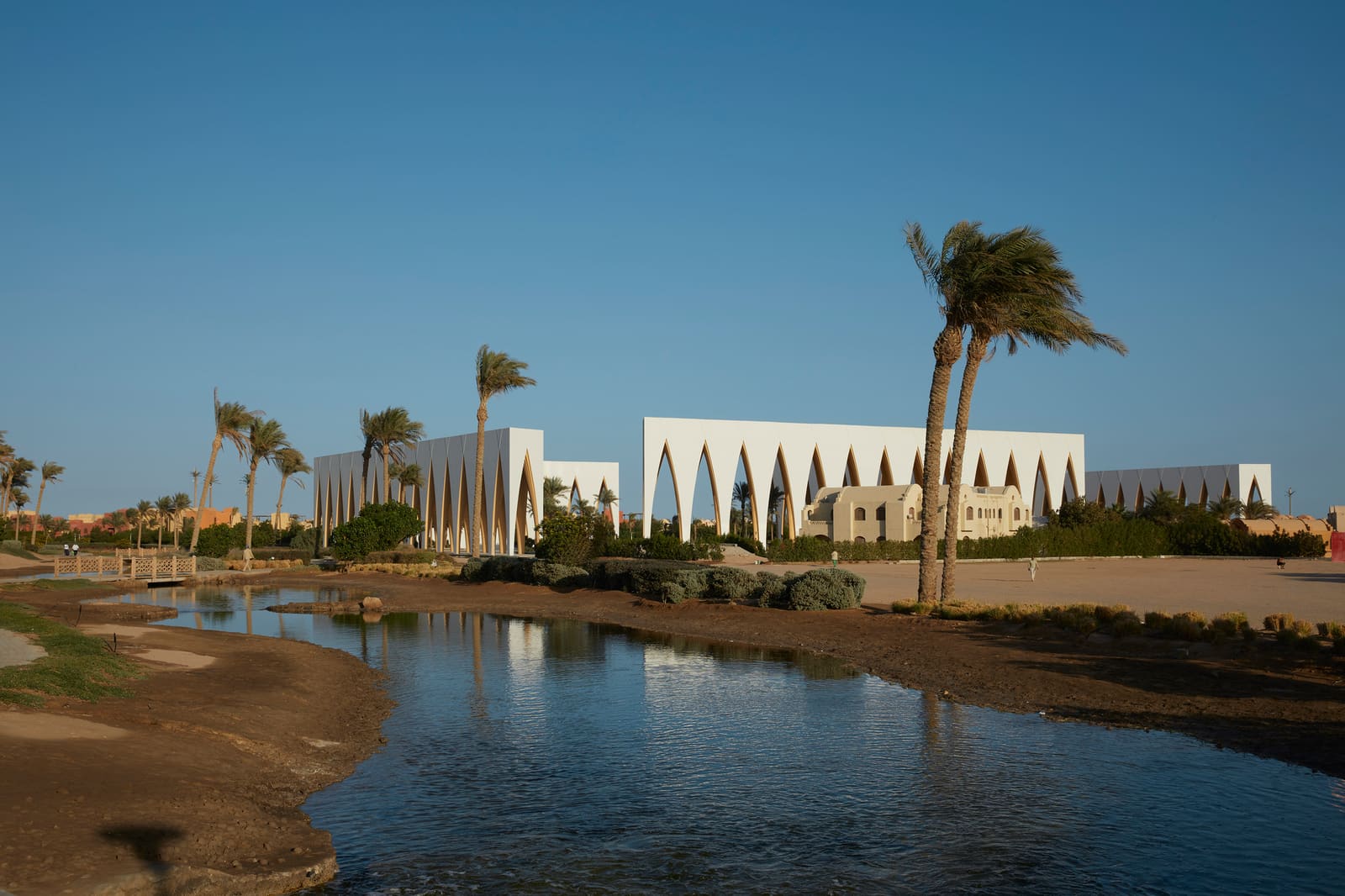
At a moment when migration, climate volatility, and resource scarcity are reshaping architectural discourse, the oasis offers more than historical precedent. It presents an alternative model of urbanism in which permanence is achieved not by resisting movement but by accommodating it. Oasis settlements suggest that architecture can sustain the networks that keep people, landscapes, and cultures connected across distance and time. Studio Seilern Architects' Festival Plaza in El Gouna translates this logic into a contemporary public space, creating infrastructure for gathering that supports both residents and visitors without privileging one over the other.
The oasis is not simply one of humanity's oldest settlement types. It survives because it continues to support relationships that extend beyond its own boundaries. That capacity to mediate between mobility and place, between individual structures and collective systems, may be its most enduring architectural legacy. In an era when cities are increasingly understood as nodes within global flows rather than isolated entities, the oasis provides a template for designing settlements that thrive on connection rather than enclosure. Water, not walls, defined these cities. The routes, not the monuments, made them matter.
Credit: Paul Riddle
Save this story. A free account keeps your reading list and the 07:00 email in one place.
CREATE FREE ACCOUNT →SIGN IN