The Unsung Hero of Outdoor Living
There's a certain kind of furniture that earns its place not through spectacle but through steady, quiet service. The outdoor bench is one such piece. While sectionals and lounge chairs command attention and real estate, benches slip into gardens, patios, and porches with an understated confidence. They anchor dining tables without the rigidity of matched chairs. They offer respite in vegetable patches. They turn awkward corners into destinations.
At World Archi Design, we've been tracking a renewed interest in benches as designers and homeowners alike reconsider what outdoor furniture should do. The answer, increasingly, is: more. A well-chosen bench adapts to shifting needs, seasons, and social configurations in ways that single-purpose pieces cannot. The challenge lies in choosing one that balances form, material integrity, and spatial intelligence.
Material Language: Wicker, Teak, and Resin Cord
Material choice defines not only durability but also spatial character. Woven wicker and rattan bring textural warmth, their hand-crafted irregularities softening modern outdoor settings. HAY's Palissade Cord Dining Bench exemplifies this approach, pairing powder-coated steel frames with woven polyester cord in olive, cream, charcoal, and rust. The backrest adds ergonomic support while maintaining visual lightness, a quality often sacrificed in outdoor dining furniture. Positioned among greenery, the olive finish recedes; in terracotta or rust, it becomes a deliberate accent.
Teak remains the gold standard for weather resistance, its natural oils repelling moisture and resisting decay. But not all teak designs are created equal. The Fretwork Teak Garden Bench from Terrain distinguishes itself through geometric lattice detailing and curved armrests, elements that elevate the silhouette beyond generic slat construction. The warm finish enhances grain visibility, lending the piece an heirloom quality that improves with patination.
Resin cord, a newer entrant in outdoor materials, offers the suppleness of natural fiber with superior weather performance. Luteca's Oasis Outdoor Bench wraps twisted all-weather cord entirely around its frame, creating a monolithic form softened by a removable quick-dry cushion. The hollow interior, while not designed for storage, accommodates baskets or garden tools discreetly. It's a detail that speaks to thoughtful space planning, particularly in compact urban gardens where every piece must multitask.
Spatial Strategies: Dining, Garden, and Threshold Zones
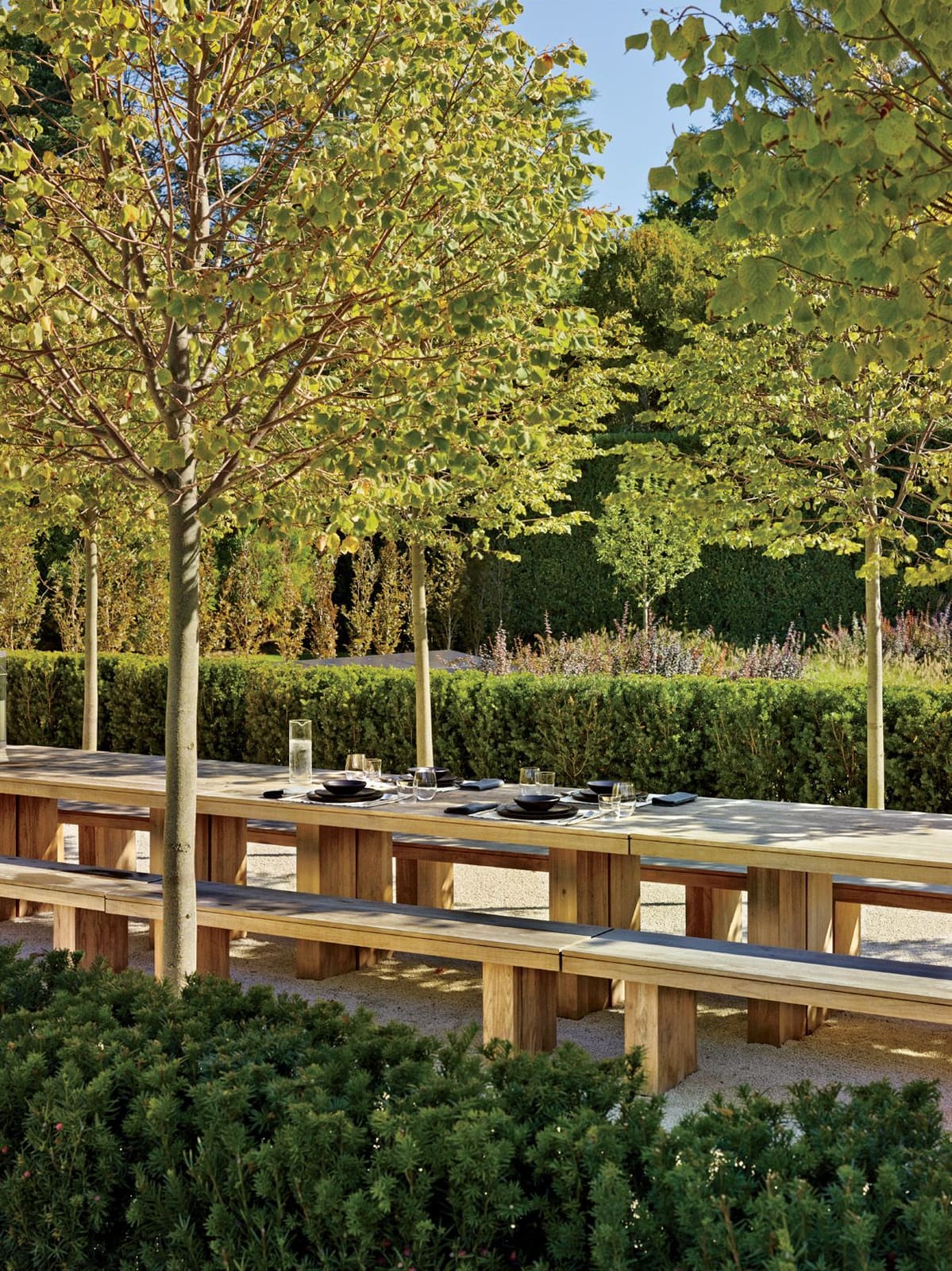
Benches occupy space differently than chairs. Their linear form creates visual continuity, drawing the eye along their length rather than fragmenting attention across individual seats. In dining configurations, a bench on one side of the table fosters intimacy, allowing diners to shift and lean without the physical barriers chairs impose.
For garden integration, placement matters as much as design. A bench nestled among raised beds or espaliered vines becomes part of the horticultural composition, not merely furniture placed within it. The backless West Elm Andalusia bench, with handwoven wicker draped over slim wrought-iron legs, reads as sculpture when positioned among foliage. Its compact footprint suits tight spaces, particularly threshold zones near back doors where quick seating for re-tying shoes or adjusting sun hats proves unexpectedly useful.
The arbor bench represents a more declarative spatial gesture. Kathy Kuo Home's Daria Arbor Garden Bench features scrollwork detailing and fleur-de-lis finials within an arched frame, a silhouette that commands attention even without surrounding plantings. When enveloped in climbing roses or clematis, it becomes a garden folly, a destination within the landscape rather than mere seating. This typology works best in larger gardens where architectural elements can anchor distinct zones.
Styling for Cohesion: The Case for Collections
Single-piece purchases risk visual isolation. Coordinated collections allow benches to participate in broader material and formal conversations. The Andalusia line extends to lounge chairs, dining chairs, and coffee tables, all sharing the same woven wicker and iron vocabulary. This approach simplifies specification while ensuring material consistency, a particularly valuable strategy for designers working with clients who struggle to visualize spatial relationships.
Serena & Lily's Riviera Étoile Bench takes a different approach, pairing bamboo frames with woven wicker in a nod to French bistro seating. Its neutral palette and airy construction make it easy to integrate with existing furniture, a flexibility that justifies its presence even as outdoor trends shift. The European bistro vernacular has proven remarkably durable, its informal elegance translating across geographies and design eras.
Budget and Versatility: The Acacia Equation
Not every project warrants custom teak or designer resin. Article's Kempel Outdoor Bench, constructed from acacia wood, offers a universally adaptable silhouette at a fraction of luxury pricing. Acacia's density and natural oils provide reasonable weather resistance, though it requires more maintenance than teak. The trade-off is affordability and formal neutrality. The Kempel works equally well flanking a tool shed, anchoring a front porch, or supplementing dining seating. Its lack of strong stylistic identity becomes an asset, allowing it to recede or step forward as context demands.
This kind of versatility matters in residential projects where outdoor spaces serve multiple functions across seasons. A bench that transitions from spring garden seating to autumn porch overflow to winter boot storage (when brought under cover) justifies its square footage in ways more specialized pieces cannot.
The Argument for Cushions and Covers
Comfort determines how long people linger. Backless benches gain significantly from cushions, which transform them from perches into destinations. The Oasis bench includes a removable cushion and weatherproof cover, thoughtful inclusions that many manufacturers charge separately for. Quick-dry foam prevents the sogginess that plagues outdoor seating after rain, a practical consideration often overlooked in favor of aesthetic concerns.
For benches without included cushions, aftermarket options abound, but dimensional compatibility and tie-down systems require attention. Cushions that shift or blow away negate their comfort benefits. Velcro straps or ties that loop beneath the seat provide adequate security without visible hardware.
Looking Forward: Benches as Spatial Infrastructure
The renewed interest in outdoor benches reflects broader shifts in how we conceptualize exterior spaces. As climate change makes outdoor living more seasonal and weather-dependent, furniture that adapts to shifting uses becomes infrastructure rather than decoration. Benches facilitate this flexibility. They're easier to move than sectionals, less precious than lounge chairs, more social than single seats.
We expect to see more hybrid typologies: benches with integrated planters, modular benches that reconfigure into chaises, benches with fold-down surfaces for drinks or laptops. The line between furniture and landscape element will continue to blur, particularly as designers trained in both disciplines collaborate more frequently.
For now, the seven examples here represent a solid cross-section of what's available: from HAY's modern cord weaving to Terrain's teak craftsmanship, from West Elm's compact wicker to Luteca's resin sophistication. Each solves spatial and programmatic problems differently, but all share a fundamental understanding that outdoor furniture should work as hard as the people who use it. The garden bench, long relegated to supporting-role status, is finally getting the recognition it deserves.
Photo: Nikolas Koenig
Save this story. A free account keeps your reading list and the 07:00 email in one place.
CREATE FREE ACCOUNT →SIGN IN