When Architecture Becomes Terrain
There is a particular discipline required to build on land already loaded with meaning. The grasslands outside Medora, North Dakota, are not neutral ground. They are the site where a 25-year-old Theodore Roosevelt arrived in 1884, devastated by the simultaneous deaths of his wife and mother, and found a kind of salvation in the unbroken prairie. That personal transformation would later become national policy: as president, Roosevelt established the US Forest Service and protected 230 million acres of public land. To design a library commemorating his life here is to contend not just with biography, but with the ecological legacy that biography produced.
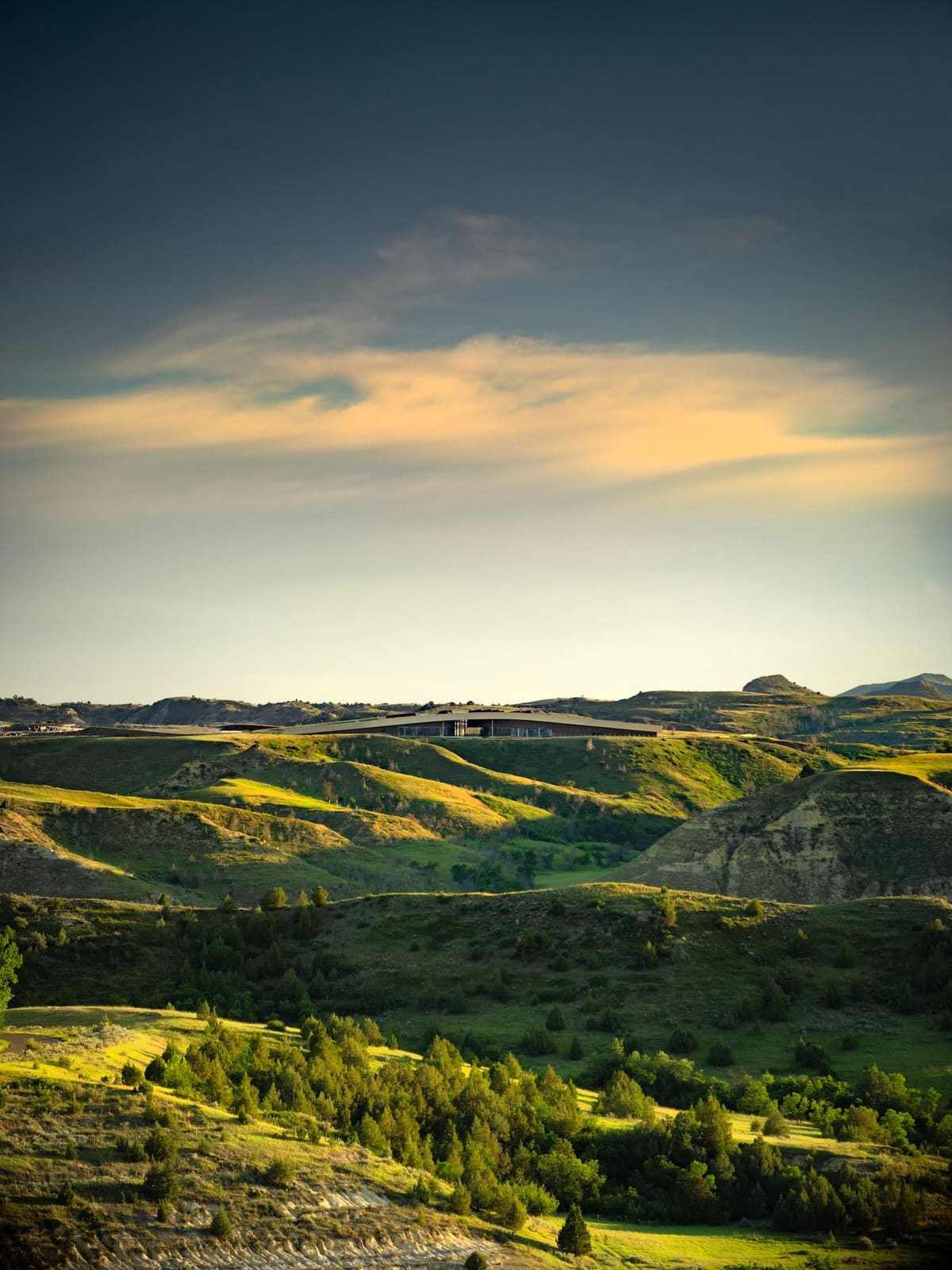
Snøhetta, working with local architect of record JLG Architects, approached the challenge by refusing the conventional monument. The 96,000-square-foot building, set to open on July 4, does not rise above the Badlands so much as fold into them. Its green roof, reaching 39 feet at its peak, follows the contours of the buttes. Trails cross its surface. From certain angles, the structure disappears entirely, camouflaged by the topography it mimics. Craig Dykers, founding partner at Snøhetta, describes the ambition plainly: hide the building from the beauty surrounding it. The face of this library, as landscape architecture director Matthew McMahon notes, is the land itself.
This is not scenic modesty for its own sake. It is architectural argument. The library occupies the same terrain that shaped Roosevelt's conservation philosophy, and the design insists that relationship remain legible. The building does not compete with its context. It extends it.
A Building That Teaches by Receding
Inside, the program is conventional enough: a café, classrooms, a digital archive, permanent and rotating galleries exploring Roosevelt's time at Elkhorn Ranch and his environmental policies, plus a 300-seat auditorium with a picture window framing the landscape behind the stage. Exhibition design by Local Projects, Dimensional Innovations, and the Future of StoryTelling guides visitors through Roosevelt's life and presidency with interactive narrative installations. But as Snøhetta landscape architect Michelle Delk points out, the real collection is outside. The site itself functions as the archive.
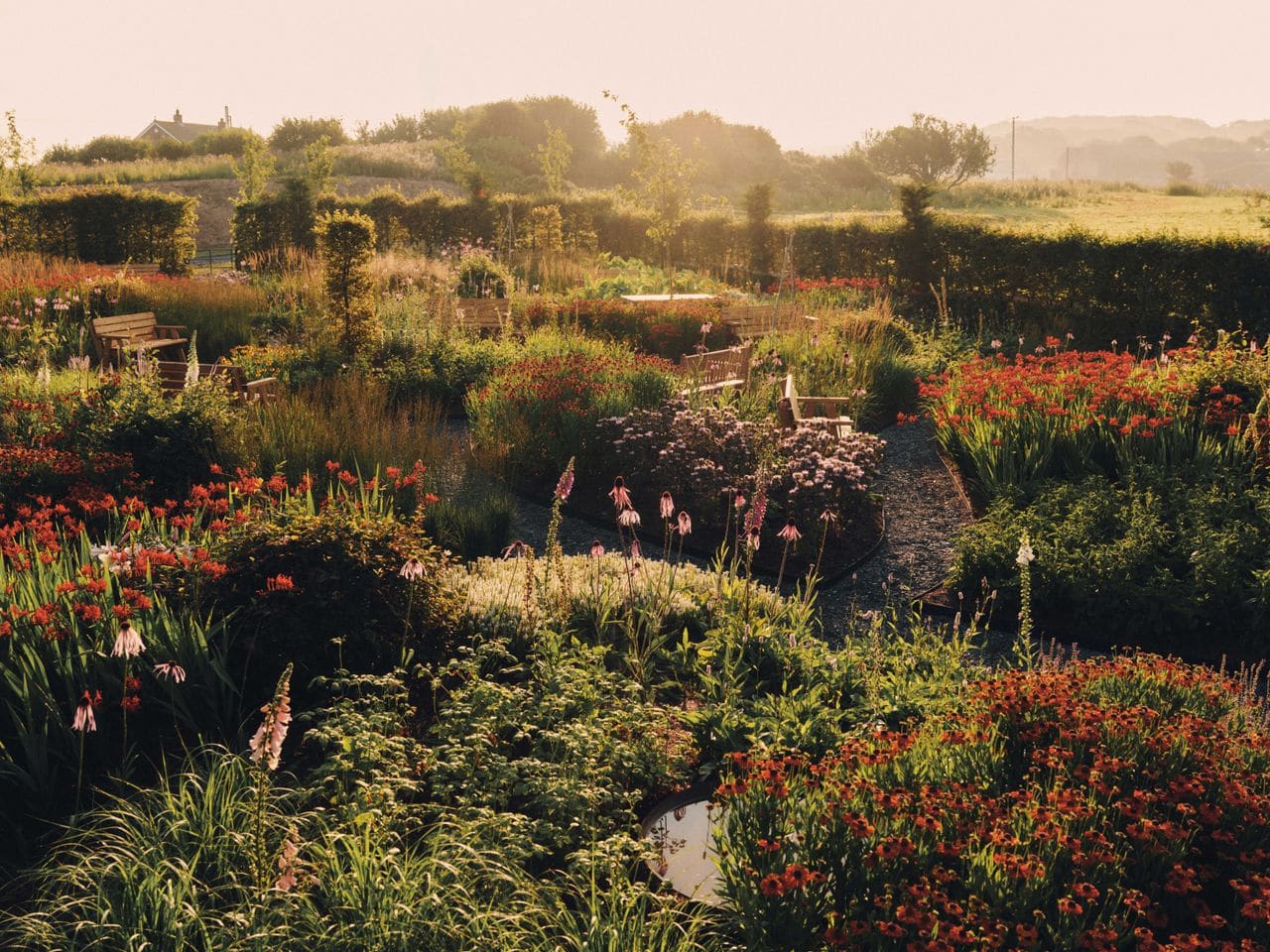
A one-mile boardwalk undulates through the museum grounds, connecting scenic overlooks, outdoor classrooms, and a suspended observation net. The path moves through a restored native grassland seeded with 400,000 plants collected by local volunteers and cultivated by North Dakota State University. The Native Plant Project, as it is called, does double work: it regenerates the immediate site while benefiting the surrounding public parkland. The landscape will be adaptively managed through controlled burns and modified grazing by local livestock, replicating the historic patterns once maintained by bison. McMahon describes it as a working landscape, not a preserved one.
The distinction matters. This is not a museum garden manicured for visual effect. It is an ecological system designed to function over time, responding to fire, grazing, and seasonal flux. The architecture recedes so the land can perform.
Carbon as Material Calculus
Sustainability in architecture often gets reduced to checklist compliance: renewable energy, low-carbon materials, LEED certification. The Roosevelt Library incorporates all of those, but frames them within a broader ambition: to become a carbon sink, sequestering more carbon over its lifespan than was embodied in its construction. Snøhetta collaborated with Atelier Ten, an environmental design studio, to model that balance.
The building generates 25% of its renewable energy on-site through solar panels and geothermal wells, with the remaining 75% supplied by off-site solar arrays. A low-energy heating and cooling system works in tandem with radiant flooring and a fireplace to minimize mechanical loads. The structure is built from mass timber and low-carbon concrete. Rammed earth walls, made from locally sourced sediment, custom pigment, and a small percentage of cement binder, serve dual functions: they are visual anchors and thermodynamic buffers, increasing thermal mass to moderate temperature swings and reduce energy demand.
Snøhetta director Aaron Dorf emphasizes that the project aims for zero carbon emissions and zero waste. The building's strategic location near existing National Park facilities allows it to share infrastructure rather than disrupt additional land. When a wildfire swept through the site in 2021, early in the design process, the team watched native plants reemerge within weeks. Delk describes that moment as a turning point, reinforcing the project's commitment to landscape regeneration rather than preservation in amber.
Precedent and the Politics of Place
Presidential libraries have historically functioned as monuments, often grandiose and inward-looking. The genre tends toward marble, symmetry, and the kind of civic formality that signals importance through mass. Roosevelt's library rejects that typology. It aligns more closely with recent work in landscape-integrated architecture: Peter Zumthor's Therme Vals, which nestles into the Swiss Alps; or Bjarke Ingels Group's CopenHill, where a waste-to-energy plant doubles as a public ski slope. Both projects blur the boundary between building and site, making infrastructure perform culturally and ecologically.
The Roosevelt Library extends that lineage into the American West, where the politics of public land remain contested. By siting the building on the same grasslands that informed Roosevelt's conservation agenda, Snøhetta ties architectural form to policy history. The design does not merely commemorate that history. It enacts it, treating the land as both subject and medium.
Access Without Prescription
Visitors can reach the library by car, mountain bike, on foot, or on horseback. A hitching post is provided. A large breezeway serves as the primary entrance, but movement through the site is not prescribed. You can walk the boardwalk without entering the building. You can picnic on the grounds without engaging the exhibitions. Locals might use the trails for recreation, indifferent to the museum program inside. The architects designed for that possibility.
This openness reflects a broader spatial philosophy. The building does not demand a singular experience. It accommodates multiple uses, some of which have nothing to do with Theodore Roosevelt. The rooftop trail offers 360-degree views of Theodore Roosevelt National Park, the Little Missouri River valley, and Elkhorn Ranch in the distance. You can visit for the views alone.
Dykers notes that throughout the design process, the team tried to imagine how Roosevelt might have approached these questions if he were alive today. That exercise, however speculative, produced a useful frame: think a century ahead. Roosevelt often did. The library's design plans for the next hundred years by embedding conservation strategies into its material and spatial logic, ensuring that the building's relationship to the land remains coherent even as climate and ecology shift.
What Persists
At World Archi Design, we have tracked a growing number of projects that position architecture as ecological infrastructure rather than object. The Roosevelt Library joins that conversation, but with a specificity that resists easy replication. This is not a formula. It is a response to a particular site, a particular history, and a particular set of environmental conditions. The building works because it refuses to dominate. It defers to the land, and in doing so, makes an argument about what monuments can be: not assertions of permanence, but gestures of stewardship.
The library opens on Independence Day, a date chosen for its symbolic resonance. But the real test will unfold over decades, as the native grasslands mature, as the controlled burns and adaptive grazing rhythms settle into routine, as the building weathers and the rammed earth walls patina. Architecture that claims to think a century ahead must be judged on that timescale. For now, what we see is a structure that understands its role: to recede, to support, to let the land teach.
Photo: Nic Lehoux
Save this story. A free account keeps your reading list and the 07:00 email in one place.
CREATE FREE ACCOUNT →SIGN IN