Abstract
As urban populations continue to grow, high-density environments demand new approaches to ensure livability, health, and resilience. Biophilia - the innate human affinity for nature - offers both a design philosophy and a practical framework to reconnect dense vertical cities with natural systems. This journal explores how biophilic design can transform skyscrapers, housing complexes, and urban infrastructure into restorative habitats. Through global examples, it examines strategies such as vertical greenery, adaptive reuse, ecological integration, and hybrid public-private landscapes. The article concludes with key design takeaways on how vertical cities can evolve into ecosystems that nourish both people and planet.
Introduction
Cities are rising higher and denser than ever before. By 2050, nearly 70% of the world’s population is projected to live in urban environments. While vertical expansion addresses land scarcity, it also creates challenges: isolation from nature, poor air quality, heat island effects, and psychological stress.
Biophilia - the idea that humans thrive when connected to natural forms, patterns, and ecosystems - has reemerged as a critical design approach in this context. Biophilic design in vertical cities is not simply about adding greenery for aesthetics; it is about weaving ecological intelligence into the fabric of high-density living. This vision turns skyscrapers into habitats, plazas into urban forests, and rooftops into gardens, reframing urban density as compatible with human well-being and ecological restoration.
Biophilia brings nature’s calm into the vertical rhythm of urban life
Understanding Biophilia: Origins and Global Impacts
The term biophilia was popularized by biologist Edward O. Wilson in his 1984 book Biophilia, where he argued that humans possess an innate tendency to seek connections with nature and other forms of life. While the word itself means “love of life” in Greek, Wilson’s insight extended beyond sentiment: he linked human survival and well-being to the quality of our interactions with the natural world.
Over the decades, biophilia has moved from ecological theory to architectural and urban practice. The biophilic design movement, championed by scholars like Stephen Kellert, emphasizes not only the presence of natural elements but also the replication of natural systems, patterns, and processes in the built environment.
Globally, biophilia has influenced urban visions in profound ways:
+ In Singapore, policies mandate the integration of greenery in new developments, creating the image of a “City in a Garden.”
+ In Scandinavia, schools and workplaces increasingly emphasize daylighting, wood interiors, and natural ventilation as part of holistic well-being.
+ In North America, the WELL Building Standard incorporates biophilic principles as part of measurable design criteria for health-centered architecture.
Today, biophilia is no longer a fringe idea - it is shaping the way cities plan their futures. As climate change, urban stress, and resource scarcity intensify, biophilia provides both a psychological anchor and an ecological strategy, reminding us that dense cities can still be habitats where people and nature thrive together.
Reframing Vertical Cities through Biophilia
Vertical Forests as Urban Habitats
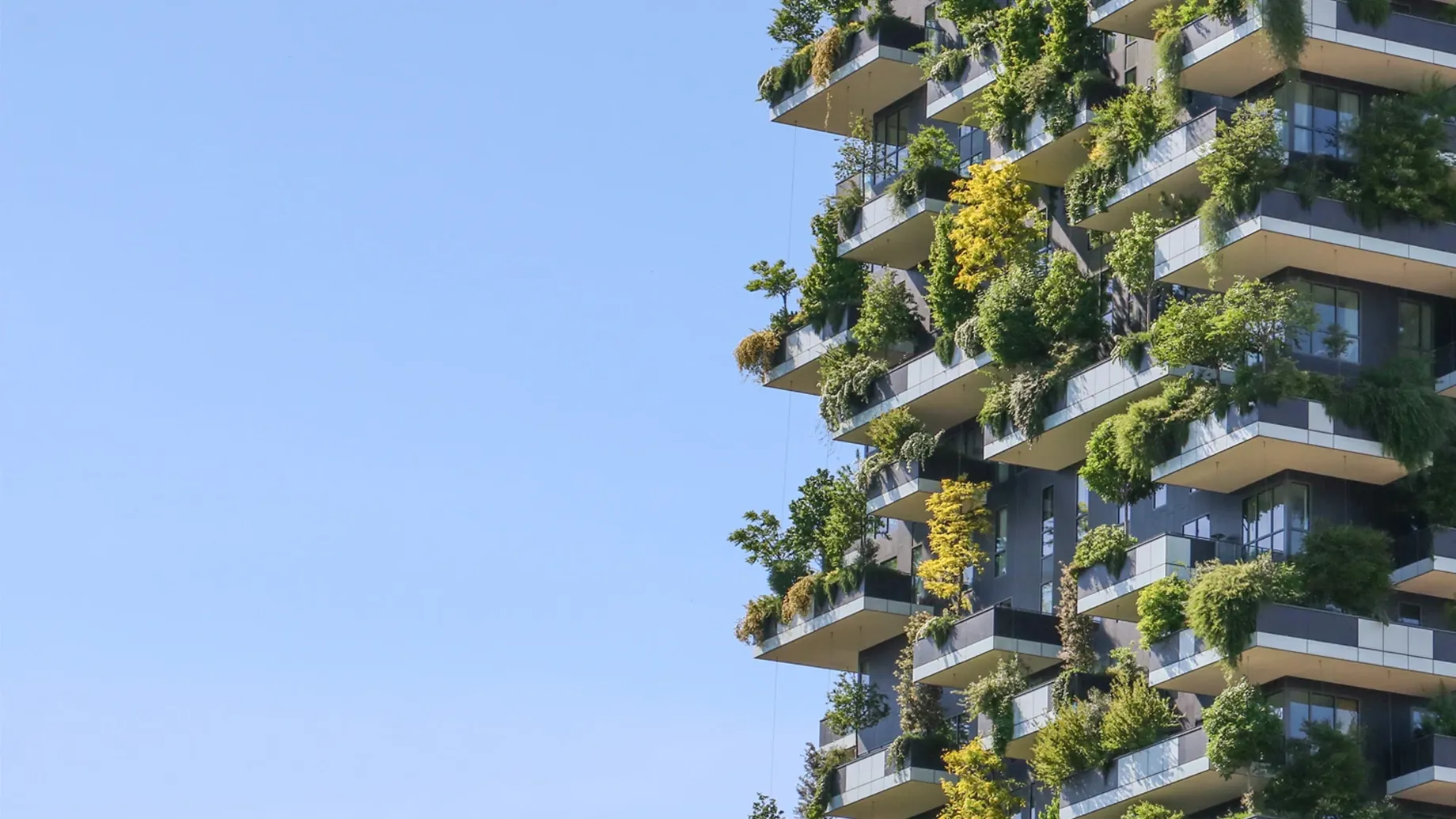
Stefano Boeri’s Bosco Verticale in Milan is a defining project in vertical biophilia. Two residential towers host more than 900 trees and 20,000 plants, effectively creating a “forest in the sky.” Beyond its iconic green façade, the project significantly reduces CO₂, filters particulates, and fosters biodiversity within a metropolitan core. Residents benefit from shaded balconies, seasonal greenery, and the psychological effects of living within a living ecosystem.
Towers transformed into living forests, where balconies host trees that purify the city air
Similarly, in Nanjing, the Vertical Forest project scales this idea to an entire district, positioning vegetation as infrastructure. Such examples prove that high-rise design can blur the line between architecture and ecology, creating vertical habitats that counterbalance the sterility of dense urban cores.
A district-scale experiment in biophilic urbanism, fusing ecology with vertical density
Biophilia in Commercial and Public Towers
Biophilic design is also redefining workplaces and cultural landmarks. Singapore’s Oasia Hotel Downtown by WOHA replaces the sealed glass tower with a porous, plant-covered skin. Its red aluminum mesh façade supports climbing vegetation, while open-air terraces serve as green communal spaces. The result is not just a hotel, but a vertical garden that breathes within the city.
A red tower wrapped in climbing greenery, redefining what a tropical high-rise can be
In Bangkok, the Sindhorn Tower incorporates stepped terraces and cascading gardens, offering workers restorative encounters with greenery throughout their day. These projects reveal how commercial towers can evolve from energy-intensive machines into living structures that foster productivity, well-being, and resilience.
Cascading gardens soften a glass skyline, offering workers restorative green terraces
Housing Complexes and Everyday Biophilia
Biophilic design cannot remain the privilege of luxury towers. In Medellín, Colombia, the city’s Green Corridors project has transformed highways and riverbanks into lush linear forests, significantly lowering temperatures and improving air quality for working-class communities.
Lush linear forests along highways cool the city and improve life for all residents
Meanwhile, Kampung Admiralty in Singapore integrates senior housing, healthcare facilities, and rooftop gardens into a single vertical complex. Its cascading terraces allow residents daily contact with nature, proving that high-density housing can be both socially inclusive and ecologically rich.
A vertical village for seniors where healthcare and gardens meet in everyday life
Public and Cultural Infrastructures as Green Anchors
Biophilia in vertical cities also extends to civic infrastructure. The Jewel Changi Airport in Singapore epitomizes this integration, with its 40-meter indoor waterfall and forest valley offering travelers an immersive nature experience at the heart of a global hub. Here, architecture demonstrates how even transitory spaces can reduce stress and create awe through ecological spectacle.
A rainforest under glass, with a 40-meter waterfall bringing calm to a global hub
On another front, Tokyo’s Shibuya Scramble Square includes a rooftop observation deck framed by gardens and wind-swept terraces. It transforms a commercial high-rise into a public landscape, connecting dense city life with sky and greenery.
Rooftop gardens and sky terraces reconnect dense city life with horizon and nature
Design Takeaways
Nature as Infrastructure, Not Decoration
Biophilic design must move beyond green walls and potted plants. When integrated structurally- through shading, air filtration, biodiversity corridors, and stormwater management - nature becomes infrastructure that supports urban resilience.
Human Well-being as a Driver
Exposure to greenery reduces stress, improves cognitive function, and enhances social cohesion. Successful vertical biophilia places people at its center, ensuring daily interaction with natural systems rather than distant observation.
Context Matters
Biophilic strategies must adapt to local climates, cultures, and urban rhythms. What works in tropical Singapore may differ from approaches in temperate Milan or arid Dubai.
Inclusivity in Access
Projects like Medellín’s Green Corridors remind us that biophilic design should not be exclusive to premium real estate but must address public infrastructure and social housing to maximize impact.
Conclusion
As density and verticality reshape the urban experience, the question is no longer whether biophilia belongs in cities - it is how deeply and creatively we can embed it. Vertical forests, rooftop farms, cascading terraces, and hybrid green infrastructure all demonstrate that high-rise environments need not alienate us from nature.
Biophilia in high-density environments is not a luxury; it is a necessity. By designing with nature as co-creator, architects and planners can transform vertical cities from machines for living into ecosystems for thriving. These living cities, rooted in ecological intelligence, hold the potential to heal the urban condition - offering not only shelter, but also health, identity, and joy.
Save this story. A free account keeps your reading list and the 07:00 email in one place.
CREATE FREE ACCOUNT →SIGN IN