A Pedagogy of Responsibility
At World Archi Design, we've been tracking a quiet shift in design education: the move from object-as-commodity to object-as-care. The latest cohort of bachelor graduates from Lucerne's School of Design, Film and Art demonstrates this ethos with unusual clarity. Across thirteen projects, students address essential tremor in the elderly, sensory overload in autistic children, the stigma of adaptive furniture, and the environmental cost of funeral floristry. What unites them is not a house style or signature aesthetic but a shared conviction that the designer's primary obligation is to systems, not surfaces.
The program, led by faculty including Thai Hua, Andreas Saxer, Christof Sigerist, and Miriam Nietlispach, explicitly frames industrial heritage as both resource and burden. Students inherit knowledge of ergonomics, material science, and manufacturing precision while confronting the extractive logic that underwrites it. The result is a body of work that refuses the binary of craft nostalgia versus tech solutionism, instead synthesizing analog technique with digital fabrication, regional supply chains with global sustainability frameworks.
Closing the Loop: Death, Waste, and New Materiality
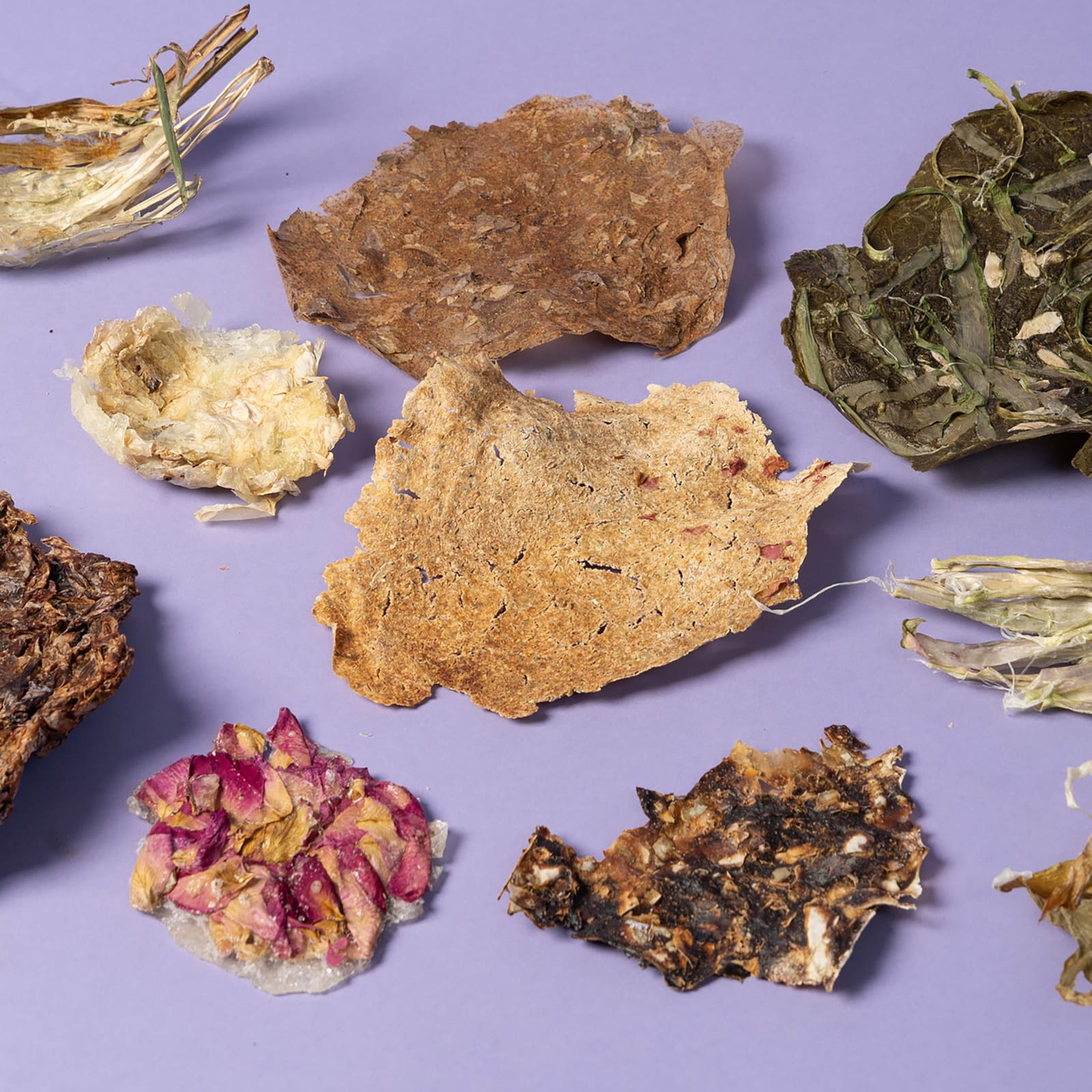
Noemi Curty's Kukka Urna exemplifies the cohort's approach to circularity. The urn is fabricated entirely from florists' cuttings and spent funeral arrangements, materials that would otherwise enter municipal waste streams. Through iterative experiments in compression, binding, and degradation rates, Curty developed a composite that breaks down biologically while maintaining structural integrity through interment. The project reframes flowers not as ephemeral decoration but as feedstock for commemorative ritual, collapsing the temporal distance between mourning and decomposition.
This is not greenwashing. The work draws on precedents in mycelium-based caskets and algae bioplastics but sidesteps the industrial infrastructure those materials require. By sourcing locally and designing for uncontrolled soil environments, Curty's urn operates within existing funeral ecologies rather than demanding new ones. It also challenges the death-denial endemic to consumer culture, a theme that has animated projects from Fernando and Humberto Campana's Favela chairs (made from scrap wood) to Neri Oxman's Silk Pavilion (which embedded silkworms into the fabrication process). Where those works aestheticized waste or biologized production, Kukka Urna centers the social rituals that give objects meaning.
Weight, Warmth, and the Haptology of Loneliness
Several graduates turned to sensory design as a vector for emotional and social support. Jessica Zwahlen's sen comprises a series of weighted, warmed objects tailored to individuals experiencing loneliness and anxiety. Developed through interviews with young adults, each piece responds to specific coping mechanisms: the need for grounding pressure, the comfort of body heat, the reassurance of tactile repetition. The forms resist clinical aesthetics, opting instead for ambiguous, almost zoomorphic silhouettes that invite private interpretation.
Zwahlen's methodology recalls the "affective turn" in interaction design, exemplified by Dunne & Raby's speculative prototypes and the MIT Media Lab's Tangible Media Group. But where those practices often prioritize novelty or provocation, sen is resolutely pragmatic. It acknowledges that loneliness is not a problem to be solved but a condition to be lived with, and that objects can scaffold that experience without pathologizing it.
Nicolas Zeller's Self-helping Hands takes a parallel approach to essential tremor, a neuromuscular condition affecting millions of older adults. By embedding calibrated weights into everyday utensils and tools, Zeller's designs physically dampen oscillations in the 5 to 12 Hz range, the frequency band where tremor is most disruptive. The intervention is invisible to observers but transformative for users, restoring autonomy in tasks like writing, sewing, and meal preparation. It's a reminder that universal design need not announce itself; sometimes the most inclusive gesture is the one that disappears.
Adapting the Everyday: Furniture, Space, and the Politics of Fit
Two projects interrogate the spatial and economic constraints of contemporary housing. Nadja Knuchel's modular partition system addresses the prevalence of open-plan rental apartments, where bedroom, office, and living areas collapse into a single undifferentiated zone. Her lightweight spruce frames and translucent cotton panels disassemble without tools, leaving no trace for landlords to penalize. The system acknowledges the precarity of rental tenure while offering renters a measure of spatial agency.
Sherine Keller's Sitta+ tackles a related problem in educational environments: the mismatch between standardized school furniture and the bodies of children with short stature or developmental differences. Her 3D-printed adjustment kit retrofits existing chairs, raising footrests and seat depths to accommodate a range of proportions. Crucially, the system is designed for classroom-wide adoption, avoiding the stigma that attends "special" furniture. It's a case study in how inclusive design can operate at the level of infrastructure rather than exception.
Both projects engage adaptive reuse, not of buildings but of objects. They accept the economic and material reality of mass-produced furniture and ask how minimal intervention can extend utility and equity. This is a far cry from the bespoke, artisanal ethos that still dominates much studio furniture, and it points toward a design practice grounded in repair, retrofit, and redistribution.
Regional Production and the Limits of Localism
Sinah-Moana Mainardi's 20944072 is a handbag produced entirely within a 50-kilometer corridor between Langenthal and Lucerne. The wool is sourced from regional sheep, then washed, carded, spun, and felted by hand. Mainardi documents each stage, rendering visible the labor and time embedded in a single accessory. The project is part auto-ethnography, part supply-chain audit, and it raises uncomfortable questions about the scalability of local production.
Can design that depends on artisanal skill and geographic proximity ever move beyond the boutique? Mainardi doesn't answer definitively, but the work itself suggests that legibility and accountability might matter more than volume. In an era of opaque global logistics and offshored exploitation, the handbag functions as both object and argument: a proof-of-concept for transparency as a design value.
Sabrina Brunner's exploration of rustic Bern ceramics operates in similar territory. She identifies the craft's core formal language, then abstracts it into a stencil system that lowers the barrier to entry for new practitioners. The engobe-painting technique, traditionally transmitted through apprenticeship, becomes accessible to hobbyists and students. Brunner's intervention is pedagogical rather than preservationist; she's less interested in freezing tradition than in ensuring its continued evolution.
Public Space, Cardboard, and the Afterlife of Consumption
Nicolas Roseng's From Consumption repurposes shipping cartons into temporary seating for public spaces. The cardboard, a byproduct of e-commerce logistics, is laser-cut and folded into modular benches that users assemble on-site. The project is a direct critique of the externalities baked into online retail: the packaging waste, the carbon cost of last-mile delivery, the erosion of street-level commerce.
Roseng's work sits within a lineage of tactical urbanism and détournement, recalling the Occupy movement's cardboard furniture and the DIY seating initiatives in cities like Bogotá and Mexico City. But it also engages the aesthetics of waste itself, refusing to beautify or disguise the material's origins. The corrugated texture, the printed logos, the creases from transit all remain legible, insisting that the bench is not a product but a remnant.
Designing for De-escalation and Collective Safety
Chiara Aeschbacher's work on security for FLINTA* individuals (an acronym encompassing women, lesbian, intersex, non-binary, trans, and agender people) proposes design as a tool for de-escalation and empowerment. The project spans four domains: personal safety devices, community signaling systems, educational materials, and institutional interventions. Aeschbacher's approach is intersectional, acknowledging that vulnerability is not evenly distributed and that one-size-fits-all solutions often replicate the power imbalances they claim to address.
The work joins a growing body of feminist design practice, from the anti-harassment wearables developed at MIT to the community-led safety mapping projects in cities like Delhi and São Paulo. What distinguishes Aeschbacher's contribution is its emphasis on collective agency rather than individual defense. The tools are designed to foster solidarity and visibility, transforming isolated experiences of harassment into shared knowledge and coordinated response.
What the Work Reveals
Taken together, the Lucerne cohort's projects sketch a design practice that is redistributive, reparative, and regionally embedded. They prioritize durability over novelty, care over consumption, and systemic intervention over aesthetic refinement. They also reveal the limits of market-driven innovation: many of these projects have no obvious commercial pathway, and some actively resist commodification.
This is not a failure. It's a recognition that design's most urgent challenges - climate breakdown, social inequality, the erosion of public goods - cannot be addressed through product launches and brand partnerships alone. The graduates are building vocabularies and methods for a post-growth design economy, one in which value is measured in extended use, reduced harm, and expanded access.
Whether these experiments will scale, institutionalize, or remain marginal is an open question. But they demonstrate that another design practice is possible, and that the tools for building it are already in students' hands.
Save this story. A free account keeps your reading list and the 07:00 email in one place.
CREATE FREE ACCOUNT →SIGN IN