A Return to the Hilltop
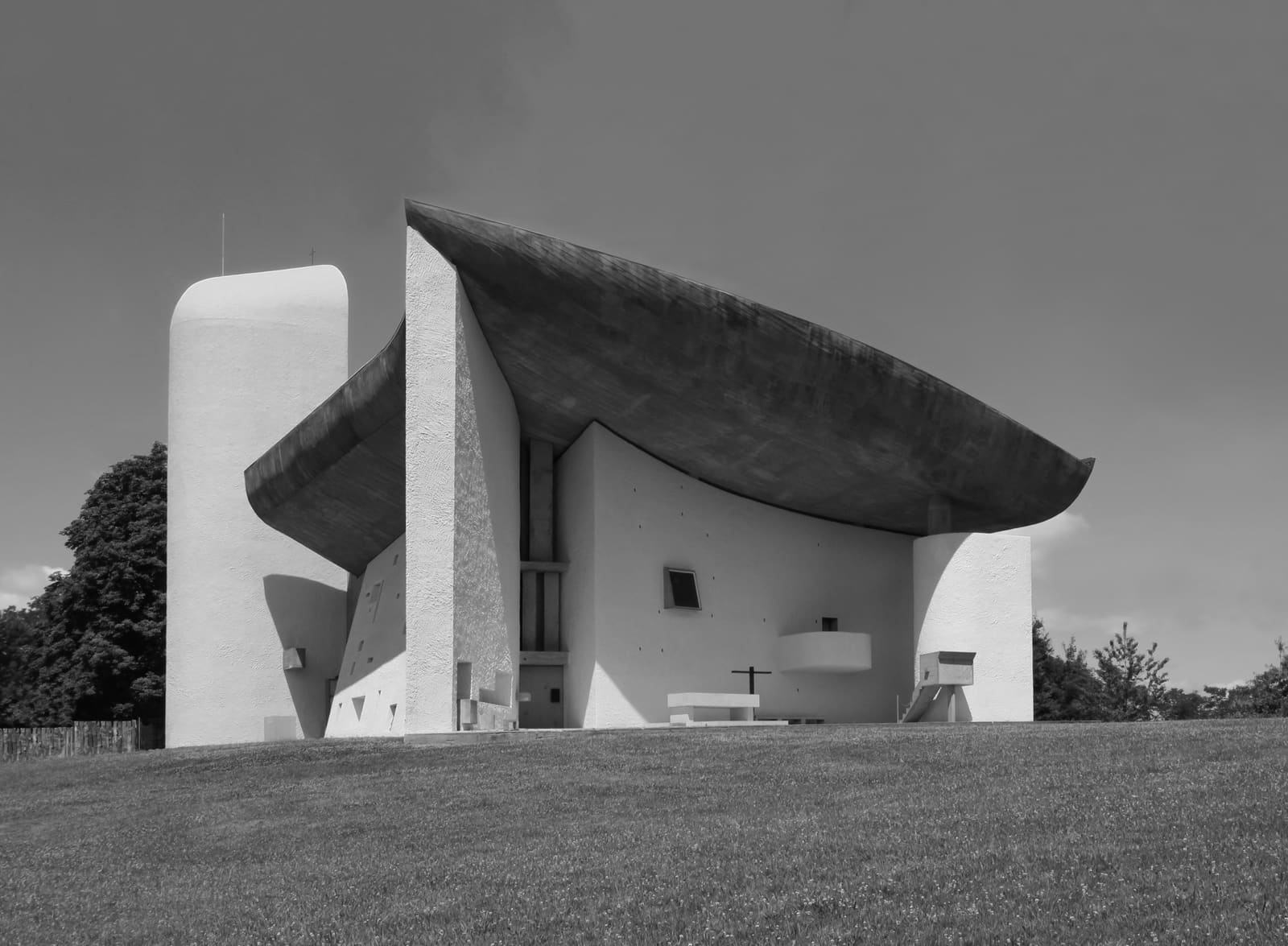
Some buildings become so iconic that their silhouette overshadows their substance. Notre Dame du Haut, perched on Bourlémont Hill in eastern France, has long been recognized for its sculptural roof and curving walls, but photographer Paul Clemence's recent work asks us to look closer at what lies beneath that famous profile. His new series moves past the chapel's well-documented exterior drama to examine something more intimate: the way sunlight animates rough concrete, how shadow carves depth into thick masonry, and the textural qualities that give the building its physical presence.
At World Archi Design, we've been tracking how contemporary photographers reinterpret canonical works, and Clemence's approach stands out for its attention to material reality rather than formal spectacle. Where earlier documentation often emphasized the chapel's plasticity and volumetric power, this series foregrounds the tactile character of its surfaces and the changing relationships between mass and illumination throughout the day.
Texture as Narrative
Le Corbusier completed the chapel in 1955 to replace a pilgrimage site destroyed during the Second World War. The project represented a significant shift from his earlier Purist vocabulary, those crisp white villas and rational housing blocks that defined much of his interwar output. Ronchamp, by contrast, embraced asymmetry, irregularity, and a rough materiality that felt almost archaic. The walls are thick, punctuated by openings of varying size and shape; the roof appears to float above them, a massive concrete shell that defies the orthogonal logic of his previous work.
Clemence's images bring that roughness into focus. "One of the elements that really surprised me was the textures of the walls," he notes. His photographs capture the grain of the concrete, the way it catches and holds light, the sense of weight and permanence that comes from surfaces shaped by formwork and weather. It's a quality that photographs of the chapel's silhouette alone can't convey, a reminder that architecture exists not just as form in space but as material in time.
The decision to shoot the exterior in black and white amplifies this reading. Without color to distract, the eye settles on geometry, shadow, and the play of light across uneven surfaces. The interior images, by contrast, retain their chromatic information, allowing the stained glass windows to introduce subtle hues into the otherwise monochromatic palette. This duality reflects two distinct aspects of the building: the expressive solidity of its concrete shell and the ephemeral, shifting quality of the light that filters through it.
The Pyramid and the Site
Clemence's series also includes documentation of the Pyramid of Peace, a smaller structure on the site designed by Le Corbusier using rubble from the original chapel. It's a detail often omitted from popular accounts of Ronchamp, yet it adds a layer of historical depth to the project. The pyramid functions both as memorial and as material witness, a physical connection between the destroyed building and its successor. By including it in the series, Clemence acknowledges that Ronchamp is not simply an object on a hill but a place shaped by destruction, reconstruction, and the rituals of remembrance that continue to draw pilgrims to the site.
The hilltop location itself plays a crucial role in how the chapel is experienced. Le Corbusier responded to the topography with a building that reads differently from each approach, its asymmetrical form revealing new facets as visitors circle the structure. Clemence's photographs capture this multiplicity, showing the building from angles that emphasize its relationship to the landscape and the way it commands the ridge without dominating it.
Light as Mass
Le Corbusier famously described architecture as "the learned game, correct and magnificent, of forms assembled in the light." Clemence takes that statement as a point of departure, treating light not as background or atmosphere but as a material element in its own right. The chapel's fenestration, those irregularly placed openings that puncture the thick walls, transform daylight into something tangible. Shafts of light become volumetric, casting defined shapes on the floor and walls, while the deep reveals of the windows create zones of transition between bright and dark.
This approach recalls Nicholas Fox Weber's observation, noted by Clemence, that Le Corbusier "captured pure light as if it had mass." The interior photographs make that visible. In some images, light appears to pool in corners or spill across the floor; in others, it carves sharp boundaries between illuminated and shadowed zones. The effect is both spatial and temporal, a reminder that the chapel is never static but constantly changing as the sun moves across the sky.
Clemence's Broader Practice
Paul Clemence has built a body of work that spans continents and typologies, from Zaha Hadid Architects' crystalline towers in Hong Kong to Heatherwick Studio's sculptural installations along Shanghai's Huangpu River. His recent documentation of Ruy Ohtake's Bioparque Pantanal in Campo Grande demonstrated his ability to capture the interplay between architecture and landscape, while his earlier series on urban infrastructure explored how large-scale projects shape public experience.
What unites these disparate subjects is a consistent interest in how buildings are perceived through movement, how they respond to their surroundings, and how materiality and light combine to create spatial character. Ronchamp fits naturally into this trajectory, a project that demands attention to both its formal qualities and its sensory richness.
Precedent and Influence
Ronchamp's influence on subsequent religious architecture is well documented. The chapel's departure from traditional ecclesiastical forms opened possibilities for a generation of architects grappling with how to design spaces for worship in the modern era. We can trace its impact through projects like Eero Saarinen's MIT Chapel, with its cylindrical brick form and top-lit interior, or Gottfried Böhm's pilgrimage church in Neviges, which shares Ronchamp's sculptural massing and dramatic roof geometry.
Yet the building also speaks to broader questions about how modern architecture engages with history, site, and material tradition. Le Corbusier's use of rough concrete and irregular openings drew on vernacular precedents, a move that anticipated later discussions about regionalism and the limits of the International Style. Clemence's photographs, by emphasizing texture and tactility, invite us to reconsider Ronchamp not just as a formal innovation but as a material experiment, one that challenged the smooth abstraction often associated with modernism.
Documentation and Interpretation
Architectural photography is never neutral. Every choice, from lens selection to framing to post-processing, shapes how a building is understood. Clemence's decision to split his series between black-and-white exteriors and color interiors is one such choice, a strategy that directs attention toward different aspects of the project. The monochrome images foreground structure and form, while the color work allows the stained glass to perform its intended role, introducing warmth and variation into the concrete shell.
This approach also acknowledges that Ronchamp resists singular interpretation. It is at once sculptural and spatial, archaic and modern, expressive and restrained. Clemence's photographs don't attempt to resolve these tensions but instead present them as complementary readings, each revealing something the other cannot.
The Enduring Question
More than seven decades after its completion, Ronchamp continues to generate discussion and debate. Its formal freedom influenced postwar architects seeking alternatives to strict functionalism, while its integration of art and architecture, particularly the stained glass and the sculptural door panels, offered a model for collaboration between disciplines. Yet the building also raises questions about authorship and intent, about how much of its power derives from Le Corbusier's vision and how much from the specific conditions of site, light, and ritual that give it meaning.
Clemence's series doesn't answer those questions, but it does remind us that buildings are experienced, not just seen. They exist in time as well as space, their character shaped by weather, season, and the angle of the sun. By focusing on texture, light, and the material presence of the chapel, his photographs offer a way into the building that complements existing scholarship and documentation. They suggest that even the most studied works retain the capacity to surprise, that there is always more to see if we're willing to look closely enough.
Save this story. A free account keeps your reading list and the 07:00 email in one place.
CREATE FREE ACCOUNT →SIGN IN