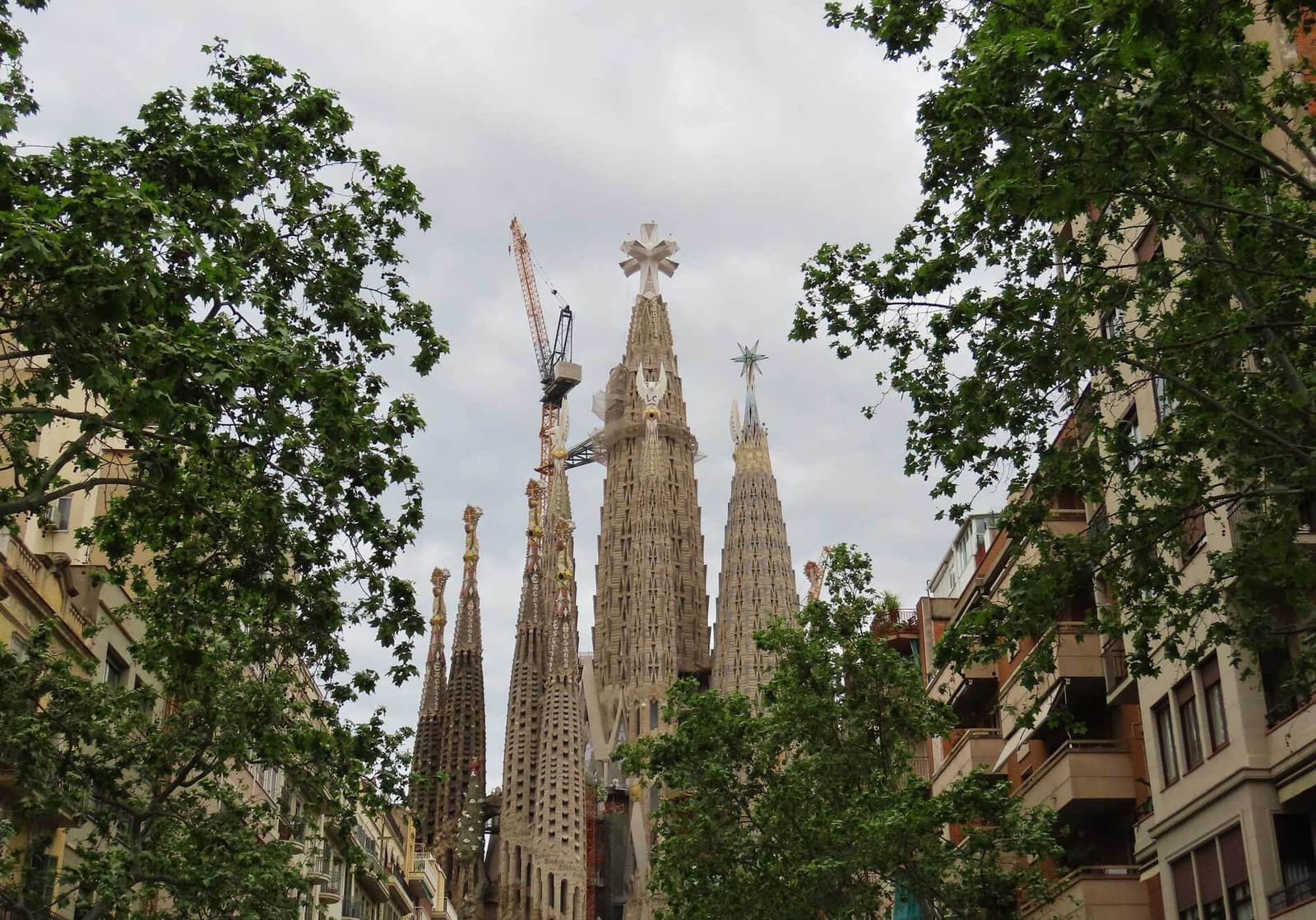
A Century in the Making
There are few buildings on Earth whose construction spans generations, where the architect's death becomes merely a chapter rather than an ending. The Sagrada Família in Barcelona is one such monument. For nearly 144 years, the basilica has climbed skyward, its spires rising above the Eixample district in a testament to both faith and architectural ambition. This June, the church reached a symbolic completion when a cross designed by Mexican architect Mauricio Cortés was installed atop its highest point, an event that coincided with the centennial of Antoni Gaudí's death in 1926.
Pope Leo XIV presided over a Solemn Mass in Barcelona to mark the occasion, offering a ceremonial blessing that acknowledged not only the building's spiritual significance but also its place in the history of modern architecture. The installation of Cortés's cross represents more than an ornamental addition; it signals the near-conclusion of a project that has defined Barcelona's skyline and tested the limits of continuity in architectural practice.
Gaudí's Unfinished Vision
When Gaudí assumed control of the Sagrada Família project in 1883, he inherited a neo-Gothic plan from Francisco de Paula del Villar. Over the next four decades, Gaudí transformed the commission into something radically different: a synthesis of natural forms, structural innovation, and religious symbolism. His design called for eighteen towers, each representing a biblical figure, with the tallest dedicated to Jesus Christ reaching 172.5 meters. Gaudí devoted the final years of his life exclusively to the basilica, living on-site and relying on donations to fund construction.
His death in 1926, struck by a tram on Gran Via de les Corts Catalanes, left the project less than a quarter complete. Only the crypt, apse, and one facade had been finished. The Spanish Civil War further delayed progress, destroying many of Gaudí's original models and drawings. What followed was a decades-long effort by successive architects to interpret his intentions through surviving plaster models, photographs, and written notes. The question of fidelity versus invention has shadowed every decision since.
At World Archi Design, we have tracked numerous projects that grapple with the challenge of completing a master's unfinished work. The reconstruction of Berlin's Stadtschloss, the ongoing debate over Frank Lloyd Wright's unbuilt designs, and the extension of Louis Kahn's Salk Institute all share a common tension: how to honor the original vision while acknowledging that architecture is a living practice, shaped by new materials, technologies, and cultural contexts.
Cortés and the Final Cross
Mauricio Cortés, based in Mexico City, was selected to design the cross that would crown the Tower of Jesus Christ, the basilica's tallest element. The cross measures approximately 17 meters in height and is fabricated from a combination of steel and translucent materials that allow light to pass through, a deliberate nod to Gaudí's obsession with natural illumination. Cortés's design draws on Gaudí's own sketches, which depicted a cross integrated with clusters of smaller elements meant to evoke light rays or celestial bodies.
The choice of a Mexican architect for this pivotal role is not without precedent. Gaudí's influence extended well beyond Catalonia, shaping modernist movements in Latin America. Architects such as Javier Senosiain in Mexico and the Brazilian Oscar Niemeyer have cited Gaudí's organic forms and structural daring as foundational to their own work. Cortés's involvement underscores the global reach of Gaudí's legacy and the collaborative, international character of the Sagrada Família's completion.
The cross was installed using a crane system that required months of engineering preparation. The tower itself, completed in 2023 according to project timelines, is the tallest structure in Barcelona and the tallest church building in the world. The cross brings the total height to just under 173 meters, deliberately one meter shorter than Montjuïc, the hill overlooking the city. Gaudí believed that human creations should not surpass the works of God, a principle that has been scrupulously maintained.
Material and Structural Continuity
One of the most difficult aspects of continuing Gaudí's work has been the question of materials. Gaudí worked with stone, ceramic, and iron, employing techniques that were labor-intensive and artisanal. Modern construction relies on reinforced concrete, computer-aided design, and prefabrication. The architects who followed Gaudí, including Francesc de Paula Quintana, Isidre Puig Boada, Lluís Bonet i Garí, and more recently Jordi Faulí, have had to balance fidelity to Gaudí's aesthetic with the realities of contemporary engineering.
The use of computer modeling has been particularly contentious. Critics argue that Gaudí's intuitive, hands-on approach to form-finding cannot be replicated through parametric software. Defenders counter that digital tools allow for a more accurate realization of Gaudí's complex geometries, which were often impossible to execute with the technology available in his time. The hanging chain models Gaudí used to determine structural loads have been translated into digital simulations, enabling engineers to test and refine his concepts with precision.
The cross designed by Cortés reflects this hybrid approach. Its form is rooted in Gaudí's sketches, but its fabrication relied on advanced metalworking and materials science. The translucent elements, which glow at night when internally lit, would have been unattainable in Gaudí's era but are entirely consistent with his ambition to create a building that functions as a luminous beacon.
Precedent and Parallel
The Sagrada Família is often compared to other long-duration construction projects, but few share its combination of architectural ambition and liturgical function. The Milan Cathedral took nearly six centuries to complete, yet its design evolved through distinct stylistic phases rather than adhering to a single vision. The Washington National Cathedral, finished in 1990 after 83 years, followed a consistent Gothic Revival plan but lacked the structural innovation that defines Gaudí's work.
A closer parallel might be found in the work of Le Corbusier's followers at Chandigarh, where the completion of the Capitol Complex after his death required interpretation of fragmentary plans and models. Similarly, the ongoing construction of the Basílica de Nuestra Señora de la Paz in Ivory Coast, designed by Pierre Fakhoury, has faced delays and modifications that test the boundary between completion and reinterpretation.
What distinguishes the Sagrada Família is the degree to which Gaudí's intentions have been codified and debated. The Gaudí Research Institute has cataloged thousands of documents, and a dedicated team of historians and architects continues to study his methods. This institutional commitment to fidelity has shaped every decision, from the choice of stone for the Passion Facade to the design of the cross that now crowns the tower.
The Papal Blessing and Cultural Context
The presence of Pope Leo XIV at the centennial Mass underscores the Sagrada Família's dual identity as both a religious site and a cultural monument. The basilica was consecrated by Pope Benedict XVI in 2010, a recognition of its liturgical function despite its incomplete state. The papal blessing this June served as both a spiritual affirmation and a public acknowledgment of the building's significance to Barcelona and to the broader history of Catholic architecture.
Barcelona has long struggled with the tension between the Sagrada Família as a place of worship and as a tourist attraction. The church welcomes millions of visitors each year, generating revenue that funds ongoing construction but also raising questions about the commodification of sacred space. The installation of Cortés's cross, and the accompanying ceremonies, can be read as an effort to reassert the building's religious identity amid its status as a UNESCO World Heritage Site and one of Spain's most visited landmarks.
What Remains
While the cross marks a symbolic completion, the Sagrada Família is not yet finished. Work continues on interior details, the sacristy, and the surrounding staircases and plazas. The final tower, dedicated to the Virgin Mary, is scheduled for completion in the coming years. Even then, questions will linger about what it means to complete a building that was, by design, meant to evolve over time.
Gaudí himself once remarked that the basilica would be finished when God willed it. The installation of Mauricio Cortés's cross, a century after the architect's death, suggests that completion is less a fixed endpoint than an ongoing process of interpretation, collaboration, and faith. The cross rises above Barcelona not as a declaration of finality but as a marker of continuity, linking Gaudí's vision to the hands and minds of those who have carried it forward.
Save this story. A free account keeps your reading list and the 07:00 email in one place.
CREATE FREE ACCOUNT →SIGN IN