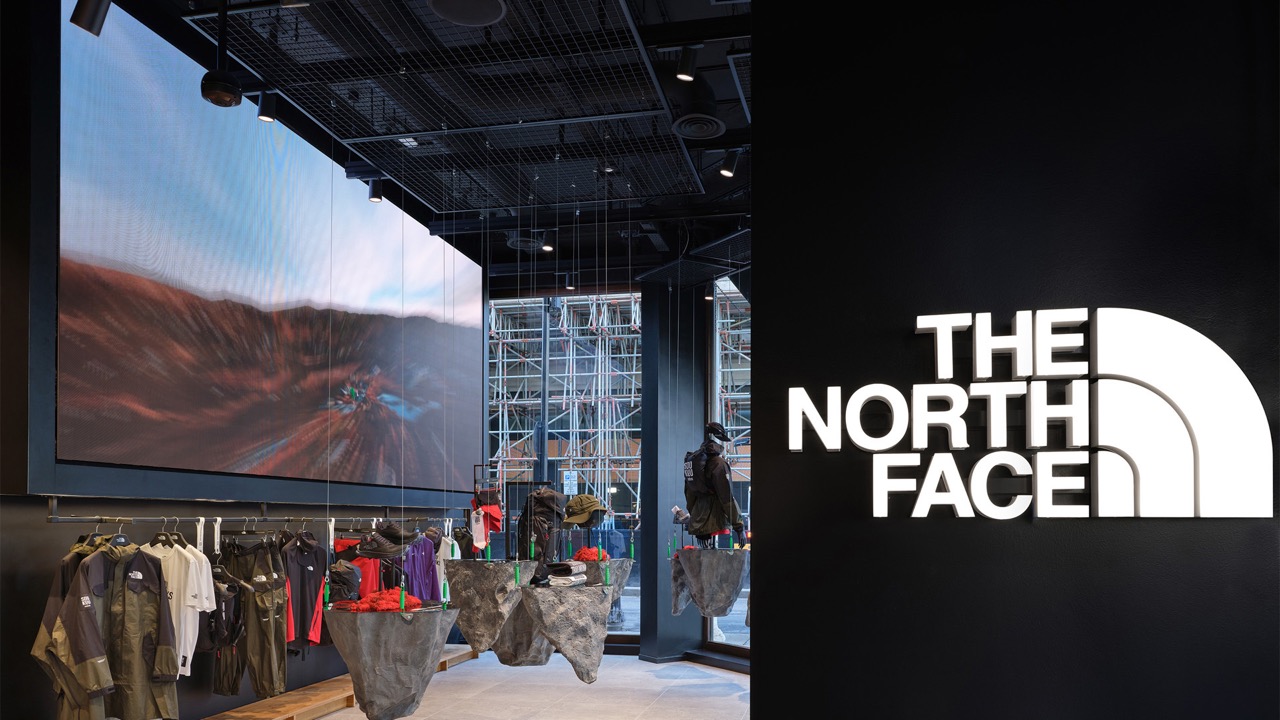
As global retail brands expand across continents, the challenge is no longer scale but relevance. For The North Face, whose identity is deeply rooted in landscape, climate, and movement, store design has become a strategic tool to translate outdoor culture into architectural form, while remaining sensitive to local building codes, urban fabrics, and cultural expectations. Rather than enforcing a rigid global template, the brand has embraced a place-responsive design strategy that allows each store to function as both a retail environment and a contextual architectural intervention.
Placemaking Through Materiality and Narrative
The North Face’s design language is rooted in the outdoors: raw timber, stone, exposed metals, and rugged textures. But these materials aren’t applied uniformly. Each store interprets them through local guidelines and expectations. For example, The North Face’s flagship on Fifth Avenue in New York City uses a concept of “above and below the treeline” to draw customers into an immersive narrative - gray cork panels etched with climbing routes on the ground floor and lighter alpine materials above, knit together with dynamic LED content and experiential cairns that evoke natural landscapes right in the urban core. This layered design responds not only to brand identity but also to the architectural context of a historic Midtown district.

Faceted cork surfaces, alpine references, and large-scale digital media transform Manhattan retail into a narrative journey through nature
Urban Density, Immersive Experiences
Different cities demand different solutions. On London’s Regent Street, one of the brand’s flagship spaces took a more experiential technological angle. Instead of purely physical material references like timber or stone, the design incorporates a 360-degree projection dome that transports visitors from busy Oxford Street to imagined wilderness environments, accompanied by synchronized sound and even fragrance. This approach respects both local planning priorities for high footfall retail streets and consumer expectations for immersive, engagement-driven spaces.

Immersive technology and atmospheric design bring the outdoors into one of London’s busiest commercial streets
Adaptive Reuse and Respect for Heritage
In heritage-sensitive contexts, The North Face adapts its retail architecture to existing constraints rather than imposing a fixed identity. Earlier New York flagships were housed in landmarked buildings where structural alterations were restricted; design strategies instead focused inward, creating “base camp” zones and tent-like fitting rooms that fit within preserved envelopes.
A similar approach appears at The North Face store in the Valentown Historic District (Victor, New York), where intersecting forms reference local barn typologies and materials such as rough timber and stone echo the 19th-century surroundings. In both cases, heritage limitations become design drivers, allowing brand expression through materiality, scale, and spatial narrative rather than overt architectural intervention.

Context-driven design allows The North Face’s outdoor identity to coexist with heritage architecture
Local Context in Everyday Stores
Even outside major flagships, smaller stores reveal how The North Face adapts its design to local context. In U.S. regional centers, interiors may subtly reference nearby landscapes - coastal ranges, deserts, or forested peaks - through the brand’s core material vocabulary, such as expanded metal façades and rugged textures that recall mountain terrain.
In other markets, cultural cues become more explicit. At ICONSIAM in Bangkok, for example, the store’s entrance is inspired by The North Face’s signature 2-meter dome tent, reinterpreted with locally influenced wooden lattice patterns. The result is a community-oriented space that blends outdoor identity with regional architectural language, tying global brand values to local culture and everyday urban life.

A community-oriented retail space where global brand identity grounded in Thai architectural language
Climate, Codes, and Sustainability
Climate plays a key role in shaping architectural choices. Stores in colder regions emphasize warmth through layered lighting and tactile materials, while those in temperate or tropical climates prioritize openness, airflow, and visual lightness. At The North Face Urban Exploration store in Pacific Place (Hong Kong), tent-inspired spatial barriers and softly diffused lighting simulate natural daylight, creating an open, breathable interior suited to a dense, humid urban environment. These design responses are often shaped by local building codes, ranging from energy performance to fire safety and spatial efficiency, turning regulatory constraints into opportunities for architectural refinement.

The Urban Exploration concept adapts outdoor design cues to high-density city retail
Sustainability further reinforces this logic. The North Face increasingly incorporates locally sourced materials, adaptive reuse strategies, and energy-efficient detailing, allowing environmental compliance to become a visible and integral part of the brand’s design narrative rather than a hidden technical layer.
Conclusion
The North Face’s store designs demonstrate that place matters. Whether through narrative-rich flagship experiences in global cities or contextually attuned regional stores, the brand shows how architecture can bridge outdoor aesthetics with local codes and cultural cues. By designing with place, rather than imposing a one-size-fits-all identity, The North Face creates retail environments that are grounded in context, rich in experience, and deeply resonant with both local communities and the global spirit of exploration.
PHOTO CREDIT: The North Face
Save this story. A free account keeps your reading list and the 07:00 email in one place.
CREATE FREE ACCOUNT →SIGN IN