Reading the Ground Plane
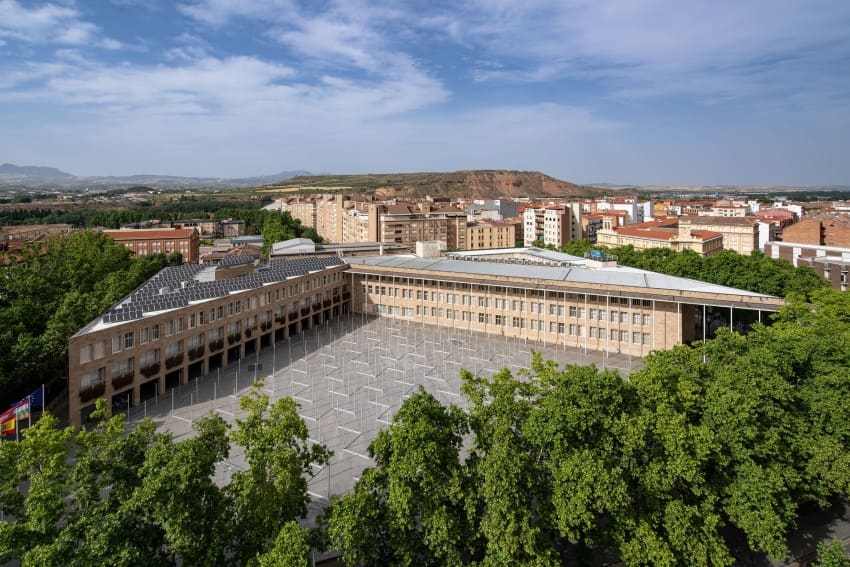
The question of how to respond to a Rafael Moneo building is rarely straightforward. His work operates through a precise geometric discipline that resists both mimicry and outright opposition. In Plaza del Ayuntamiento in Logroño, Spain, PPAA has offered one possible answer: a temporary installation that extends the City Hall's underlying order into the public realm without attempting to compete with the permanence of its neighbor.
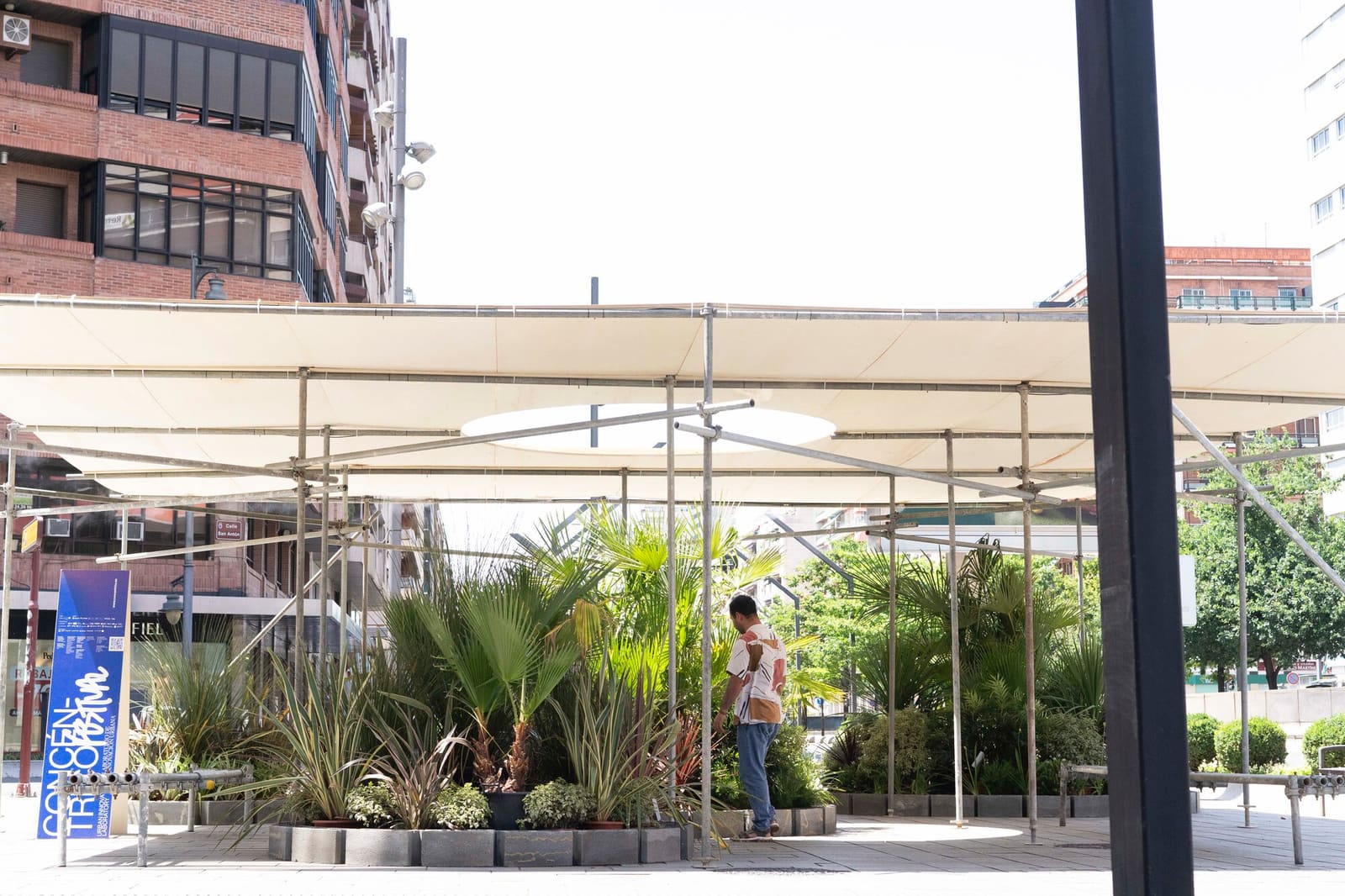
Resonancia, as the project is titled, deploys a lightweight aluminum lattice that traces and amplifies the grid Moneo embedded in the civic complex. Rather than introducing a contrasting formal language, the intervention reads the existing architecture as a set of spatial instructions and translates those instructions into a structure scaled for human occupation. The result is a pavilion that feels less like an object placed in a plaza and more like a diagram made inhabitable.
At World Archi Design, we have been tracking a growing interest in temporary installations that engage seriously with their architectural context rather than treating public space as a neutral backdrop. Resonancia belongs to this lineage, but it distinguishes itself through its commitment to geometric continuity over spectacle.
Lattice as Spatial Extension
The core gesture is straightforward: an aluminum framework that echoes the modular rhythm of Moneo's facades and extends it horizontally across the plaza. The lattice is not dense enough to enclose, nor sparse enough to disappear; instead, it establishes a threshold condition that modulates light, frames views, and suggests enclosure without enforcing it.
This approach recalls the tectonic strategies of Japanese architect Junya Ishigami, whose lightweight structures often rely on seriality and repetition to create spatial effects that feel both rigorous and ephemeral. Where Ishigami tends toward the atmospheric, however, PPAA leans into legibility. The aluminum members are clearly articulated, their joints visible, their structural logic apparent. The installation does not seek to dematerialize but rather to assert a different kind of presence: one that is temporary but not provisional, lightweight but not fragile.
The choice of aluminum is worth noting. As a material, it carries associations with both industrial production and high-performance architecture. Here, it serves a dual purpose: the metal's reflectivity activates the plaza by catching and redirecting sunlight, while its low weight allows for a spanning system that would be impractical in steel or timber of comparable section. The lattice can therefore achieve a delicacy that reinforces its conceptual alignment with Moneo's building without attempting to match its mass.
Moneo's Geometry as Precedent
Rafael Moneo's Logroño City Hall, completed in the late 1980s, is characteristic of his broader preoccupation with typology, context, and the discipline of the grid. The building organizes itself through a clear structural bay system, with facades that articulate rhythm and proportion through the repetition of openings and the careful modulation of solid and void. It is architecture that insists on order but does not fetishize it; the grid is a framework for civic presence, not an end in itself.
PPAA's intervention recognizes this and responds by treating the grid as a generative system rather than a static composition. By projecting the City Hall's geometric logic outward, Resonancia effectively argues that Moneo's architecture is not confined to the envelope of the building but extends into the public realm as a set of spatial relationships. The lattice becomes a way of making those relationships legible and experiential.
This kind of dialogue between old and new, permanent and temporary, is not without precedent. One thinks of the ephemeral structures inserted into historic courtyards during design festivals, or the timber pavilions that occupy museum forecourts for a season before being dismantled. What distinguishes Resonancia is its refusal to signal its temporality through formal exuberance. The installation is restrained, almost austere. It does not ask to be photographed from every angle but rather invites a more patient engagement with the spatial conditions it creates.
Activation Without Spectacle
There is a tension in contemporary public-space design between the desire to activate urban environments and the risk of turning every plaza into a stage for Instagram-ready installations. Resonancia navigates this tension by prioritizing use over image. The lattice provides shade, defines zones within the larger plaza, and offers a framework for informal gathering. It does not prescribe specific activities but rather establishes a flexible spatial armature that accommodates a range of behaviors.
This approach aligns with the thinking of landscape architects like Michel Desvigne, who has long argued for interventions that work through subtraction and reconfiguration rather than addition and spectacle. The lattice does not fill the plaza but reframes it, creating pockets of enclosure and openness that shift depending on one's position and the angle of the sun.
The installation also raises questions about the role of the architect in public space. In an era when many civic interventions are driven by municipal branding strategies or cultural programming agendas, Resonancia offers a quieter model: one in which the designer's role is to clarify and extend the spatial logic already present in the site. This is not a rejection of authorship but a reframing of it. The intervention is clearly designed, but its design is in service of a larger conversation with the existing architecture.
Temporality and Tectonic Expression
The fact that Resonancia is temporary is central to its meaning. Unlike Moneo's City Hall, which asserts permanence through masonry and mass, the lattice acknowledges its own ephemerality through its material choices and its structural system. The aluminum members are bolted rather than welded, suggesting an assembly logic that anticipates disassembly. The foundation is minimal, leaving no lasting trace on the plaza once the installation is removed.
This kind of reversible architecture has gained traction in recent years, driven in part by sustainability concerns and in part by a recognition that not all interventions need to be permanent to be meaningful. The challenge, however, is to avoid the pitfall of treating temporality as an excuse for sloppiness. Resonancia succeeds because it brings the same level of tectonic rigor to a structure meant to last a few months as one might expect in a building designed for decades.
The installation's engagement with light is another dimension of its tectonic expression. The lattice casts a shifting pattern of shadows across the plaza, creating a temporal dimension that connects the intervention to the daily and seasonal cycles of the city. This is architecture that changes over the course of a day, not through mechanical transformation but through its relationship to the sun. In this sense, Resonancia operates as a kind of solar diagram, making visible the passage of time in a way that Moneo's solid building cannot.
Public Space as Architectural Laboratory
One of the more interesting implications of projects like Resonancia is the way they position public space as a site for architectural experimentation. The plaza becomes a testing ground for ideas that might inform more permanent work: ideas about materiality, structure, spatial sequence, and the relationship between old and new. The temporary installation is not a lesser form of architecture but a different one, with its own set of constraints and opportunities.
For PPAA, a studio based in Mexico City with a portfolio that spans residential, cultural, and urban projects, Resonancia represents an extension of ongoing interests in geometry, material economy, and the calibration of architectural presence. The installation does not announce a new direction so much as it distills certain preoccupations into a concentrated form. It is a project that benefits from the freedom of the temporary brief while still demonstrating the discipline of more permanent work.
Looking forward, one wonders whether this kind of intervention might serve as a model for other historic plazas where the challenge is not to compete with existing architecture but to engage with it in a way that is both respectful and generative. The success of Resonancia suggests that such engagement is possible, but only when the designer is willing to subordinate formal invention to spatial intelligence.
Save this story. A free account keeps your reading list and the 07:00 email in one place.
CREATE FREE ACCOUNT →SIGN IN