Abstract
In the 21st century, urban centers face mounting pressures from climate change, population growth, and environmental degradation. As cities expand, traditional grey infrastructure - concrete roads, culverts, bridges, and cleared channels designed solely for human use - have increasingly disconnected people from nature and exacerbated ecological decline. In response, a global urban transformation is underway: cities are reimagining and repurposing existing infrastructure to create natural, multifunctional spaces that support biodiversity, improve public health, and enhance climate resilience. This journal explores how such transformations are taking shape, presenting key global examples, underlying their outcomes, and emerging lessons for planners, policymakers, and communities.
Introduction
Historically, urban infrastructure prioritized efficiency and economic growth. Roads were widened, rivers were culverted or paved over, and landscapes were leveled for development - all under the assumption that nature was outside the city’s functional boundaries. This grey-centric model delivered transportation networks, engineered drainage, and high-density builds, but at the cost of ecological integrity and human well-being.
Today, cities are shifting paradigms. Rather than seeing nature as a luxury, urban planners treat it as essential infrastructure - one that absorbs stormwater, reduces heat islands, filters air, supports wildlife, and creates vibrant public spaces. This transformation hinges on two powerful ideas:
+ Green infrastructure: managed ecosystems that provide ecological services.
+ Urban regeneration: adapting existing man-made structures for new, nature-centric functions.
In essence, grey to green is not just a technical shift but a cultural redefinition of what constitutes infrastructure in the modern city.
Urban Strategies and Contemporary Case Studies
1. Elevated and Linear Green Parks
Viaduct Gardens - Leeds, UK
Leeds converted a disused Victorian railway viaduct into the Viaduct Gardens, an elevated urban park completed in 2023. The project repurposed historical infrastructure as a green corridor featuring planting beds, seating areas, and access points that knit previously underutilized spaces into the city’s social and ecological fabric.

A former railway viaduct reactivated as an elevated green corridor, stitching nature and public life back into the historic urban fabric
Photo Credit: Andrew Heptinstall
CyanLines - Manchester & Salford, UK
This ambitious initiative, launched in September 2025, aims to create a 100-mile network of connected parks, waterways, canals, and green pathways linking formerly grey industrial spaces into a cohesive urban nature corridor. Early routes already connect landmarks like Mayfield Park and Castlefield Viaduct, blending biodiversity enhancement with active mobility.

A regional network that reconnects parks, canals, and post-industrial landscapes into a continuous urban nature system
Photo Credit: CyanLines
2. Grey Infrastructure Beneath and Around Urban Fabric
The Bentway - Toronto, Canada
Under the Gardiner Expressway, The Bentway has evolved from vacant space into a dynamic corridor offering trails, eco-gardens, and public programming. New sections opened in 2023 include Staging Grounds with innovative stormwater planters that collect runoff and support native plant growth, turning a typically neglected under-bridge area into functional green infrastructure.

Under an elevated expressway, planting beds and public programs transform residual infrastructure space into an active green spine
Photo Credit: Nic Lehoux
Kangaroo Point Green Bridge - Brisbane, Australia
Completed in December 2024, the Kangaroo Point Green Bridge is a pedestrian and cyclist bridge across the Brisbane River that enhances connectivity while integrating green design features. The new bridge provides access to riverside parks and encourages non-motorized travel, helping shift urban mobility toward nature-friendly infrastructure.

A pedestrian-focused river crossing that prioritizes landscape connections and non-motorized movement within the city’s green network
Photo Credit: COX Architecture
3. Nature-centric Stormwater and Flood Management
Benjakitti Forest Park - Bangkok, Thailand
As part of Thailand’s sponge city initiative, Benjakitti Forest Park was developed on a former brownfield and industrial site into a multifunctional green park with engineered wetlands that store stormwater, reduce flood risk, and support diverse ecosystems. The park’s design proved resilient during intense rainfall events in 2022 and has become a model of urban water-sensitive design.

Wetlands and terraced landscapes convert a former industrial site into a flood-resilient urban sponge and public park
Photo Credit: Turenscape&Arsomsilp
Portland Green Streets - Portland, USA
Portland’s Green Streets program continues to install bioswales and rain gardens along residential streets to capture and infiltrate stormwater where it falls. These nature-based installations reduce pressure on grey drainage systems, improve water quality, and provide vegetated corridors throughout neighborhoods.

Bioswales and rain gardens embedded into everyday streets capture stormwater while softening the residential streetscape
4. Rewilding Urban Riparian and Waterfront Zones
Qianhai Guiwan Park - Shenzhen, China
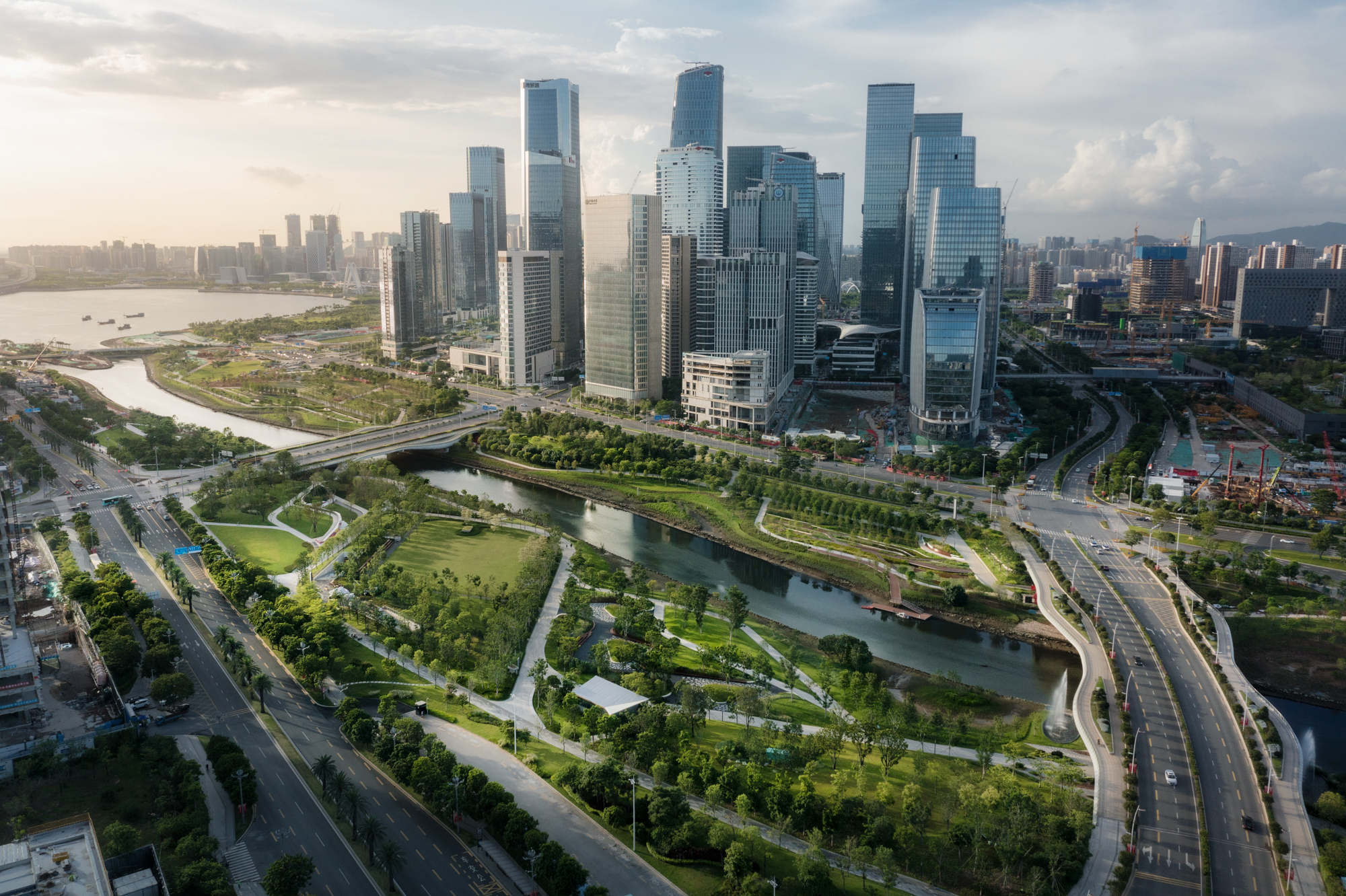
Developed along a formerly hard-engineered waterfront, Guiwan Park restores tidal wetlands, native planting, and flood-resilient landscapes within Shenzhen’s Qianhai district. The project transforms rigid infrastructure into a blue-green ecological corridor that improves water quality, supports biodiversity, and provides generous public access along the urban shoreline.

Restored tidal wetlands and terraced edges reshape a hard waterfront into a resilient blue-green urban corridor
Photo Credit: HOLI Landscape Photography
Green River Park - New Administrative Capital, Egypt
This colossal project, already established in 2024, is creating a 35-kilometer park network through Egypt’s New Administrative Capital. Designed as a continuous green corridor linking neighborhoods, the Green River reflects an ambitious reintegration of natural space into a modern, planned city layout.

A continuous linear park cutting through a newly planned city, using landscape infrastructure to structure urban growth, mobility, and microclimate
Photo Credit: CUBE
5. Reimagining Streets and Public Squares
Sankt Kjelds Square & Sønder Boulevard - Copenhagen, Denmark
While Copenhagen’s greening has roots before 2025, recent expansions of projects like Sankt Kjelds Square (turning a traffic-dominated roundabout into a climate-resilient urban forest) and Sønder Boulevard (a formerly grey traffic strip now a lush social green axis) illustrate how cities are reallocating pavement to advance ecological function and public life. These interventions have dramatically increased tree cover and reduced heat island effects.

A traffic-dominated junction reimagined as an urban forest, integrating climate adaptation with everyday public space
Photo Credit: Landezine
Lyon’s Green Islands - Lyon, France
In response to heatwaves and urban heat stress, Lyon has created îlots de fraîcheur (“cool islands”) - dense clusters of vegetation in streets, former industrial lots, and plazas that lower surface temperatures and offer relief for residents, demonstrating how urban greening adapts public spaces for climate resilience.

A network of tree-dense landscapes and open lawns introduced at city scale, creating cooling corridors that reconnect urban life with river and park systems.
Photo Credit: Permafforest
Lessons Learned
1. Multifunctionality Drives Resilience
Green infrastructure must serve multiple purposes, from stormwater storage to cooling, habitat creation to recreation, to justify investment and maximize community benefits.
2. Community Participation Fosters Stewardship
Projects that involve residents in planning and maintenance tend to cultivate stronger public ownership and long-term use.
3. Policy and Funding Integration Is Critical
Transformative green projects often rely on cross-sector collaboration and policy alignment, combining municipal planning, sustainable design frameworks, and climate adaptation priorities.
4. Adaptive Reuse Expands Urban Nature Innovatively
Reclaiming existing grey infrastructure demonstrates that urban nature can be woven into cities without wholesale demolition or new land consumption.
Closing
The movement from grey to green represents a paradigm shift, redefining infrastructure not as static and impermeable but as dynamic, regenerative, and deeply entwined with nature. As cities evolve, the boundary between built and natural environments blurs, allowing urban residents to reclaim ecosystems within their everyday lives. From elevated green parks to water-sensitive sponge landscapes, cities are proving that ecological restoration is not merely nice to have - it is infrastructure essential for sustainable, resilient urban futures. Ultimately, the grey of yesterday will be remembered not as progress but as a lesson: that true progress is green.
Save this story. A free account keeps your reading list and the 07:00 email in one place.
CREATE FREE ACCOUNT →SIGN IN