The Fountain as Sonic Infrastructure
What defines a garden in 2026 may not be its plantings, but its soundscape. Water features—once relegated to decorative accents—are increasingly treated as spatial anchors, organizing circulation, modulating ambient noise, and framing views. The contemporary fountain is less object, more atmosphere: a device for layering sensory experience into the landscape.
This shift reflects a broader trajectory in landscape architecture. From the qanat systems of Persian gardens to the shakkei (borrowed scenery) of Japanese tea gardens, water has always been infrastructural. Today's designers are revisiting these precedents, pairing ancient hydraulic logic with contemporary materials—corten steel, glass panels, reclaimed stone—to create features that feel both elemental and precise.
The 25 typologies explored here span scales from balcony interventions to estate-scale lakeside installations. What unites them is intentionality: each fountain is positioned not as decoration, but as a threshold device, marking transitions between garden rooms, filtering sound, and anchoring movement through space.
Typology 1: The Courtyard Cascade—Vertical Flow in Bounded Space
Courtyard fountains operate within architectural constraints, where vertical drop becomes a design asset. The Mediterranean wall cascade exemplifies this: water spills from arched niches into a linear basin, the sound amplified by enclosing walls. This typology borrows from Moorish patio design, where fountains cooled air and masked street noise.
In contemporary practice, designers like Studio Mumbai and Vo Trong Nghia Architects have adapted this model, embedding cascades into rammed earth or laterite walls to evoke vernacular cooling strategies. The key is material continuity: when fountain and wall share texture, the feature reads as integral, not applied.
The lush courtyard stream variant softens this geometry, tucking water into fern beds and irregular stone clusters. Here, the fountain becomes biophilic infrastructure, blurring the line between hardscape and planting. It's a strategy seen in Peter Zumthor's Therme Vals, where water is less feature than spatial medium, shaping movement and light.
Typology 2: The Sculptural Column—Verticality as Gesture
The sculptural stone cluster fountain operates differently: instead of enclosure, it claims open ground. Water trickles down rough-hewn columns rising from a pebble bed, each surface catching light at different angles. This recalls Richard Serra's Torqued Ellipses—not in form, but in spatial strategy. Both use verticality to anchor sprawling horizontal fields.
In Southeast Asian contexts, this typology resonates with lingam stones in Khmer temple gardens, where water flows over carved surfaces to sanctify space. Contemporary iterations strip the iconography but retain the ritual logic: water as purifier, sound as boundary.
The Parisian statement fountain pushes this further into ornament. Its layered tiers and sculptural detailing demand attention, functioning as focal object rather than atmospheric device. This is fountain-as-monument, a typology better suited to formal gardens where symmetry and axiality dominate. Think of the Latona Fountain at Versailles—water becomes theater, not backdrop.
Typology 3: The Minimalist Basin—Restraint and Reflection
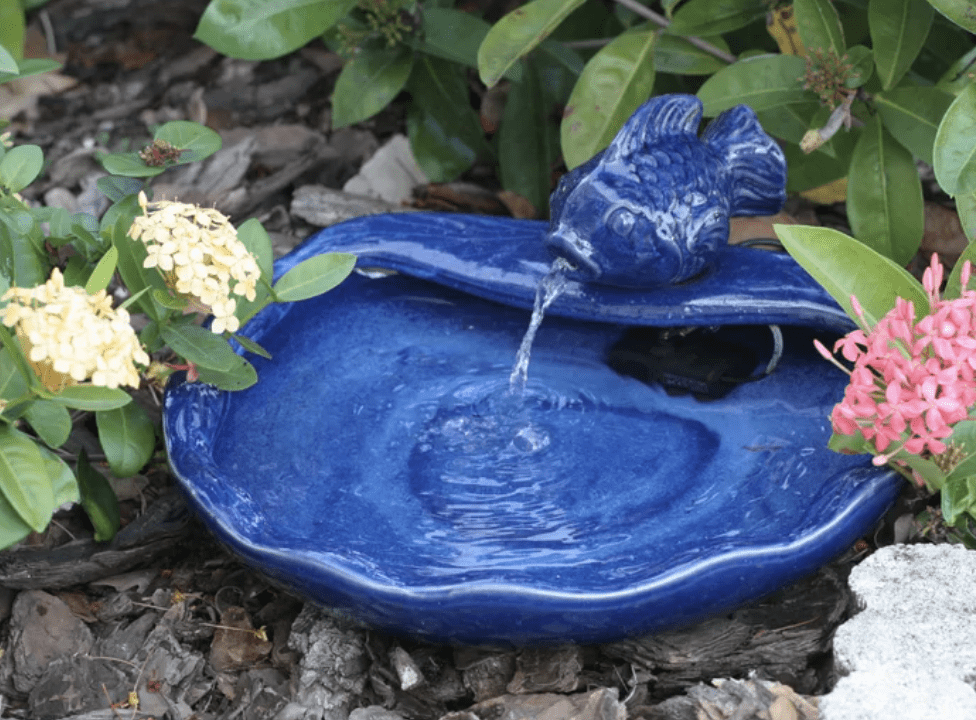
The modern bowl fountain and rustic stone basin represent a third lineage: the contained pool. Here, water barely moves—a gentle bubble, a quiet overflow. The design language is reductive, prioritizing surface and edge over cascade.
This approach owes debts to Japanese tsukubai (stone basins) and the minimalist landscapes of Dan Kiley, where geometric pools anchor broader compositions. The sleek black waterfall box extends this logic vertically, using dark stone to absorb light and emphasize the water's movement. It's a technique borrowed from Maya Lin's Storm King Wavefield: subtractive form that amplifies natural phenomena.
In smaller gardens, the balcony Zen corner demonstrates how scale compression intensifies effect. A low basin, tight pebble bed, and minimal planting create a microcosm, a portable landscape that functions more like furniture than infrastructure. This is adaptive design for urban contexts, where balconies and terraces replace traditional garden plots.
Typology 4: The Naturalized Cascade—Mimicking Geological Process
The natural rock pond cascade and layered boulder waterfall reject formal geometry entirely, instead simulating erosion. Water spills over irregular stone stacks, meandering rather than falling in clean sheets. The design strategy is apparent naturalism—making human intervention invisible.
This approach has roots in 18th-century English landscape gardens, where Capability Brown softened estate grounds into picturesque tableaux. Contemporary practitioners like Piet Oudolf and Topher Delaney have updated this, using native stone and ecological succession planting to blur garden edges into surrounding ecosystems.
The risk, of course, is pastiche. Poorly executed naturalized cascades read as theme park geology, lacking the patina and material logic of actual springs. The solution lies in restraint: fewer interventions, more observation. Let stone settle, let moss colonize, let water find its path before redirecting it.
Typology 5: The Architectural Insert—Water as Building Material
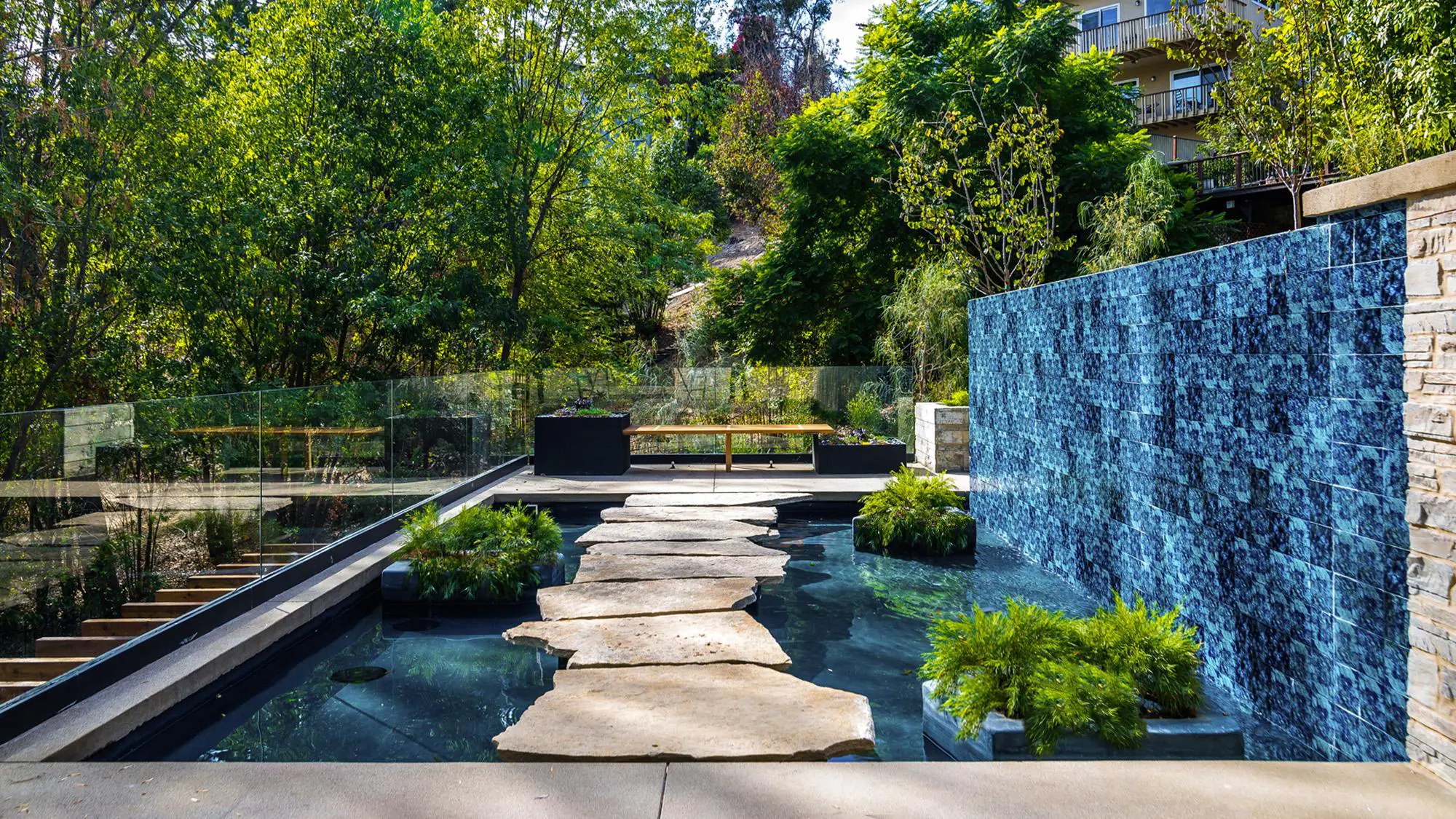
The indoor glass water wall and sleek water wall feature treat water not as landscape element but as architectural surface. Glass panels channel thin sheets of water, creating translucent screens that divide space while maintaining visual continuity. This is fountain as partition, a strategy explored by Tadao Ando in the Church of the Water and Kengo Kuma in the Nezu Museum.
In tropical climates, such features double as passive cooling devices, evaporating water to lower ambient temperature. The textured water wall variant adds tactility, using ribbed or porous surfaces to scatter light and amplify sound. It's a technique seen in the work of Barragán, whose colored walls and water planes created immersive chromatic fields.
These typologies challenge the garden's boundary. When water becomes wall, when fountain becomes room, the distinction between inside and outside collapses—a central preoccupation of modernist architecture, now manifesting in landscape design.
Material Continuity and Cultural Context
Across these 25 examples, material choice emerges as narrative device. Dark basalt evokes volcanic landscapes; warm limestone suggests Mediterranean climates; reclaimed wood and rusted steel signal adaptive reuse. The greenhouse classic fountain, with its aged stone patina, performs history—anchoring a conservatory in imagined antiquity.
In Asian contexts, this material consciousness carries additional weight. The woodland urn fountain, for instance, uses a single dark vessel to echo celadon ceramic traditions, where glaze and form communicate restraint. Similarly, the streamline fountain's narrow channel recalls Korean madang (courtyard) water features, where linear flow organizes spatial hierarchy.
The formal garden fountain circle demonstrates how geometry itself can be culturally coded. Its tiered structure and radial symmetry reference European parterre design, where fountains anchor axial compositions. Transplanted into a Southeast Asian garden, such a feature requires careful contextualization—perhaps through plant selection or paving material—to avoid reading as colonial pastiche.
Precedent and Evolution
These fountain typologies don't emerge in a vacuum. The lakeside fountain escape, with its twin jets rippling across still water, recalls Isamu Noguchi's unrealized designs for Riverside Park, where water and land merged into continuous sculptural fields. The entryway courtyard fountain echoes Thomas Church's Donnell Garden, where a simple basin became the garden's conceptual center.
Contemporary designers are building on these precedents while addressing new constraints: water scarcity, urban density, climate adaptation. Recirculating pumps, greywater systems, and drought-tolerant planting now shape fountain design as much as aesthetic considerations. The rustic courtyard bowl fountain, nestled among lavender and terracotta, exemplifies this: a low-water feature that relies on evocative minimalism rather than continuous flow.
The southern grand fountain, by contrast, represents a different era's logic—one of abundance and display. Its multi-tiered structure and sculptural figures demand significant water volume and maintenance. Such features persist as heritage objects, valued for their historical resonance even as contemporary practice moves toward restraint.
Conclusion: The Garden's Sonic Threshold
What these 25 typologies reveal is a medium in flux. The garden fountain is no longer a fixed type but a flexible strategy, adapting to site, climate, and cultural context. Whether minimalist basin or baroque cascade, each feature negotiates between presence and atmosphere, between object and infrastructure.
As urban gardens densify and climate pressures mount, the fountain's role will continue evolving—less as ornament, more as ecological and sensory device. The question isn't whether to include water, but how to make it resonate: as sound, as light, as the quiet anchor that holds a garden together.
Based on reporting from Trendir (https://www.trendir.com/garden-fountain-ideas/), with editorial analysis by World Archi Design.
Save this story. A free account keeps your reading list and the 07:00 email in one place.
CREATE FREE ACCOUNT →SIGN IN