The Acoustic Layer of Landscape Design
We spend enormous energy on the visual composition of gardens—massing plants by height, calibrating color sequences, framing sightlines. Yet the most memorable gardens we've encountered deploy a second layer of design that operates almost subliminally: sound. A trickling fountain, a rustling bamboo grove, or the deliberate absence of mechanical noise can define the experience of a garden as powerfully as any pergola or perennial border. Water features, in particular, function as acoustic devices first and ornamental gestures second—a principle that stretches back to Moorish courtyards and Japanese tsukubai basins, where the sound of water was calibrated to mask street noise and mark thresholds between public and private realms.
Contemporary residential water features have inherited that dual function, though the materials and scales have shifted. Ceramic, resin, fiberglass, and polystone have largely replaced carved granite and poured concrete, making acoustic design accessible to gardens that lack the infrastructure—or budget—for monumental hydraulics. What remains constant is the design intent: to introduce a controlled soundscape that modulates the ambient acoustic environment.
Ceramic and Glazed Finishes: Color as Acoustic Counterpoint
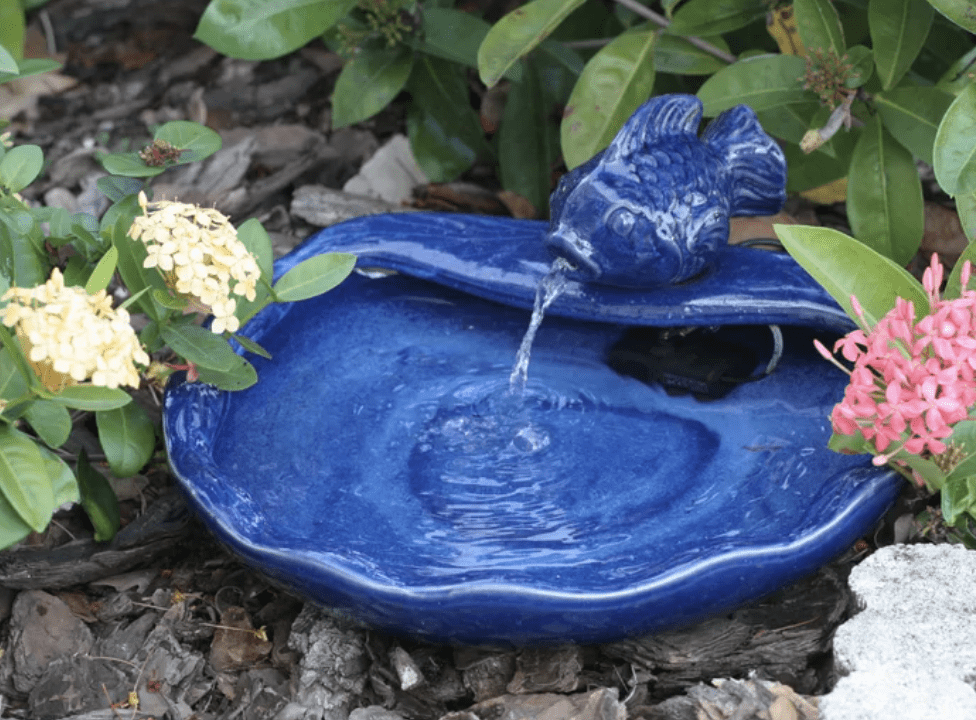
Ceramic water features bring a distinct tonal quality to garden beds—not just visually, through cobalt blues and aqua glazes, but sonically. The hard, nonporous surface of glazed ceramic produces a sharper, more percussive splash than softer materials. A koi-motif ceramic fountain, for instance, uses a single spout to animate a shallow basin; the water strikes the glazed surface at a consistent angle, creating a rhythmic plink rather than a diffuse murmur. This kind of feature works best in tightly planted beds where the sound needs to cut through dense foliage—ornamental grasses, hostas, ferns—that would otherwise absorb ambient noise.
Another ceramic typology—stacked vase fountains—exploits the resonance of hollow vessels. Water descends from one patterned urn to another, each impact generating a brief echo inside the chamber before spilling over the lip. The effect is less naturalistic than sculptural: you're hearing the geometry of the vessel as much as the water itself. In coastal or Mediterranean-inspired gardens, where terracotta pots and whitewashed walls already evoke a specific vernacular, a glazed ceramic fountain in deep blue or teal reinforces that material palette while adding a sonic throughline.
Tiered Resin and Fiberglass: Mimicking Natural Hydrology
Resin and fiberglass fountains occupy a middle ground between authenticity and pragmatism. They mimic the look of stacked stone or weathered wood—materials that would otherwise require significant structural support—but weigh a fraction as much and can be repositioned seasonally. A four-tiered resin bowl fountain, for example, uses a submersible pump to cycle water through progressively smaller basins, each overflow creating a layered soundscape: a low gurgle at the base, a sharper trickle at the second tier, a soft splash at the third. The acoustic effect is akin to a natural spring descending over sedimentary ledges—a hydrology that landscape architects have long studied in precedents like Fallingwater's terraced streams or the cascades at Villa d'Este.
The material's lightness also allows for more experimental siting. Unlike a poured-concrete fountain anchored to a single location, a resin feature can migrate from a shaded corner in summer to a sun-drenched patio in autumn, adapting to seasonal planting schemes. That flexibility is particularly useful in small urban gardens, where every square meter is contested and no design decision can be permanent. The trade-off is durability: UV exposure will eventually fade the faux-stone finish, and the hollow construction makes these features vulnerable to wind unless weighted or staked.
LED Integration and Nighttime Acoustics
Several contemporary water features embed LED lighting within the fountain structure—typically in the basin or along the tiers—to extend their presence into evening hours. This is less about illumination (most garden paths require separate task lighting) than about visual rhythm. A three-tier fiberglass fountain with integrated LEDs uses warm white or amber diodes to trace the water's descent, turning movement into a kind of slow-motion animation. The light doesn't brighten the space so much as emphasize the kinetic event—the way a spotlight might pick out a dancer on a dark stage.
Acoustically, nighttime gardens behave differently. Ambient noise drops; traffic recedes; the soundscape compresses. A fountain that felt subtle during the day can dominate the evening garden, its trickle magnified by the absence of competing sounds. Designers working in dense urban contexts sometimes use this phenomenon deliberately, programming fountains on timers to activate only after dusk, when the acoustic environment is most conducive to the effect they're after. In that sense, the LED isn't just a visual accessory—it's a signal that the garden has shifted into a different sensory mode.
Vernacular Forms: Farmhouse Barrels and Hollow Stumps
Not all water features aspire to naturalism. Some lean into overt nostalgia, using recognizable rural typologies—hand pumps, barrel buckets, tree stumps—to evoke a pastoral or agrarian aesthetic. A three-tier pump-and-barrel fountain, for instance, stages a miniature tableau of 19th-century farm infrastructure: water spills from a cast-resin pump spout into stacked wooden (or wood-effect) barrels, each overflow dripping into the tier below. The sound is irregular, almost arhythmic, because the barrels aren't uniform in size or depth. You hear the water hitting different surfaces—metal, wood grain, basin liner—at different intervals, creating a syncopated pattern that feels less designed than found.
Similarly, a hollow tree stump fountain uses the form of a decaying log as both vessel and metaphor. Water trickles down oversized leaves carved into the resin surface, pooling in knotholes and fissures before draining into a hidden reservoir. The acoustic effect mimics rainfall in a forest clearing—soft, diffuse, ambient. These features work best in gardens that already incorporate rustic or reclaimed materials: weathered timber fencing, galvanized metal planters, gravel paths. Placed in a minimalist or contemporary garden, the same fountain would read as kitsch; context is everything.
Polystone and the Rainforest Waterfall Typology
Polystone—a composite of crushed stone and resin—offers greater textural fidelity than fiberglass alone. A rainforest waterfall fountain in polystone can replicate the irregular surface of basalt or schist, complete with fissures, moss stains, and mineral deposits. Water cascades over multiple ledges, each one slightly offset, so the flow breaks and reforms in a way that feels geologically plausible. The sound is layered: a low rumble where the water hits the base pool, higher-pitched splashes where it strikes protruding ledges, a soft hiss where it films over smooth surfaces.
This typology draws directly from 20th-century landscape precedents—Roberto Burle Marx's biomorphic pools, Lawrence Halprin's urban waterfalls—where the goal was to compress the scale and intensity of natural hydrology into a designed frame. The polystone version is a suburban adaptation of that ambition: it can't match the kinetic force of Halprin's Ira Keller Fountain, but it can introduce a similar layering of sound and movement into a 200-square-foot patio. The material's weight (heavier than fiberglass, lighter than cast stone) also provides stability without requiring a poured foundation, which is critical for rental properties or temporary installations.
Metal Tiers and the Contemporary Minimalist Fountain
For gardens that skew modern or industrial, metal fountains—typically powder-coated steel or aluminum—offer a cleaner formal language. A tiered metal waterfall fountain uses stacked geometric planes—circles, ellipses, rectangles—to create a sculptural silhouette that reads as much as an art object as a water feature. The sound is sharper than resin or stone: water striking metal produces a bright, percussive tone, almost bell-like. In a gravel courtyard or alongside a steel-and-glass pavilion, that acoustic quality reinforces the material continuity of the design.
The minimalist fountain also invites a different kind of interaction. Because the form is abstract rather than representational, the focus shifts entirely to the water's behavior—how it sheets across a tilted plane, how it beads along a welded seam, how it pools in a recessed basin. This is fountain-as-kinetic-sculpture, a lineage that runs through George Rickey's wind pieces and Jean Tinguely's motorized assemblages. The garden becomes a gallery; the fountain, an installation.
Siting Strategy: Foreground, Middleground, Background
The acoustic impact of a water feature depends as much on placement as on design. A fountain positioned in the foreground—near a seating area or entry path—functions as an active sonic element, something you engage with directly. A fountain in the middleground—visible but at a remove—acts as ambient sound, a backdrop to conversation or reading. A fountain in the background—partially obscured by plantings or sited at the garden's edge—becomes subliminal, felt more than heard.
At World Archi Design, we've observed that the most successful residential water features are sited in the middleground, where they can modulate the acoustic environment without dominating it. Foreground placement risks monotony (the sound becomes intrusive over time), while background placement risks irrelevance (the feature is too faint to register). The sweet spot is a location where the sound is present but not insistent—where it can recede into the background when you're focused on a task, and come forward when you're sitting still.
The Limits of Plug-and-Play Hydraulics
For all their accessibility, submersible-pump fountains have acoustic limitations. The pump itself generates a low hum—usually masked by the water sound, but audible in quiet moments. The flow rate is fixed or adjustable only within a narrow range, which means you can't fine-tune the sound the way you might with a custom-engineered system. And because the pump sits in the basin, any debris—leaves, twigs, algae—can clog the intake and alter the sound, turning a smooth trickle into a ragged gurgle.
These are not design flaws so much as inherent trade-offs. A plug-and-play fountain prioritizes ease of installation over acoustic precision. For most residential gardens, that's an acceptable compromise. For projects where sound is a primary design driver—meditation gardens, hospice courtyards, therapeutic landscapes—a more calibrated approach is warranted: custom spillways, adjustable flow valves, concealed pumps. The acoustic environment, in those cases, isn't incidental; it's the parti.
Closing Reflection: Sound as Spatial Boundary
Water features do more than ornament a garden; they define its acoustic boundaries. A well-sited fountain can mask traffic noise, signal a transition from public to private space, or simply provide a focal point for attention in an otherwise unstructured landscape. The materials—ceramic, resin, polystone, metal—each carry distinct sonic signatures, and the formal typology—tiered bowls, stacked urns, naturalistic cascades—determines how that sound unfolds over time. In an era when gardens are increasingly asked to function as outdoor rooms—extensions of domestic space rather than discrete zones—the acoustic layer of design becomes as critical as the visual. We may enter a garden through the eyes, but we stay for the ears.
Save this story. A free account keeps your reading list and the 07:00 email in one place.
CREATE FREE ACCOUNT →SIGN IN