A Building with Many Chapters
The Colonial-style structure standing in Old Bennington, Vermont has accumulated identities the way old buildings do: first as a seminary in 1829, then a country club, faculty housing for Bennington College, and finally a private residence occupied by one family for sixty years. Each iteration left traces, the kind of patina that cannot be manufactured. For architect Rafe Churchill, cofounder of Hendricks Churchill, this layered history was precisely the appeal when he acquired the property in 2025.
Churchill's initial vision was modest: create accommodations for college trustees, visiting families, and prospective students at his alma mater. But the project expanded into something more ambitious, a hospitality model called Place in Mind, developed with partner Casey Sunderland. The Seminary, soft-launched in late May, now offers six guest suites in a building that wears its age lightly. Nearby, The Walloomsac, a 1771 inn, is being developed into a forty-plus-room property with restaurant, spa, and bathhouse, forming a two-building preservation venture that prioritizes architectural integrity over conventional hotel metrics.
Intervention Without Erasure
The design philosophy Churchill and his team adopted can be summarized as stealth rehabilitation. Five original bedrooms were converted into suites, with bathrooms inserted into the footprints of oversize closets. The attic became a sixth suite, crowned by a reconstructed bell tower informed by archival photographs and built with assistance from Bennington students. Floorboards were refinished, millwork repaired, details uncovered. The goal was to improve the building without announcing the work.
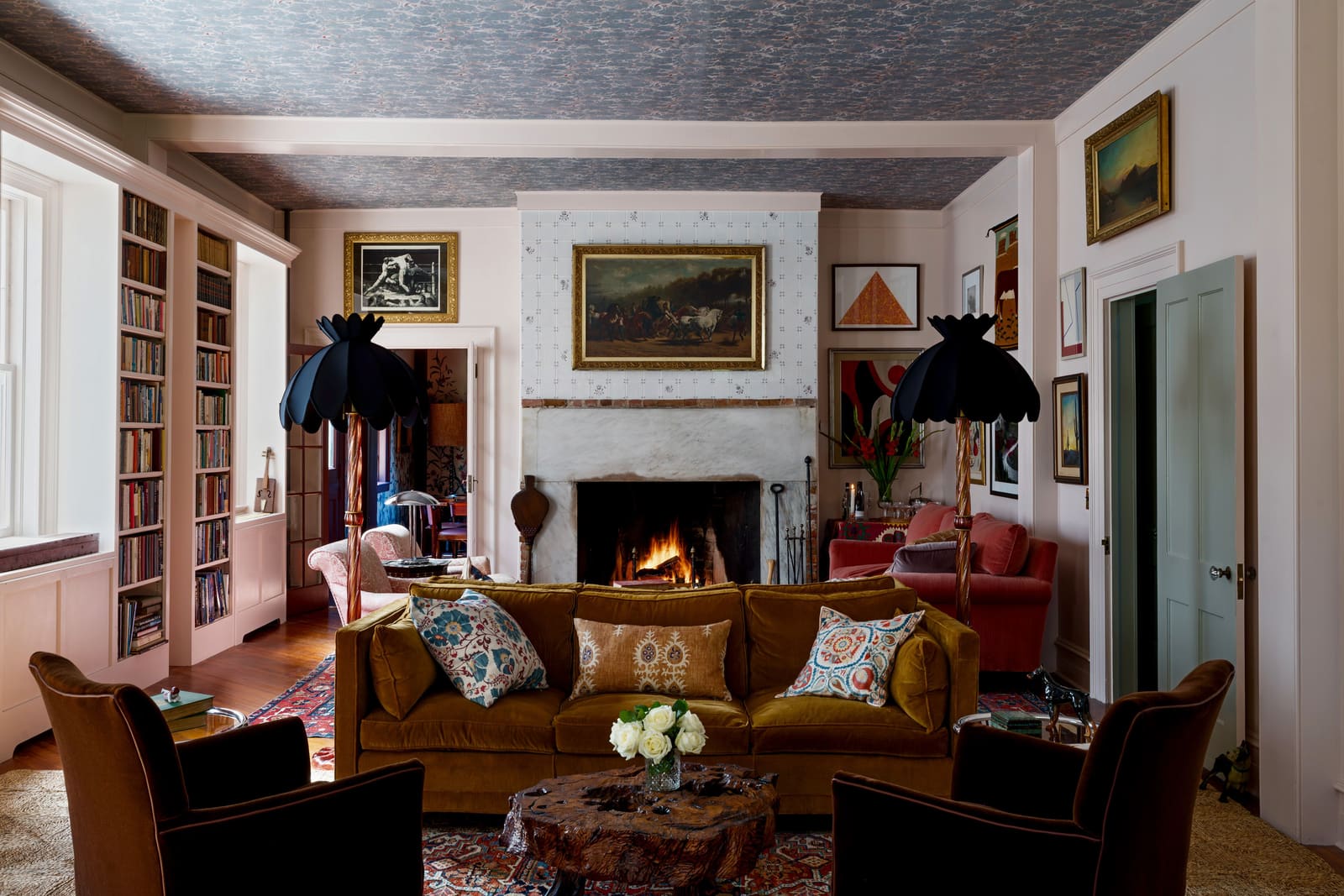
Sunderland describes the approach: leaving no visible mark requires as much effort as bold transformation. This restraint extends to material choices. Sinks salvaged from The Walloomsac were relocated to The Seminary; paint colors and wallpaper patterns were reproduced from existing elements. One guest room's blue tone references the boiler room in the neighboring Walloomsac building. A bathroom's green derives from the Seminary's barn shutters. Red paint in another suite was inspired by the nearby Shaker Museum at Mount Lebanon. The furnishings, selected by Churchill's wife and creative partner Heide Hendricks, are entirely vintage.
The result occupies a zone between boutique hotel polish and bed-and-breakfast informality. Churchill likens the experience to entering an eccentric aunt's home, a space that might shift a visitor's perspective by the time they leave.
A Response to Image-Driven Design
Churchill's critique of contemporary design culture is embedded in the project. He argues that platforms like Instagram and the rise of artificial intelligence have fostered superficial visual education, producing work that disregards historical context and harms both emerging designers and aging buildings. Place in Mind positions itself as a corrective, prioritizing depth over virality.
This stance carries practical implications. The venture rejects the heads-in-beds logic that governs most hospitality operations, opting instead for something deliberately idiosyncratic. Hospitality partner Terry Sanford and brand director Conor Brady are part of a team that has touched every surface of The Seminary, though the interventions remain largely invisible to guests. AD100 landscape architect Grace Fuller is addressing the gardens, while fashion designer Alex Casertano is developing uniforms and a capsule clothing line for the property.
Precedent and Parallel
Churchill's approach recalls adaptive reuse projects that foreground tectonic authenticity over stylistic imposition. The restraint here is reminiscent of work by practices like Peter Zumftor's interventions in historic structures, where new elements are legible but deferential, or the careful insertions seen in certain National Trust properties in the UK, where modern amenities are threaded through historic fabric without compromising spatial character.
The Seminary's material palette, drawn from the building's own context, echoes vernacular preservation strategies that treat color, texture, and detail as site-specific rather than imported. This is not pastiche but a kind of architectural listening, where decisions about paint or millwork emerge from close observation of what already exists. The salvaged sinks and reproduced wallpaper patterns create a dialogue between the two properties, treating Place in Mind as a micro-ecosystem rather than isolated interventions.
Forward Trajectory
The team is now evaluating additional historic properties in New England and beyond, seeking structures with architectural merit in regions with creative communities. Sanford has noted the potential for an American hospitality brand rooted in overlooked historic architecture, a model that privileges place-specific character over scalable design formulas.
For Churchill, the project has redefined his professional trajectory. Originally contemplating retirement or a career pivot, he found a third option: applying decades of hands-on rehabilitation experience to rescue imperiled buildings for broader public access. The work is labor-intensive, requiring archival research, material sourcing, and coordination with local craftspeople and students. The Seminary's reconstructed bell tower alone involved historical image analysis and fabrication by Bennington students, a process that doubled as pedagogy.
The Larger Argument
At its core, Place in Mind proposes that adaptive reuse can function as both preservation and critique. By foregrounding the architecture itself as the primary attraction, the venture challenges hospitality conventions that treat buildings as neutral containers for branded experience. The Seminary and The Walloomsac are not backdrops; they are the subject.
This aligns with a broader shift in architectural discourse around adaptive reuse, where embodied carbon and material longevity are increasingly valued over demolition and new construction. Churchill's emphasis on leaving no visible mark, paradoxically, requires meticulous intervention: structural assessment, systems integration, code compliance, all executed within the constraints of historic fabric. The work is technically demanding, even as it aims for aesthetic understatement.
The project also raises questions about scale and replicability. Can a model this labor-intensive and context-dependent function beyond a few select properties? The team's ambitions suggest they believe it can, though success will depend on finding sites with similar architectural merit, community ties, and market conditions. The Bennington properties benefit from proximity to the college, a built-in audience of visitors and alumni. Translating that to other regions will require different strategies.
Place and Practice
Churchill's connection to Bennington College as an alumnus adds another layer. The Seminary was initially conceived as infrastructure for the institution, a way to support the academic community while giving back to a place that shaped his own trajectory. That civic dimension distinguishes Place in Mind from purely commercial ventures, even as it operates as a for-profit enterprise.
The involvement of students in the bell tower reconstruction and the collaboration with Fuller and Casertano suggest an interest in building networks of practice, not just properties. The venture becomes a platform for multiple disciplines: architecture, landscape, fashion, hospitality, preservation. This cross-pollination may be as significant as the buildings themselves, creating a model where adaptive reuse functions as collaborative pedagogy.
As Place in Mind expands, the challenge will be maintaining this level of specificity and care across multiple sites. The Seminary's success depends on its singularity, the sense that every decision emerged from close attention to this particular building in this particular place. Scaling that ethos without diluting it will test whether the model can become a movement or remains a compelling anomaly.
Photo: Casey Sunderland & Conor Brady
Save this story. A free account keeps your reading list and the 07:00 email in one place.
CREATE FREE ACCOUNT →SIGN IN