The Problem of Floating in Glass
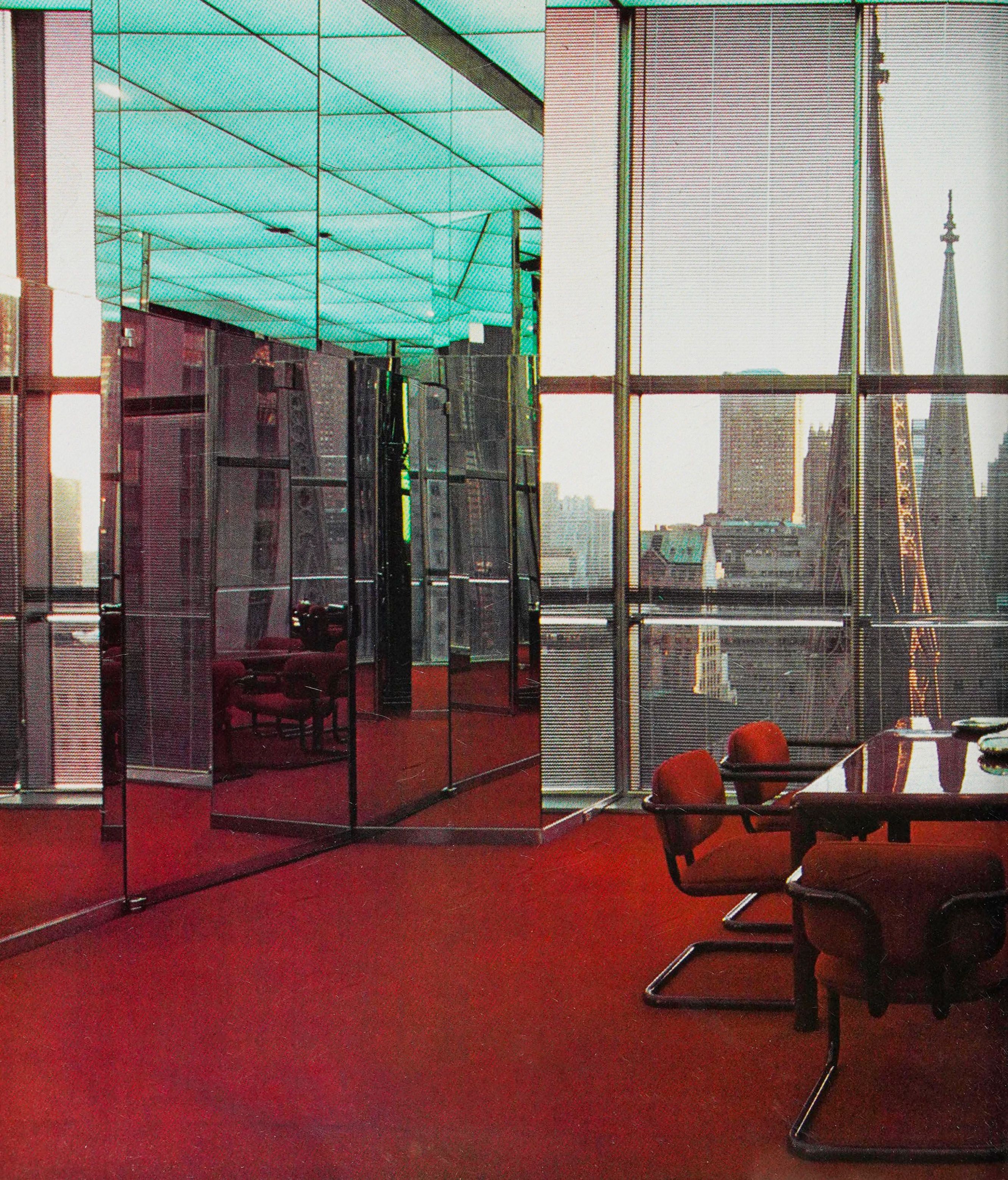
There is a specific vertigo that comes with working inside a curtain wall. Twenty-one floors above Fifth Avenue, surrounded by mirror and steel, Roy Halston Frowick understood this instinctively: when every surface reflects and the city spreads gray below, a room can lose its anchor. His solution was not subtle. He flooded his Olympic Tower office—designed by Skidmore, Owings & Merrill in the mid-1970s—with red. Thirty lacquered Parsons tables, designed by SOM's Charles Pfister, lined the mirrored showroom. Then Halston asked for a chair.
What Pfister delivered a year later was not a typical corporate task seat. The SOM79—a cantilevered, tubular-steel frame upholstered in the same arterial red—possessed a sinuous, racerback silhouette that read more like a garment than furniture. Halston ordered twenty. They were used for fittings, for dining, occasionally as seating for his invitation-only runway shows. And now, as SOM marks its 90th year, the firm has reissued the chair through IKONstudio, reintroducing a form that encodes a quiet but consequential shift in late-modernist design.
A Chair That Moves Like Fabric
SOM79 / Charles Pfister, SOM Interiors Group, New York, 1979
The SOM79's cantilevered frame—a continuous steel tube bent into a C-profile—is structurally efficient and formally expressive. It eliminates rear legs, allowing the seat to hover and flex under load. This is Breuer territory: Marcel Breuer's Cesca chair, designed in 1928, pioneered the tubular-steel cantilever as both structural system and visual signature. But where Breuer's frame is orthogonal and rationalist, Pfister's is curvaceous, almost anatomical. The backrest arcs inward, then flares at the shoulders—a gesture that Julia Murphy, a partner at SOM, likens to the three-dimensionality of a dress. "Like a garment, it's a 360 design," she notes. "Even from below, the frame reads as a single, unbroken line."
This formal continuity is significant. In the context of SOM's broader practice—a firm synonymous with the corporate rectilinearity of Lever House, the Sears Tower, and countless curtain-wall office towers—the SOM79 represents a departure. Its curves are not structural necessity but aesthetic choice, a softening of the hard-edged rationalism that defined the firm's output through the 1960s and early '70s. Chris Cooper, another SOM partner, describes it as "a softening of the decade prior," a phrase that undersells the broader stylistic pivot underway in 1979: postmodernism was ascending, and even the bastions of high modernism were beginning to modulate their geometries.
The Total Office Environment—and Its Limits
SOM's venture into furniture was not incidental. By the 1970s, the firm had developed an integrated design practice that extended from skyscraper to desk lamp. The "total office environment"—a concept SOM helped codify—assumed that architecture, interiors, and furnishings should emerge from a unified design logic. Pfister's Parsons tables and the SOM79 chair were part of this continuum, bespoke elements calibrated to the spatial and programmatic demands of specific projects.
But Halston's commission complicates this narrative. His showroom was not a corporate office in the traditional sense; it was a stage, a social space, a branding instrument. The mirrored walls multiplied the red chairs into an infinite field, a Warholian gesture that transformed functional seating into spectacle. The SOM79, in this context, was less about ergonomic efficiency than about presence—how a chair could hold its own against reflection, against the gray sprawl of midtown, against the egos of the people sitting in it.
This duality—functional object and visual statement—anticipates the way furniture would be deployed in the 1980s, as corporate interiors became increasingly concerned with image and identity. The SOM79 was designed at the cusp of this shift, and its reissue by IKONstudio suggests that we are once again interested in furniture that performs both roles.
Precedent: The Cantilever as Modernist Icon
The cantilevered chair has a long pedigree. Beyond Breuer's Cesca, there is Mies van der Rohe's MR chair (1927), Mart Stam's S33 (also 1926), and later, Verner Panton's S-shaped polypropylene experiments. Each iteration tested the limits of material and form: how much spring could steel provide? How thin could the profile become before the structure failed?
Pfister's contribution lies not in structural innovation—by 1979, the cantilever was a solved problem—but in the way he inflected the typology toward the body. The SOM79's backrest cradles the spine without the upright severity of Breuer's woven cane or the hard-edged geometry of Mies's leather sling. It is, in Murphy's words, a chair that "resonates" with the human form, a quality that would have been legible to Halston, who spent his career draping fabric over bodies.
This biomorphic inflection—subtle but unmistakable—aligns the SOM79 with a broader trend in late-'70s design: the reintroduction of organic form into the modernist vocabulary. We see it in Eero Saarinen's posthumous influence, in the rising interest in Scandinavian craft, in the early experiments with postmodern eclecticism. The SOM79 is not radical, but it is symptomatic.
Why Reissue Now?
SOM's decision to reissue the chair through IKONstudio raises questions about what we value in archival furniture. Cooper frames it in terms of formal consistency—"structure, balance, purity of platonic form"—but the timing suggests other motivations. At World Archi Design, we've been tracking a resurgence of interest in late-modernist furniture, particularly pieces that occupy the ambiguous zone between corporate modernism and postmodern gesture. The SOM79 fits neatly into this category: it is modern enough to signal seriousness, but inflected enough to avoid the coldness that has made high modernism unfashionable in residential contexts.
The reissue also speaks to SOM's ongoing project of self-historicization. As the firm enters its tenth decade, it has been actively mining its archives, reissuing furniture, publishing monographs, and positioning itself within a longer design lineage. This is not nostalgia; it is brand curation. The SOM79, with its glamorous backstory and photogenic form, is an ideal vehicle for this narrative.
But beyond branding, the chair's reissue underscores a broader shift in how we consume design history. We are no longer content with the canonical heroes—Breuer, Mies, Le Corbusier—and are increasingly interested in the secondary figures, the corporate commissions, the one-off projects that complicate the received narrative. Pfister, working within SOM's interiors group, is exactly this kind of figure: not a household name, but a designer whose work reveals the nuances of a particular moment.
A Chair That Knew What Was Coming
Halston's Olympic Tower showroom was dismantled long ago, its mirrored walls and red chairs dispersed. But the SOM79 endures, not because it was revolutionary, but because it was prescient. Designed in 1979—the year Margaret Thatcher took office, the year the Walkman launched, the year disco died—it encodes the aesthetic shift from the corporate rationalism of the '60s to the image-conscious pluralism of the '80s. It is a modernist object that already knows modernism is ending.
And perhaps that is why it feels relevant again. We are, after all, living through our own period of stylistic recalibration, in which the certainties of mid-century modernism no longer hold and the path forward is unclear. The SOM79, with its supple frame and ambiguous lineage, offers no answers. But it does offer a reminder: that the most interesting objects are often the ones that arrive just as one era gives way to another, flexible enough to bend without breaking.
Save this story. A free account keeps your reading list and the 07:00 email in one place.
CREATE FREE ACCOUNT →SIGN IN