The Transient Generation Puts Down Roots
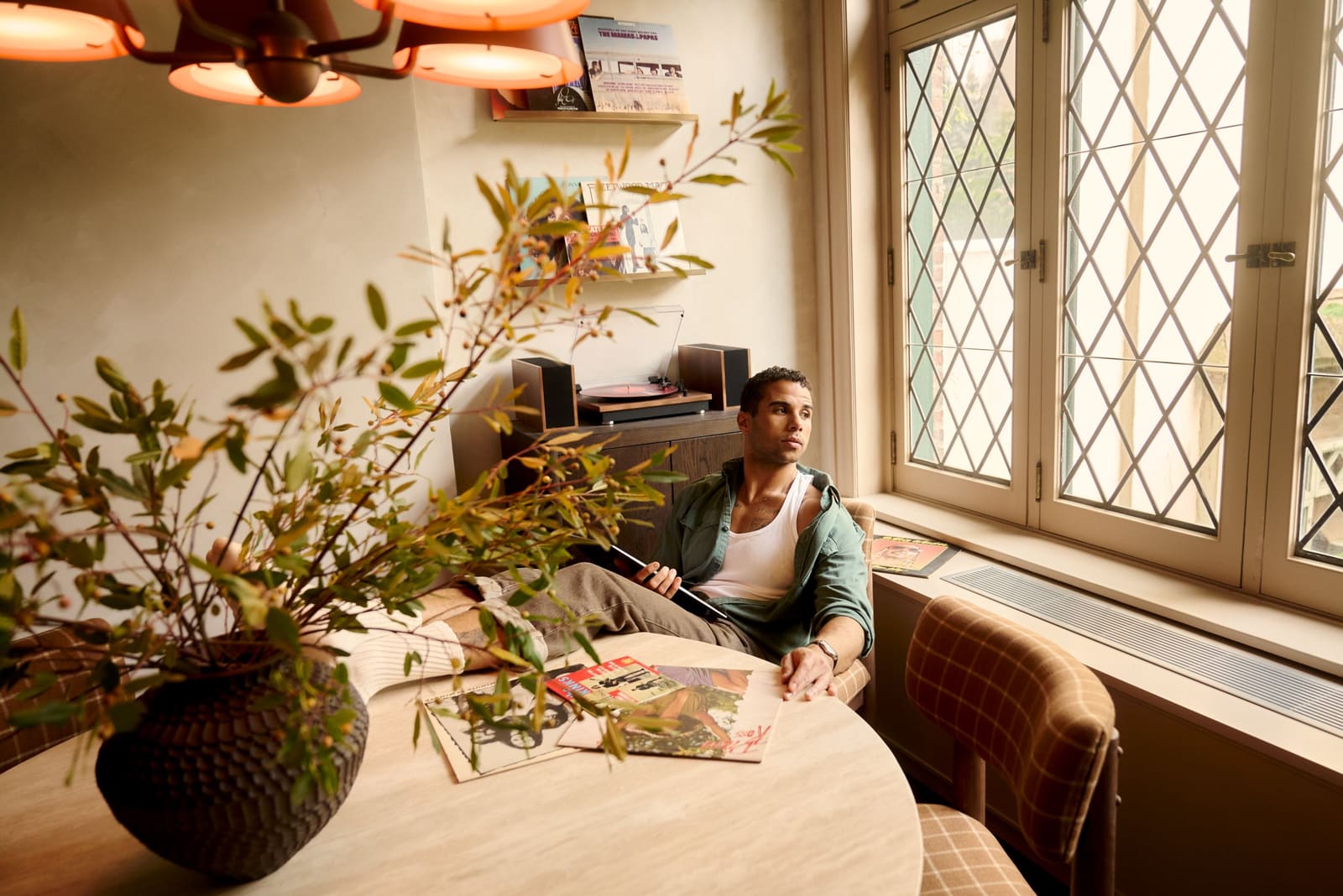
There comes a moment when perpetual motion loses its charm. For actor Mason Gooding, nearing thirty and familiar with the nomadic rhythm of film production, that moment arrived with clarity: he wanted permanence. Not in Los Angeles, where he grew up, but in Manhattan, a city he first encountered as a university student and where culture unfolds just beyond the threshold.
The apartment he purchased spans roughly 650 square feet, surrounded by courtyard greenery that filters light through diamond-paned windows. It required substantial renovation, but Gooding recognized what many overlook - that constraint can sharpen vision. Working with designer Claudia Roth of Claudia Allegra Interiors, he transformed a dated, inefficient layout into a residence that balances boldness with intimacy, a rare feat in compact urban dwellings.
Chromatic Courage in Confined Space
At World Archi Design, we've tracked a recurring hesitation in small-footprint residential projects: designers default to white or pale neutrals, believing they expand perceived volume. Roth and Gooding took the opposite approach. When the actor referenced the Ralph Lauren SoHo store as inspiration - comfortable yet compelling - Roth understood it as permission to saturate.
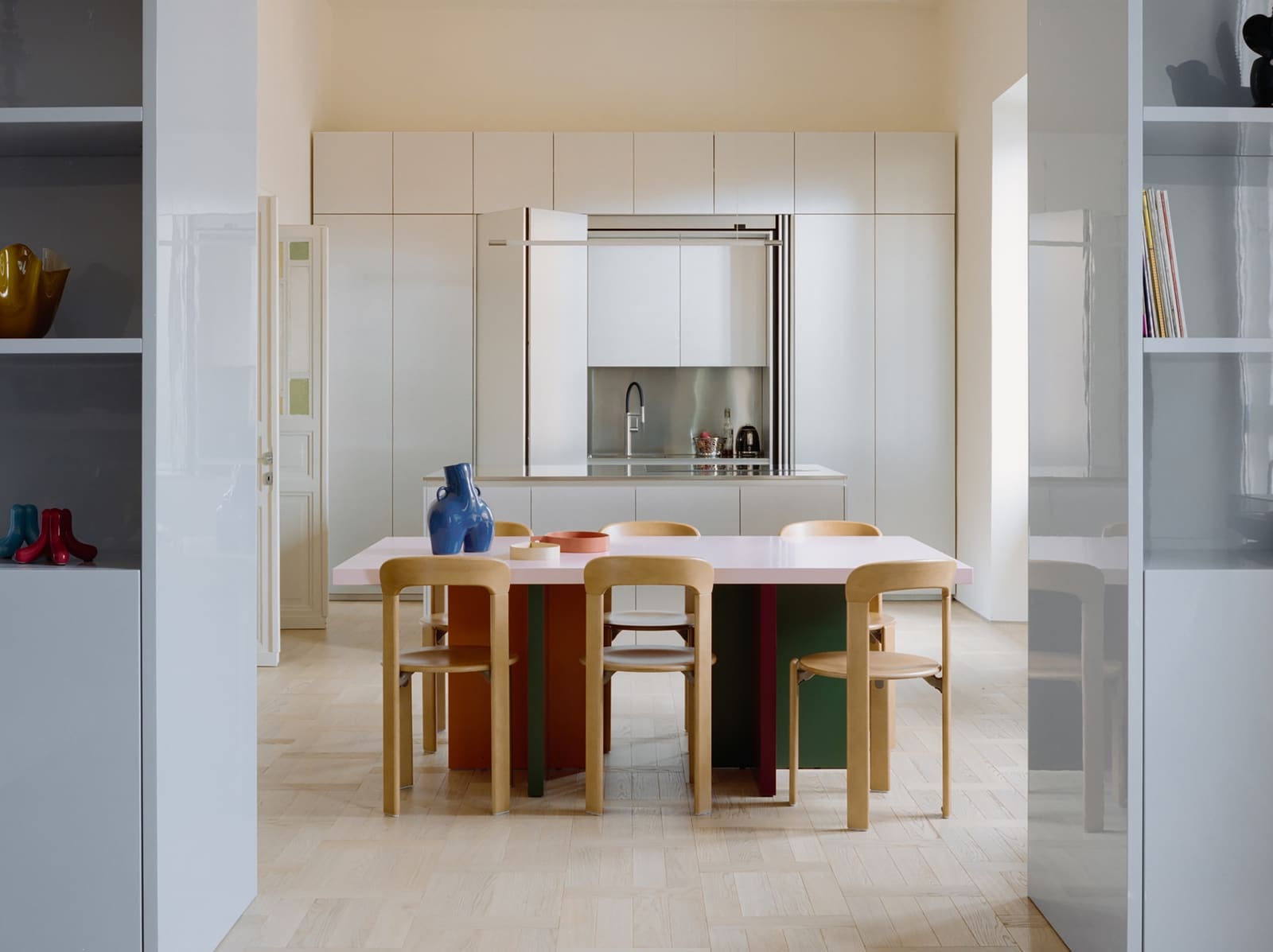
The kitchen, once cramped and wood-clad, became an aubergine jewel box. Roth specified cabinets painted in Farrow & Ball's Brinjal No. 222, paired with zellige tile from Clé, viola marble countertops, and aged brass hardware from MG & CO. The result contradicts conventional wisdom: the deep purple reads as enveloping rather than oppressive, and the reflective properties of zellige add dimensional shimmer that optically enlarges the space.
In the living area, the oversized fireplace was pared back to reclaim square footage, but its surround gained presence through green tile. This chromatic anchor grounds a palette of browns and greens, echoed in a vintage Danish 1940s armchair reupholstered in chocolate shearling, a Dune sofa from Maiden Home, and sculptural Ingresso accent chairs from House of Léon. An Ernesta rug unifies the scheme, its tonal variation preventing monotony.
Millwork as Spatial Strategy
The apartment presented the usual Manhattan irritants: exposed radiators, window air conditioning units, inadequate storage. Rather than treat these as immovable obstacles, Roth deployed millwork as both concealment and opportunity. Custom cabinetry hides mechanical equipment while introducing display surfaces and shelving, particularly in the second bedroom, which functions as a den.
This approach exemplifies adaptive thinking we see too rarely in residential work. Millwork is often dismissed as expensive or old-fashioned, yet here it solves multiple problems elegantly: it streamlines visual clutter, increases storage capacity, and adds architectural texture to Sheetrock boxes. The built-in shelving in the den doubles as nightstands when the American Leather sleeper sofa hosts guests, a pragmatic detail that acknowledges how small homes must perform multiple roles.
Preserving Character, Selectively
Roth faced pressure to replace the diamond-patterned living room windows, a suggestion she rejected outright. Those windows, with their leaded glass geometry, carry the apartment's historical DNA. Replicating them in modern materials would produce a hollow pastiche, the kind of pseudo-historical gesture that undermines authenticity.
She extended this preservation instinct to smaller details: original glass and brass doorknobs remain throughout. They are delicate, almost incongruous against the apartment's bold interiors, yet they anchor the space in its pre-renovation life. Gooding himself kept a kitchen tile hand-painted with lemons, a fragment of unknown provenance that now resides in storage - a private talisman of continuity.
This selective retention reflects a mature understanding of renovation. Not everything old deserves preservation, but certain elements encode irreplaceable character. The skill lies in discernment, in knowing when to strip away and when to honor.
The Analog as Anchor
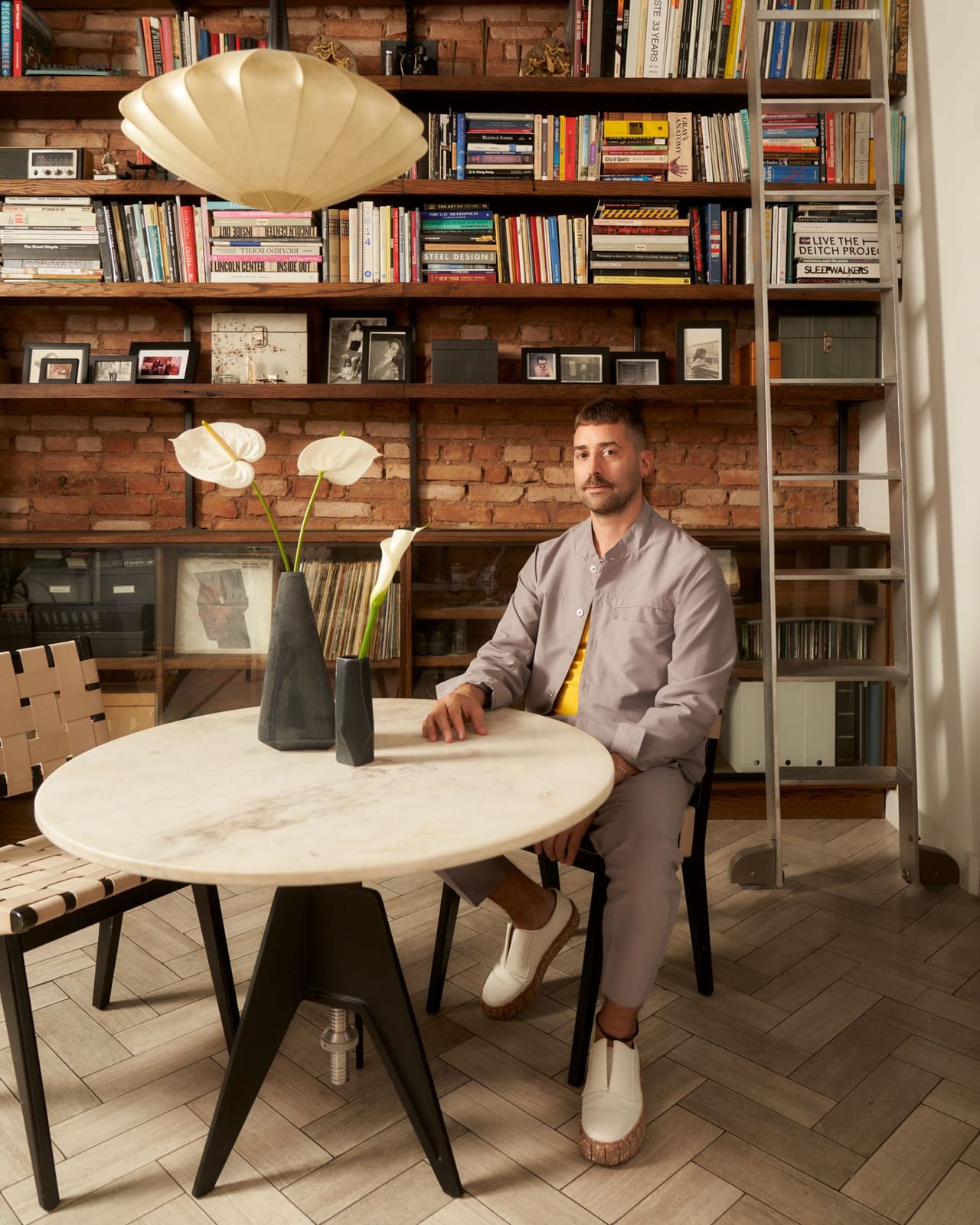
Gooding's one non-negotiable when furnishing the apartment was his record collection. Roth initially planned a bar cart beneath the dining area windows; Gooding redirected her toward storage and display for vinyl. The collection includes rare Frank Ocean pressings, and for Gooding, the ritual of selecting, handling, and playing records represents a deliberate relationship with the analog.
We've written before about the resurgence of physical media in residential design, particularly among younger homeowners who came of age during streaming's dominance. The record player serves as counterpoint to the frictionless, the instant, the dematerialized. It demands attention, occupies space, and resists portability - qualities that align with Gooding's broader desire for rootedness.
The dedicated music nook also reflects a spatial hierarchy worth noting. In a 650-square-foot apartment, allocating square footage to a single-purpose function is a luxury. That Gooding prioritized it over a bar or additional seating reveals his values clearly: this home is designed around practices that matter to him, not generic entertaining conventions.
Material Texture and Sensory Depth
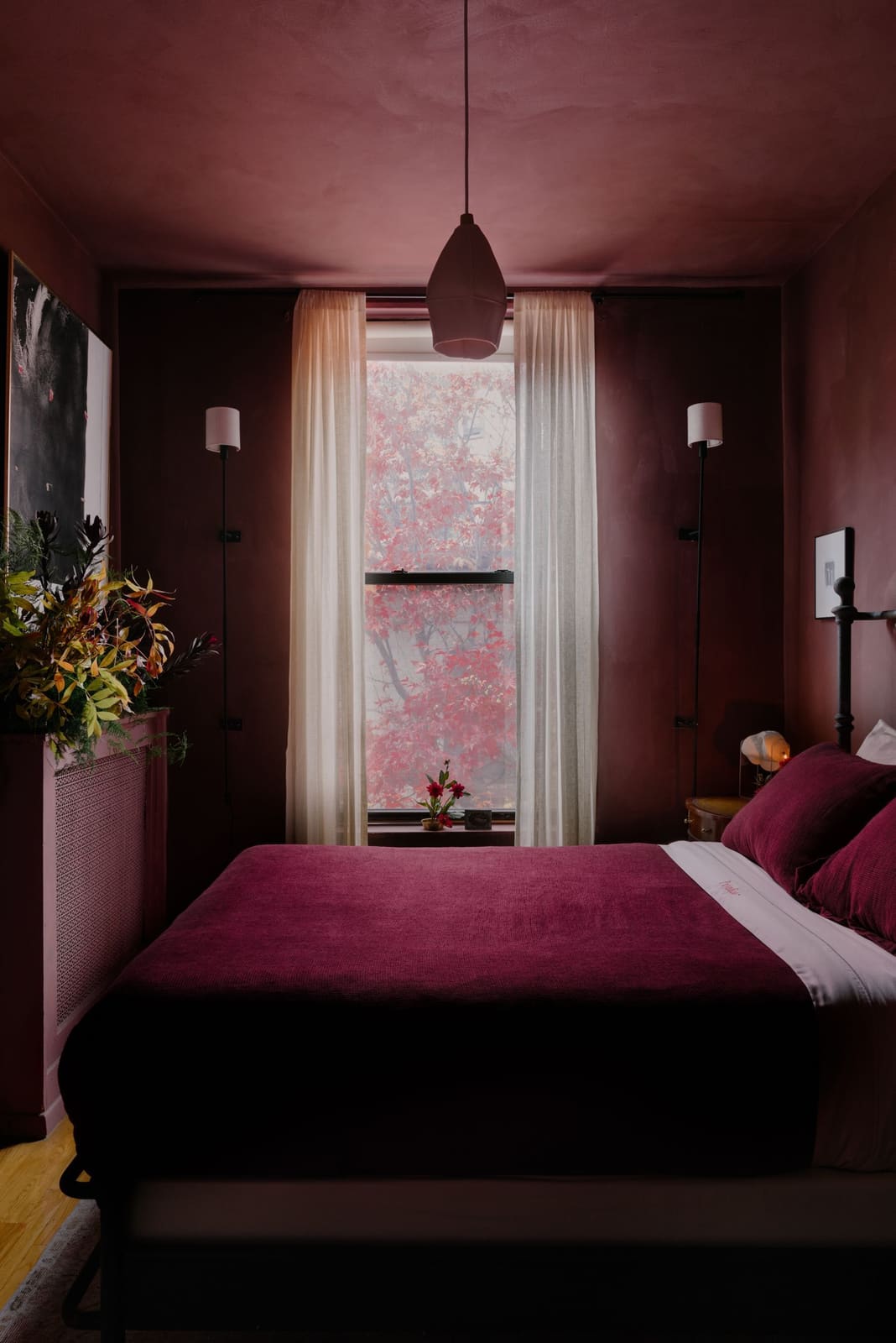
The bedroom introduces Pierre Frey's Toile De Nantes Intisse wallpaper, a pattern that could read as traditional or twee but instead amplifies the apartment's embrace of the outdoors. Roth initially considered green plaid, then pivoted toward something less predictable. The toile's pastoral imagery connects to the courtyard greenery visible through the windows, blurring the boundary between interior and exterior.
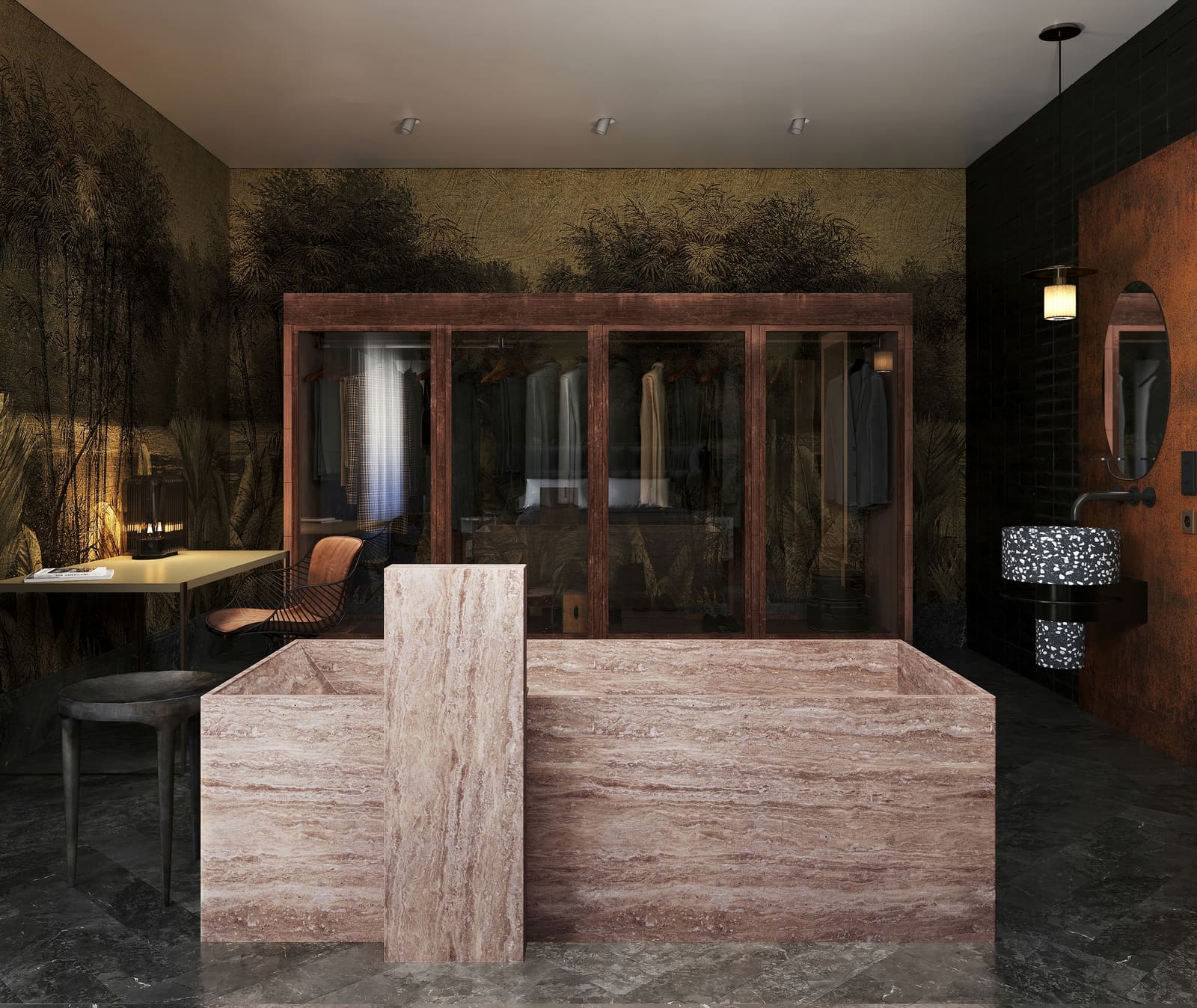
In the bathroom, Portola Paints' Cigarro creates a moody, cocooning atmosphere, paired with an RH vanity, a Rejuvenation medicine cabinet, and an Ethnik Living sconce. The space reads as deliberate retreat, a small volume rendered immersive through color saturation and cohesive material choices.
Across the apartment, texture plays an outsized role: shearling upholstery, jute-blend rugs, travertine, zellige, viola marble. These materials introduce tactile variation that prevents the bold color palette from feeling flat or one-dimensional. They also age visibly, developing patina in ways that matte paint cannot, which aligns with Gooding's stated appreciation for objects that carry time.
Spatial Compression and Domestic Ritual
Gooding spends significant time traveling for work or visiting his girlfriend in Austin, yet the apartment functions as psychological anchor. He describes it as a physical manifestation of himself, a phrase that captures the emotional weight homeownership can carry for those who have lived transient lives.
The kitchen, once so narrow only one person could occupy it, now accommodates two. Gooding and his girlfriend cook together there, a domestic ritual enabled by the renovation's spatial reorganization. The fire escape, accessible from the living room, serves as his morning coffee spot, where he hears bells from a nearby church - a romantic detail he notes without irony.
These moments of use reveal the project's success more clearly than any photograph. A well-designed small apartment does not simply look appealing; it supports the specific rhythms of its occupant's life. Roth's work here demonstrates that understanding, translating Gooding's aspirations into spatial and material decisions that function daily, not just editorially.
What Small-Footprint Design Can Learn
This project offers several lessons for designers working within tight urban constraints. First, chromatic boldness can expand perceived space when handled with material intelligence. Second, millwork remains one of the most versatile tools for solving storage and concealment challenges. Third, selective preservation of existing character elements grounds renovation work in continuity rather than erasure.
Perhaps most importantly, the apartment succeeds because it reflects a specific occupant's values rather than generic resale considerations. Gooding's willingness to dedicate space to his record collection, to embrace aubergine cabinetry, and to retain hand-painted tiles speaks to a client unafraid of idiosyncrasy. Roth's skill lay in channeling that fearlessness into coherent design.
As more young professionals invest in first homes, we expect to see this kind of risk-taking proliferate. The generation that grew up in beige rental apartments is hungry for color, texture, and objects that carry meaning. Gooding's Manhattan tree house suggests that the future of small-space residential design may be far bolder than its recent past.
Credit: Seth Caplan
Save this story. A free account keeps your reading list and the 07:00 email in one place.
CREATE FREE ACCOUNT →SIGN IN