The Accidental Archive
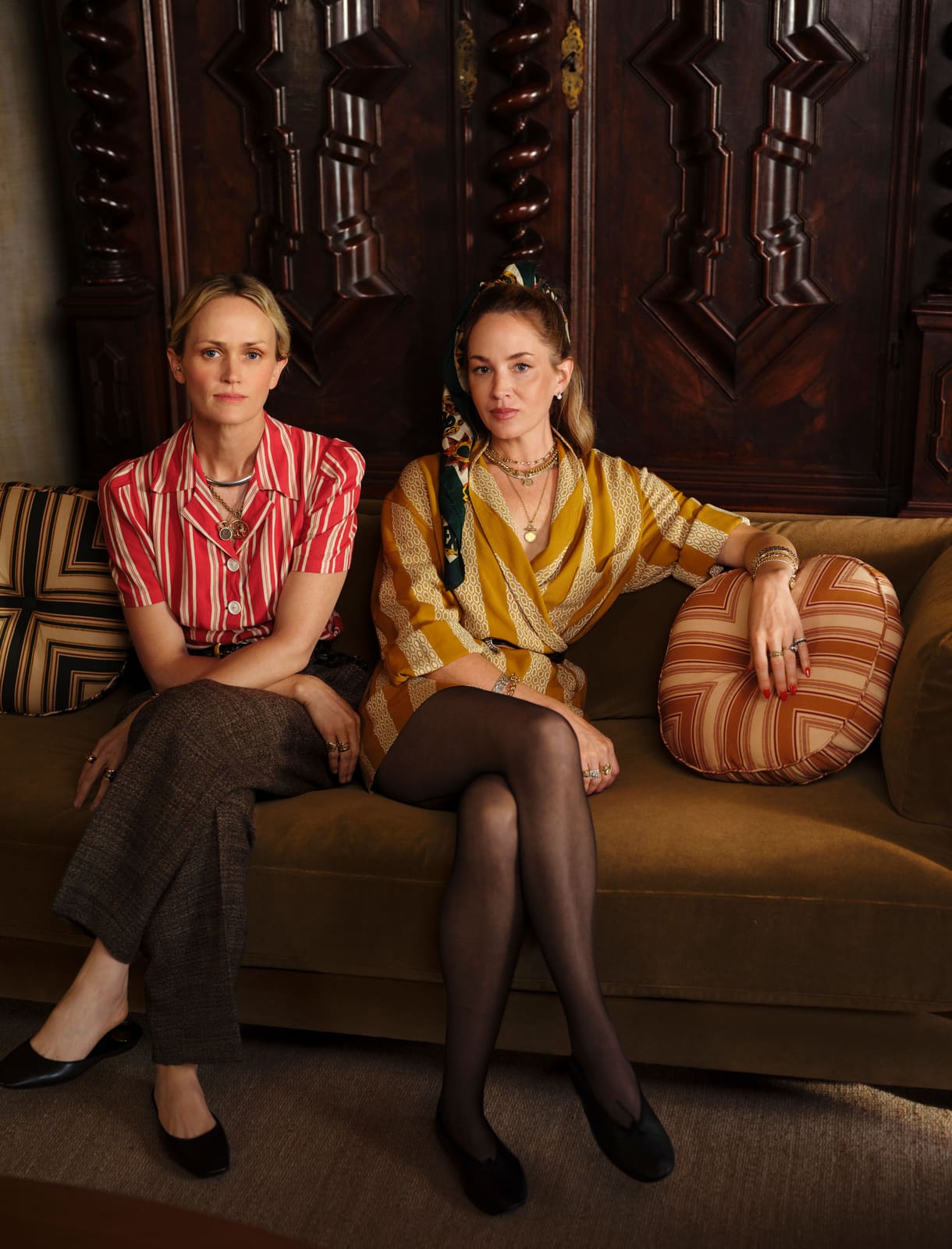
Most design partnerships operate on mood boards and CAD files. Louisa Pierce and Emily Ward work from the back of a semi-truck. Over a dozen years, the AD100 firm has accumulated what can only be described as a roving cabinet of curiosities: objects pulled from estate sales, antique markets, and late-night phone calls that may or may not have involved cocktails. Their process is less curation than accretion. They buy things first, figure out where they belong later, and in the spaces between instinct and intention, a signature style has emerged.
Their second collaboration with West Elm grows directly from that instinct. The collection, which debuted this summer, expands beyond furniture into bedding, bath, and tabletop categories while introducing materials like burlwood, cork, and lacquer. But the conceptual anchor is narrower and more personal: tramp art, a 19th-century American folk tradition of layered, notched woodworking that Pierce's late mother-in-law collected obsessively.
When she passed, Pierce inherited more carved boxes, mirrors, and frames than any one household could absorb. Some pieces went into storage. Others found their way into client projects, where they became visual punctuation marks in otherwise polished rooms. Eventually, Pierce and Ward began sourcing tramp art deliberately, weaving it into their maximalist interiors as a textural counterpoint to upholstered curves and high-gloss finishes. The West Elm line translates that vocabulary into accessible, reproducible forms.
Tramp Art as Tectonic Language
Tramp art occupies a strange position in the American decorative canon. Born from itinerant craftsmen working with salvaged cigar boxes and shipping crates, the style is defined by chip-carving: repetitive, geometric notches that build up in pyramidal layers. The technique is labor-intensive, almost compulsive, and the resulting objects carry an unmistakable handmade texture. In recent years, as the market for folk art has heated up, tramp art has moved from flea market curiosity to auction-house staple.
What Pierce and Ward recognize in tramp art is not just its current trendiness but its formal utility. The carved layers create depth without adding bulk. The geometric patterning reads as decorative detail at a distance and as tactile relief up close. It is ornament that does not apologize for itself, a quality that aligns perfectly with the duo's approach to interiors, which rejects the minimalist reflex in favor of rooms that feel accumulated over time.
The Novelty Burl Side Table exemplifies this translation. Its high-contrast burl veneer mimics the visual density of carved wood, while its silhouette borrows the chunky proportions of vintage tramp art frames. The result is a piece that could plausibly be mistaken for an antique, at least until you check the price tag. This is not pastiche but reinterpretation: taking the material language of a historical craft tradition and rendering it in forms suited to contemporary production.
Maximalism as Method, Not Aesthetic
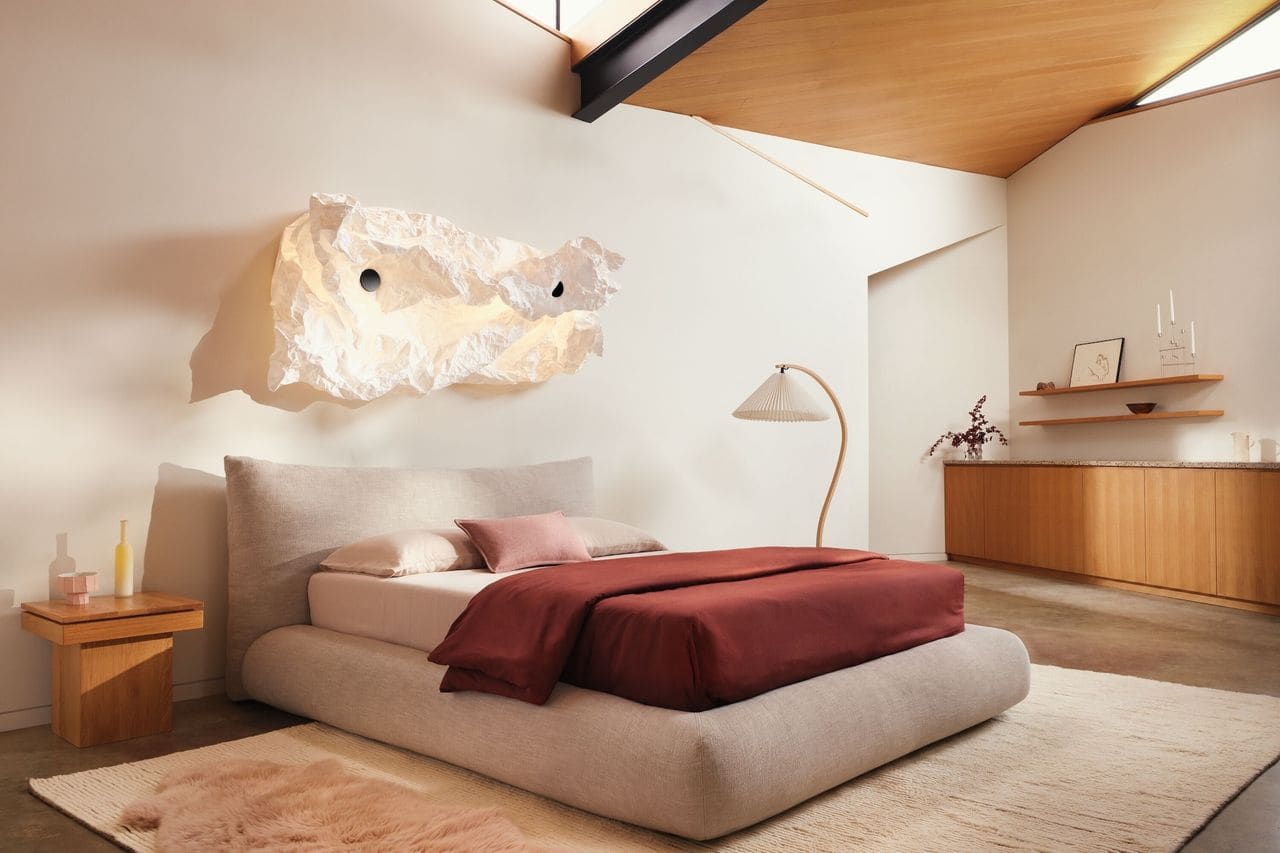
Pierce and Ward's reputation rests on their ability to create interiors that look layered without looking cluttered. They work for clients like Emma Roberts and Dakota Johnson, whose homes demand a certain visual richness but cannot veer into kitsch. The West Elm collection attempts to bottle that balance, offering pieces designed to be mixed rather than matched.
The bedding line is the clearest example. Block-print-adjacent florals sit alongside ogee patterns, clover motifs, and twill stripes, all rendered in cotton and engineered to layer without obvious coordination. The logic is additive: you are meant to pile on pillows, mix duvet covers with contrasting sheets, and treat the bed as a composition rather than a coordinated set. This is maximalism as method, a deliberate accumulation of pattern and texture that resists the tyranny of the suite.
West Elm granted the designers near-total creative freedom, which allowed for experiments that might not have survived a more conservative approval process. A hybrid-purpose table comes finished in what Ward calls Serene Cypress, a peculiar green that splits the difference between sage and moss. A striped loveseat, which both designers insist reads as a neutral, pushes the boundaries of what neutrality can mean in a maximalist context. A swirling bar cart in mahogany and mindi wood toggles between mid-century utility and contemporary sculpture.
These are not safe choices. They are the kinds of pieces that require confidence to deploy, the design equivalent of buying a chandelier sight unseen because your partner said yes over the phone. But that confidence is precisely what Pierce and Ward are selling. The collection does not offer instructions so much as permission.
The Price of Provenance
One of the tensions inherent in any mass-market collaboration is the question of authenticity. How do you replicate the feeling of a home assembled over years, with objects pulled from disparate sources, when everything in the collection shares a single manufacturer and a unified aesthetic? Pierce and Ward's answer is to lean into the contradiction. They acknowledge that the collection is, by definition, coordinated, but they design it to resist that coordination visually.
The mixed-wood console, for instance, combines different veneers in a single piece, creating the impression of assembled rather than manufactured furniture. The ceramic dinnerware, inspired by Impressionist paintings, carries the irregularity of hand-thrown pottery even though it is factory-produced. The floating bookshelf and bistro table are designed to look like vintage finds, the kinds of pieces you might stumble across in a New Orleans antique shop after a few drinks.
This is not deception but theater. The collection operates in the same register as the duo's interiors: creating a sense of history through careful staging. The price points make that staging accessible, eliminating the need for years of hunting or the algorithmic exhaustion of online marketplaces. When Pierce jokes that buying everything from the collection would give you a perfect home, she is half-serious. The curation is already done. You are buying not just furniture but a curated point of view.
What Comes After Instinct
At World Archi Design, we have long argued that the most successful retail collaborations are those that translate a designer's process, not just their aesthetic. Pierce and Ward's West Elm line succeeds because it encodes their improvisational method into a fixed product range. The pieces are designed to be recombined, layered, and mixed with existing collections, both from the first collaboration and from outside sources. The collection is not an endpoint but a starting condition.
The tramp art influence is significant not because it introduces a new style to the market but because it demonstrates how historical craft vocabularies can anchor contemporary design. Tramp art's layered geometry provides a visual and tactile richness that feels earned, even when it is reproduced at scale. It is a reminder that ornament, when deployed with intention, can carry meaning beyond decoration.
Whether the collection will resonate with consumers remains to be seen. The market for maximalist interiors is robust but fickle, and the line's success will depend on whether buyers are willing to embrace the confidence it demands. But as a design proposition, it is coherent and compelling. It takes the instinct that has defined Pierce and Ward's practice and makes it reproducible, proving that even in an age of algorithmic curation, there is still room for the semi-truck approach.
Credit: West Elm
Save this story. A free account keeps your reading list and the 07:00 email in one place.
CREATE FREE ACCOUNT →SIGN IN