The Furniture That Disappeared
For two decades, Knoll simply didn't make beds. The Pennsylvania furniture manufacturer, known for its midcentury classics and corporate office solutions, had quietly removed the typology from its roster, focusing instead on seating, tables, and storage systems that populated workspaces and public lounges. The bedroom, it seemed, was a frontier the company had decided to abandon.
That absence ends now. Knoll has unveiled a new bed designed by Willo Perron, marking the brand's return to residential sleeping furniture after a twenty-year hiatus. The timing reflects a broader shift we've observed across contract furniture makers, many of whom are rediscovering the home as a site of design innovation rather than simply a spillover market for office-adjacent pieces.
A Designer Who Defies Categories
Perron occupies an unusual position in contemporary design. His practice spans set design for musicians like Beyoncé and St. Vincent, brand identity work for Chanel, and increasingly, furniture that sits somewhere between sculpture and everyday object. The breadth of that portfolio, combined with a Los Angeles sensibility that privileges ease over formality, makes him an unexpected but logical partner for a heritage brand seeking to soften its institutional image.
The collaboration between Knoll and Perron began in 2024 with the Pillo sofa, a piece defined by its quilted upholstery and deliberately casual proportions. That initial launch has since expanded into lounge chairs, modular seating, and cushions, all under the Pillo umbrella. The bed represents the latest iteration of this system, extending the vocabulary of plush, upholstered volumes into the bedroom.
Headboard as Cushion
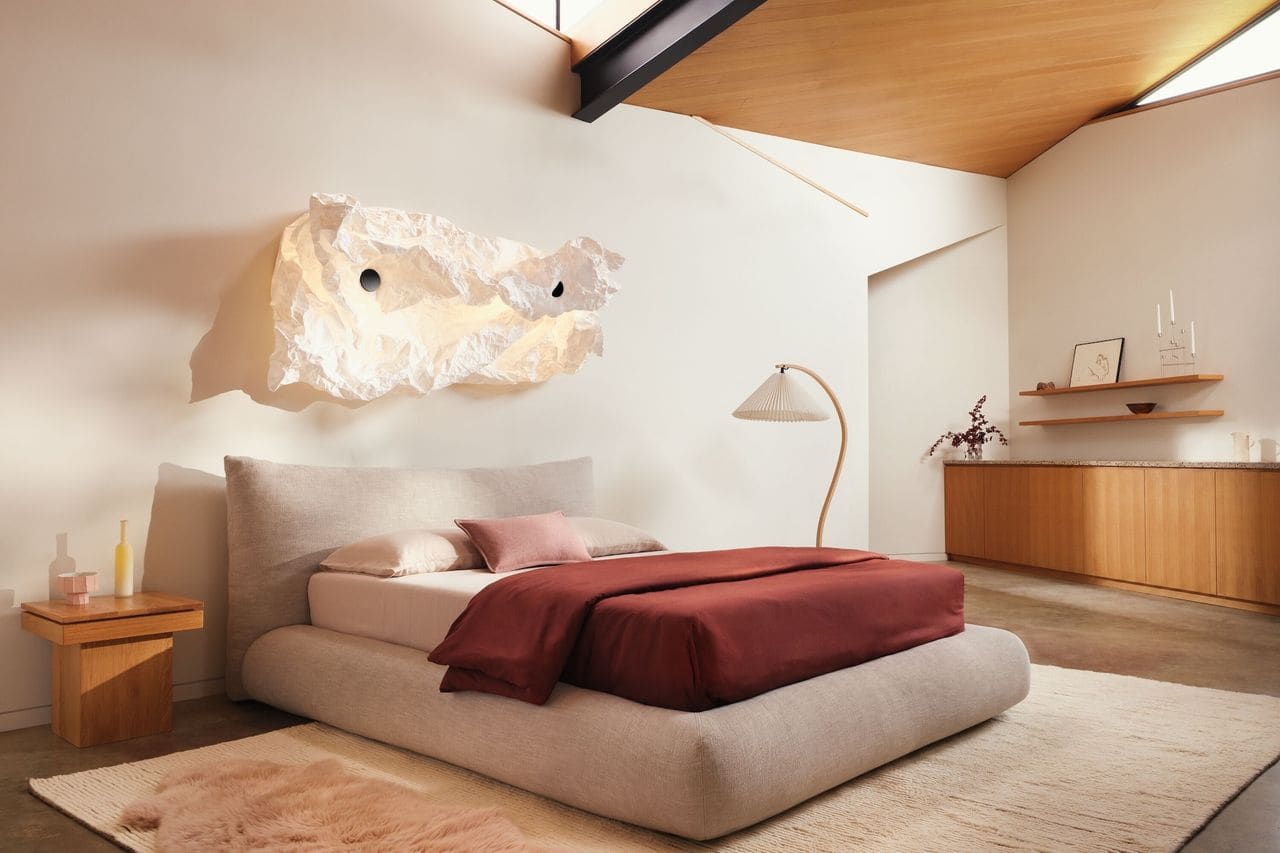
The defining feature of the Pillo bed is its headboard, which functions less as a structural element and more as an oversized cushion. Upholstered in the same fabric as the bed frame, it invites users to lean back fully, blurring the line between sitting and reclining. This is furniture designed for the contemporary habit of reading, scrolling, or watching television in bed, a reality that much residential furniture still ignores in favor of more idealized notions of sleep.
The frame itself is entirely upholstered, with no exposed wood or metal. The effect is one of softness and volume, a piece that reads as a single padded mass rather than a collection of parts. It's a formal strategy that echoes earlier experiments by designers like Gaetano Pesce and the Memphis Group, both of whom used upholstery to challenge the hard edges of modernist furniture. Here, though, the gesture is quieter, more concerned with comfort than provocation.
Customization Within a System
Knoll is offering the bed with customizable upholstery options, allowing buyers to select fabrics and colors that suit their interiors. Jonathan Olivares, the brand's creative director, has described the piece as one that "quietens and simplifies the bedroom," a claim that positions the bed as a neutral backdrop rather than a focal point. That framing is somewhat at odds with the bed's substantial visual presence, but it speaks to a design philosophy that values adaptability over singular expression.
Perron himself has emphasized the importance of personalization within the Pillo system. The pieces are intended to be mixed and matched, not necessarily coordinated into a uniform set. This approach reflects a broader trend in furniture design, one that moves away from the totalizing vision of the interior, where every element is specified by a single hand, toward a more improvisational model where users assemble their own environments from compatible but varied components.
The Bed as a Late Addition
It's worth asking why the bed arrives last in the Pillo family. Sofas, chairs, and modular seating all preceded it, suggesting that Knoll and Perron were testing the market's appetite for this aesthetic before committing to a piece as large and as personal as a bed. Beds occupy a unique position in furniture design, they are deeply intimate objects, yet they must also perform structurally in ways that seating does not. The decision to expand the Pillo system into the bedroom signals confidence in the language Perron has developed, as well as a belief that the quilted, cushioned aesthetic can translate across typologies without losing coherence.
The bed also positions Knoll more directly in the residential market, a space the brand has historically approached with caution. While pieces like the Barcelona chair and the Tulip table have long been fixtures in high-end homes, Knoll's core business has remained tied to commercial interiors. A bed, by contrast, is unambiguously domestic, and its introduction suggests a strategic shift toward capturing a segment of the market that values design pedigree but seeks comfort and softness over the austere lines that defined much of Knoll's twentieth-century output.
Context and Precedent
The Pillo bed arrives at a moment when upholstered, enveloping furniture is experiencing a resurgence. Designers like Pierre Yovanovitch, India Mahdavi, and Cristina Celestino have all explored rounded, cushioned forms in recent years, often as a reaction against the hard minimalism that dominated the previous decade. The appeal is partly tactile, furniture that invites touch and use rather than admiration from a distance, but it's also psychological, a desire for interiors that feel protective rather than austere.
Perron's contribution to this conversation is his willingness to treat the bed not as a standalone object but as part of a larger furniture ecosystem. The Pillo system operates as a kind of soft architecture, a collection of upholstered elements that can be arranged and rearranged to suit different needs and spaces. It's a more flexible approach than the monolithic bedroom suites that furniture brands have traditionally offered, and it reflects a design sensibility shaped by the fluid, multi-use interiors that characterize contemporary living.
What It Signals
The reintroduction of a bed to Knoll's catalog after twenty years is not simply a product launch, it's a marker of how the company understands its role in the current design landscape. By partnering with Perron, a designer whose work bridges multiple disciplines and audiences, Knoll is signaling a willingness to move beyond its modernist legacy and engage with a softer, more adaptable aesthetic. Whether that strategy resonates with buyers will depend on how successfully the Pillo bed translates its visual appeal into lived experience, but the piece itself represents a clear departure from the restrained formalism that has long defined the brand.
Credit: Knoll
Save this story. A free account keeps your reading list and the 07:00 email in one place.
CREATE FREE ACCOUNT →SIGN IN