The Recursive Problem of Exhibiting Architecture
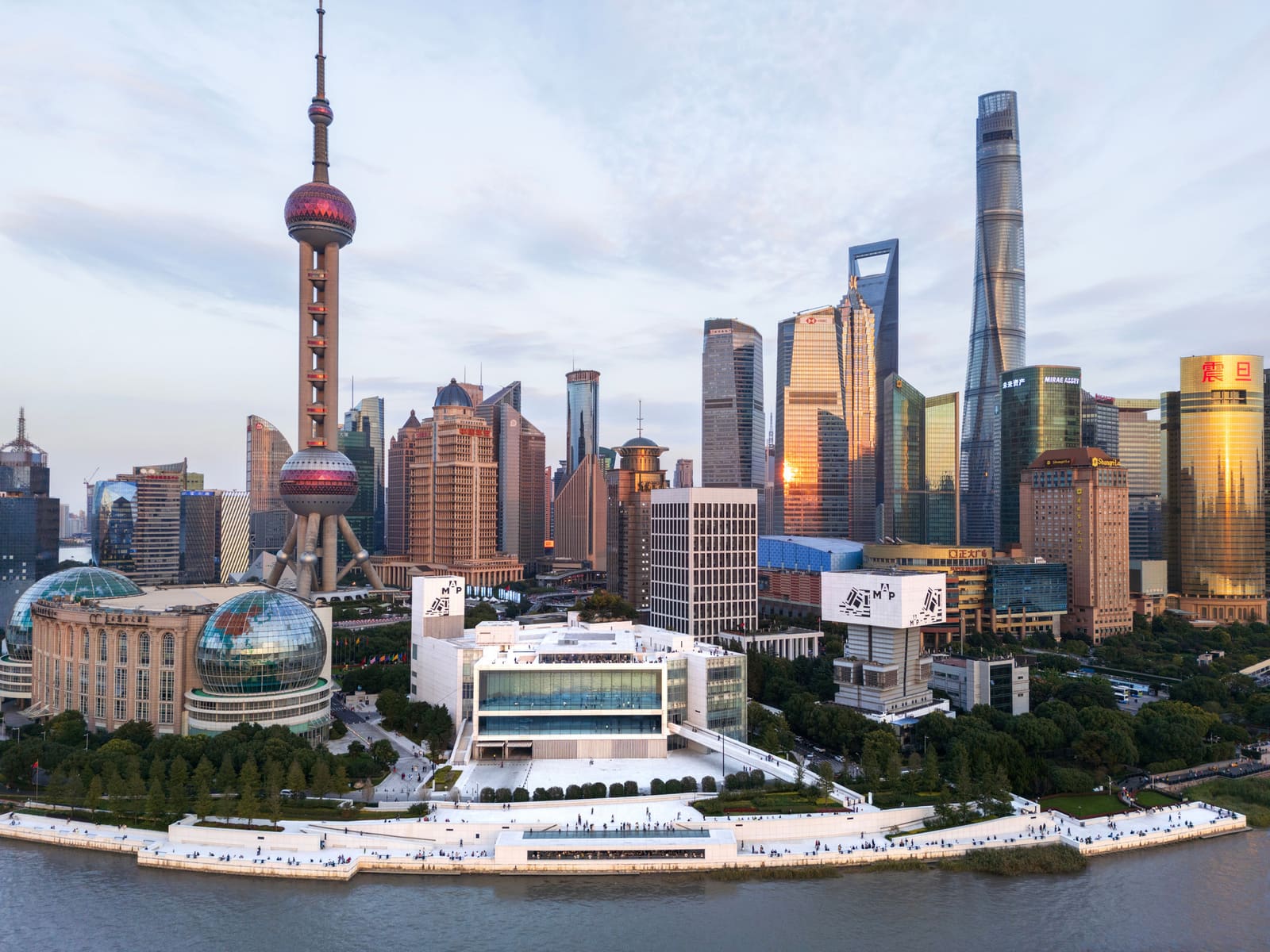
There is a peculiar recursion at play when an architect exhibits their own work inside a building they designed. The museum becomes both container and content, infrastructure and artifact. At Museum of Art Pudong in Shanghai, Jean Nouvel's retrospective runs through August 2026, and it confronts this recursive condition head-on. Rather than treating the 2021 building as a neutral white cube, the exhibition folds the architecture itself into the narrative, positioning MAP as both venue and case study within a fifty-year body of work.
The show, organized by Museum of Art Pudong in partnership with Ateliers Jean Nouvel, marks the museum's fifth anniversary. It is the first time Nouvel has staged a solo exhibition inside one of his own buildings, a fact that shifts the terms of engagement. Visitors are not simply looking at models and drawings of distant projects; they are moving through one of those projects, experiencing firsthand the spatial logics, material choices, and calibration of light that define Nouvel's practice.
Architecture as Cultural Landscape
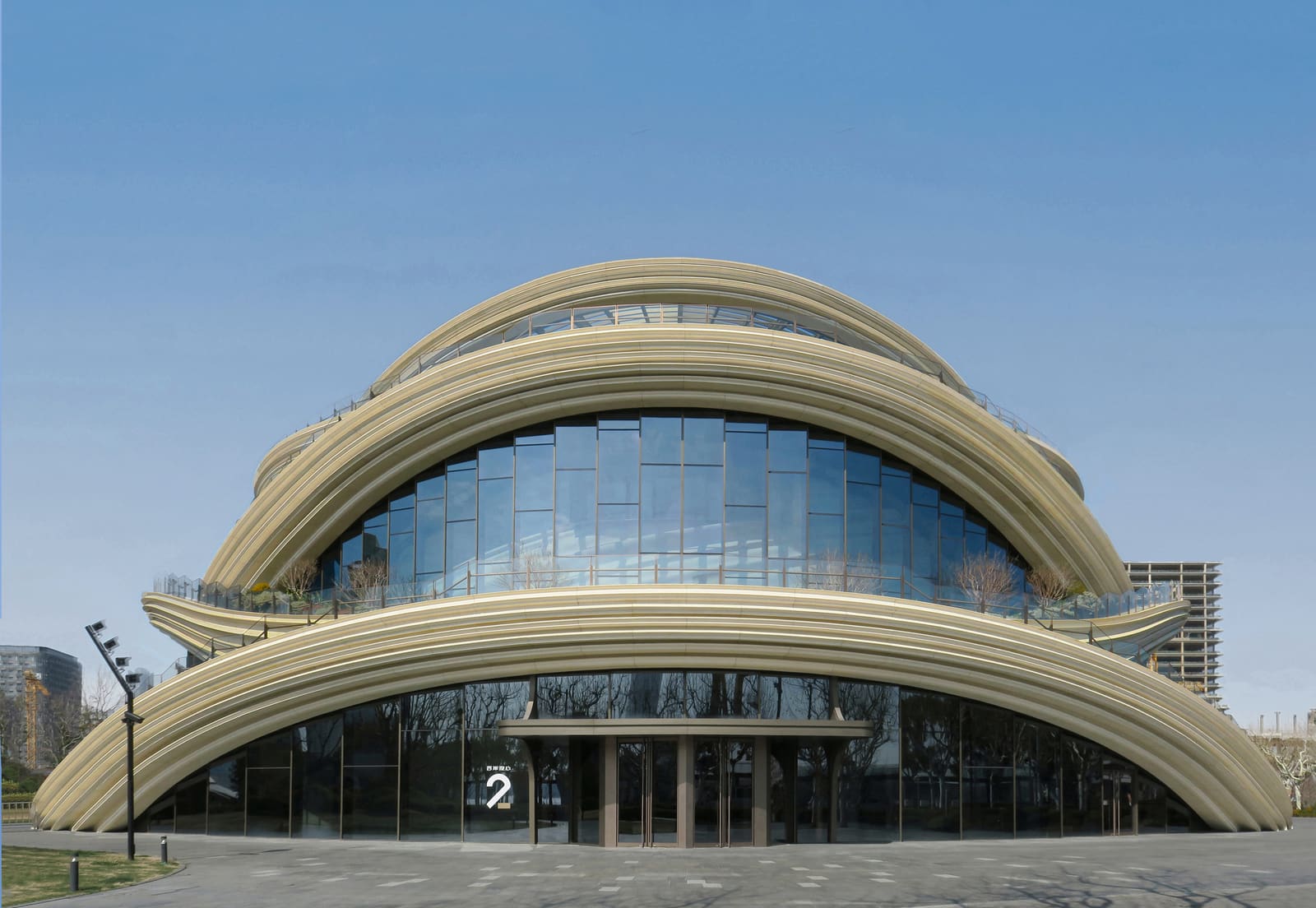
Museum of Art Pudong was designed between 2015 and 2021 as part of Shanghai's Lujiazui cultural cluster, a district that has become a testbed for high-profile international commissions. Nouvel conceived the building not as an isolated object but as a cultural landscape extending toward the Huangpu River, emphasizing porosity between architecture, city, and public realm. The museum's massing is deliberately horizontal, a counterpoint to the vertical thrust of Pudong's skyline. Large-scale glazing and carefully choreographed sightlines orient visitors toward the river and the historic Bund across the water.
For the retrospective, new audiovisual installations and site-specific interventions have been embedded within the building's galleries, drawing attention to how Nouvel orchestrates perception, context, and atmosphere. This approach is consistent with his broader practice, where architecture is understood less as formal composition and more as a set of experiential conditions. The building becomes legible not through plan diagrams alone but through the accumulated sensory data of moving through it.
Fifty Years, Five Continents
The exhibition takes its title from Nouvel's 2025 publication Jean Nouvel: Mes Convictions, and it adopts a structure that privileges process over product. Large-scale films, drawings, conceptual studies, and archival material document projects completed across five continents. A reconstruction of the Ateliers Jean Nouvel studio in Paris occupies one gallery, offering access to digital project archives and interview recordings. The gesture is part institutional archaeology, part working office, collapsing the distance between design as it happens and design as it is remembered.
Several of Nouvel's projects in China are presented alongside international works. These include Museum of Art Pudong itself, the Shanghai Start Museum, Tencent's Guangzhou Headquarters, and the Shenzhen Opera House. Each of these commissions engages a different urban condition, from the corporate campus to the civic monument, and each demonstrates Nouvel's insistence on site specificity over signature form. The exhibition also includes architectural models of the Philharmonie de Paris, the National Museum of Qatar, and Fondation Cartier pour l'art contemporain at Palais Royal, accompanied by drawings and project documentation.
Material from Nouvel's Emergences series presents conceptual studies for both realized and unrealized projects, including Tour Sans Fins and Tête Défense. These projects, many of which were developed in the 1980s and 1990s, reveal an architect working through urban scale and symbolic ambition at a moment when Paris was rethinking its periphery. They also underscore the durability of certain preoccupations across Nouvel's career: the negotiation between building and skyline, the use of reflective and translucent materials, the interest in dematerialization.
Context, Materiality, Light
Nouvel established his practice in the early 1970s, a period when postwar modernism was being interrogated from multiple directions. His work has consistently resisted universal templates, instead responding to the specific conditions of each site. This is not contextualism in the literal sense of mimicking adjacent buildings, but a more elastic engagement with climate, culture, program, and urban fabric. Materiality and light are not decorative but structural to the architectural idea. In the Arab World Institute in Paris, the mechanized apertures of the south facade modulate daylight in response to solar intensity. In the Louvre Abu Dhabi, a perforated dome generates a shifting pattern of light and shadow, a contemporary reinterpretation of vernacular cooling strategies.
Nouvel has received several international distinctions over the course of his career, including the Golden Lion at the 2000 Venice Architecture Biennale, the Royal Gold Medal from the Royal Institute of British Architects, the Praemium Imperiale, and the 2008 Pritzker Architecture Prize. These accolades have positioned him within a lineage of architect-intellectuals who articulate a theory of practice through built work, writing, and public discourse.
The Studio as Exhibition Device
One of the more unusual elements of the MAP retrospective is the reconstructed Paris studio. By replicating the workspace where much of this work was conceived, the exhibition makes visible the material culture of architectural production: the pin-ups, the models at various scales, the iterative drawings, the digital files. It is a gesture that acknowledges the collective nature of design, even as the exhibition is framed around a single authorial figure. The studio reconstruction also raises questions about what constitutes primary source material in architecture. Is the finished building the definitive document, or is there equal value in the sketch, the discarded scheme, the internal debate captured on video?
This tension between individual authorship and collaborative labor runs throughout Nouvel's career. The exhibition title itself, "Without the Artist, Architecture Disappears," suggests a romantic view of the architect as auteur. Yet the material on display reveals a more complex picture: large teams, long timelines, iterative revisions, and the negotiation of client demands, regulatory constraints, and construction realities. The romanticization of the architect-artist is a persistent trope in the discipline, one that can obscure the distributed intelligence required to realize ambitious projects.
Reading the Building Through the Exhibition
At World Archi Design, we have been tracking how retrospectives of living architects increasingly use the architect's own buildings as exhibition venues. The strategy has precedents, Frank Gehry's 2015 exhibition at the Fondation Louis Vuitton in Paris, for example, but it remains relatively rare. The advantage is experiential immediacy; visitors can test the claims of the work against the reality of the space they occupy. The disadvantage is a certain circularity, where the building's virtues are asserted rather than debated.
In the case of Museum of Art Pudong, the building's design logics become more legible through the exhibition. The horizontal datum, the river orientation, the calibration of natural and artificial light, all are reinforced by the way the retrospective is installed. But the exhibition also reveals the building's limitations. The galleries, while generous in plan, impose a certain neutrality that can flatten the specificity of individual projects. The challenge for any architecture exhibition is to convey the atmospheric and spatial qualities of buildings through representational media, models, drawings, photographs, and film. When the exhibition space is itself a work of architecture with strong spatial character, the risk is that one set of design intentions competes with another.
Broader Currents in Architectural Exhibition
The MAP retrospective is part of a broader moment of reflection on architectural authorship, geography, and historiography. Recent exhibitions have explored different trajectories. In Berlin, Aedes presented A Structure of Feeling: On a New Generation of Architects in China, featuring nine practices examining contemporary approaches to urban transformation. At the Museum of Modern Art in New York, Architects of Liberation: Modernism in Western Africa examined modern architecture in seven West African countries during the decades following independence. In Barcelona, Parlour Gardens: Dreams from the Rooftop revisited the centenary of the jardinets de saló miniature gardens, with ceramic landscape installations by fourteen international landscape architects.
These exhibitions reflect a discipline grappling with questions of geography, power, and representation. Who gets to narrate architectural history? Whose work is considered exhibition-worthy? What role do museums play in legitimizing certain practices over others? Nouvel's retrospective, staged in a building he designed in a city where he has completed multiple commissions, occupies a different position within this discourse. It is a consolidation of an already established legacy, rather than an argument for recognition or revision.
What Remains
Architecture exhibitions are inherently incomplete. They can document, interpret, and contextualize, but they cannot fully replicate the experience of inhabiting a building. The MAP retrospective acknowledges this limitation by making the museum itself part of the exhibition. Visitors leave not only with an understanding of Nouvel's broader oeuvre but with a direct experience of one building in depth. Whether that experience confirms or complicates the narrative presented in the galleries is, ultimately, up to each visitor to decide.
The retrospective runs through the end of August 2026, after which the building will return to its primary function as a venue for other exhibitions, other narratives. The recursive loop will close, and Museum of Art Pudong will once again be infrastructure rather than subject. But the questions raised by the exhibition will linger: what does it mean to exhibit architecture? What is lost and gained when the architect is treated as artist? And when the builder becomes the subject, who is left to build?
Save this story. A free account keeps your reading list and the 07:00 email in one place.
CREATE FREE ACCOUNT →SIGN IN