When Landscape Becomes Language
There is a particular stillness that settles over the interconnected waterways of Kerala, where lily pads drift across lagoons and the boundary between land and water feels negotiable rather than fixed. For Priyanka Itadkar and Falguni Bhatia of The Act of Quad, that quality of suspension and continuity became the conceptual anchor for a residential project in Mumbai that needed to hold three generations under one roof without feeling cramped or compartmentalized.
Named A Borrowed Memory, the apartment renovation demonstrates how vernacular landscape can inform contemporary spatial planning when designers resist literalism. Instead of importing decorative motifs or surface-level references, the studio translated the formal and experiential qualities of the backwaters into architectural moves: curved walls that replace orthogonal corners, continuous green flooring that reads as a single plane, and bespoke furniture that echoes organic growth patterns without mimicking them outright.
The result is a home that feels expansive despite its modest single-floor footprint, where the needs of elderly grandparents and a younger couple are met through thoughtful adjacencies and adaptive design rather than through segregation or compromise.
Material Translations of Water and Growth
The Act of Quad approached materiality as a form of narrative compression. A hand-carved timber pillar sourced directly from Kerala anchors the living space, its intricate detailing offering both a geographic marker and a textural counterpoint to the apartment's softer interventions. Lime-washed walls curve gently from room to room, their tactile finish absorbing and diffusing light in ways that recall the humid, diffused atmosphere of the backwaters.
Furniture becomes sculptural without tipping into decoration. A coffee table cast in fiber from a clay mold takes its shape from floating lily pads, its jade surface embellished with resin droplets that suggest water without illustrating it. Dining chairs feature undulating backrests, and a door-mounted green sculpture curls like an oversized leaf, all pieces designed in-house to maintain formal cohesion.
The continuous green flooring operates as the project's unifying gesture, a decision that collapses visual boundaries between zones and reinforces the sense of arrival at a water's edge. It is a bold choice in a residential context, where flooring typically delineates territory. Here, it does the opposite.
Designing for Divergent Needs Within Shared Space
Multi-generational housing in Indian cities often defaults to subdivision, carving apartments into discrete units that sacrifice communal space for privacy. The Act of Quad rejected that model, instead calibrating spatial hierarchies to accommodate both togetherness and retreat.
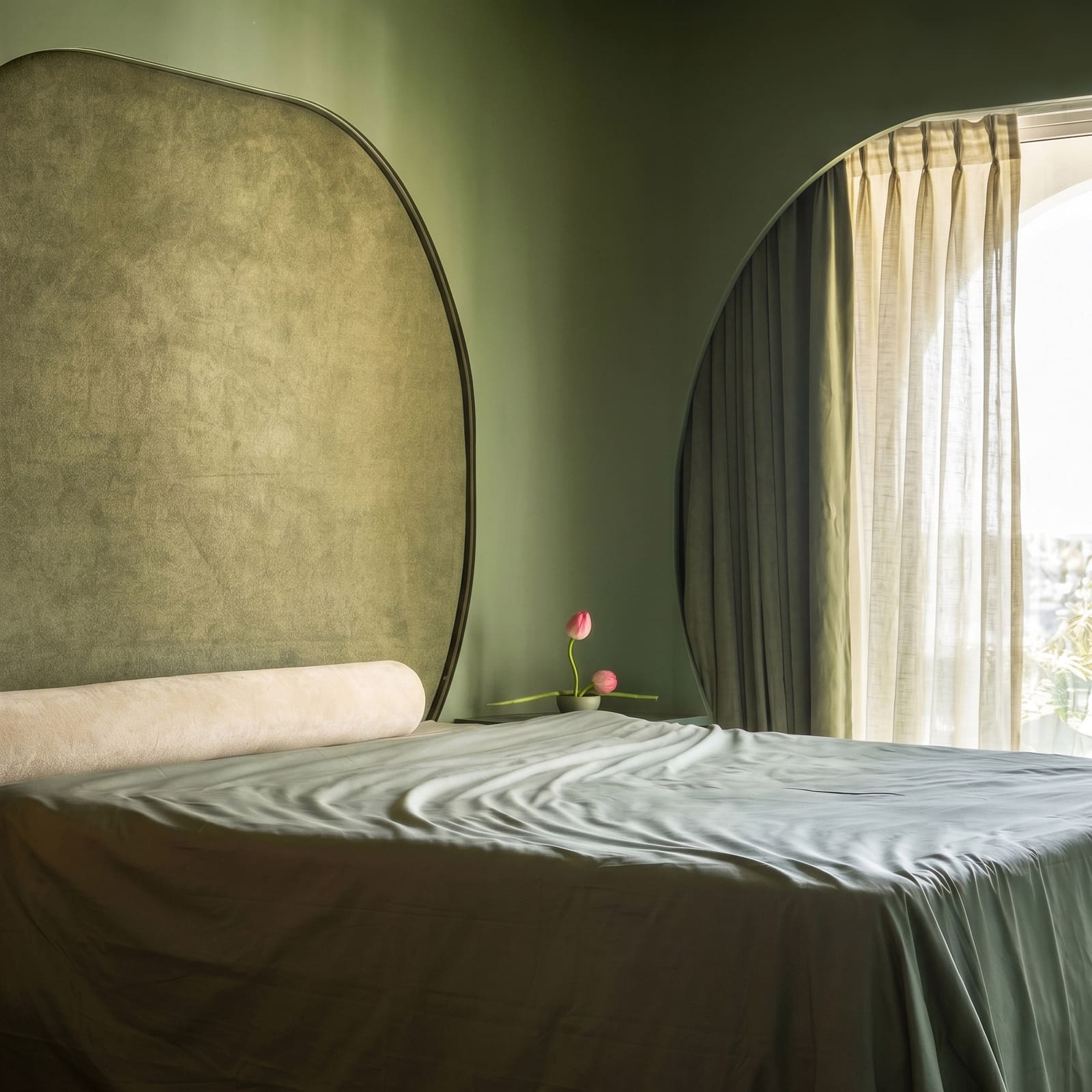
The grandparents' bedroom was conceived as the quietest zone, with muted tones and handcrafted timber furniture that privilege rest over activity. Rounded windowpanes and mirrors soften the room's geometry, a subtle echo of the lily pad motif that recurs throughout the apartment without becoming prescriptive.
For the younger couple, the bedroom incorporates a custom wardrobe system that conceals a full walk-in dressing area behind sliding timber panels. The move preserves visual simplicity while maximizing function, a spatial sleight-of-hand that reflects the studio's broader commitment to density as a design challenge rather than a limitation.
Accessibility informed several key decisions. A curved wall in the dining area was introduced not for aesthetic reasons but to enlarge the adjacent bathroom, making it navigable for wheelchairs. The gesture is instructive: formal moves can serve multiple agendas simultaneously when designers remain attentive to lived experience.
Against the Permanent Television
In the living space, The Act of Quad opted for a concealed home theatre system rather than a wall-mounted screen, a choice rooted in cultural observation. Traditional multi-generational Indian homes prioritize conversation and shared activity over passive media consumption, and the studio sought to reinforce that dynamic through the absence of a fixed focal point.
The decision reflects a broader stance on luxury, one that Itadkar and Bhatia articulated as residing in personalization and emotional resonance rather than in square footage or material excess. In increasingly compact urban environments, they argue, the meaningful work lies in crafting spaces that respond to the specific rhythms and relationships of their inhabitants.
This philosophy extends to the project's bespoke elements. Rather than sourcing off-the-shelf solutions, the studio designed furniture and fixtures tailored to the family's routines and preferences, treating customization as a form of spatial intimacy.
Precedent and Practice in Compact Indian Urbanism
Founded in 2019, The Act of Quad has built a practice around the spatial constraints of Mumbai, a city where residential real estate is among the most expensive globally and where multi-generational living remains normative. Their portfolio includes a self-designed studio carved from a former library and another high-rise residence organized vertically to accommodate extended family.
A Borrowed Memory sits comfortably within that lineage, demonstrating how regional material culture and landscape typologies can inform contemporary interiors without devolving into pastiche. The Kerala references are present but oblique, operating as formal principles rather than decorative overlays.
The project also invites comparison to other practices working within tight urban footprints. Studio Mumbai, for instance, has long explored the intersection of craft tradition and spatial economy, while firms like SPASM Design Architects have addressed multi-generational housing through flexible planning and material restraint. What distinguishes The Act of Quad's approach here is the clarity of its conceptual framework: the backwaters are not backdrop but organizational logic, a way of thinking about continuity, adjacency, and the relationship between stillness and movement.
The Limits of Borrowed Memory
There is a risk inherent in translating landscape into interior architecture, particularly when that landscape carries cultural and ecological weight. The Kerala backwaters are not merely picturesque; they are working ecosystems, sites of livelihood and environmental vulnerability. To borrow their imagery without acknowledging their complexity can feel extractive, a reduction of place to aesthetic resource.
The Act of Quad navigates this tension through restraint. The apartment does not attempt to recreate the backwaters or to transport its occupants elsewhere. Instead, it borrows formal qualities, fragments of memory and sensation, and integrates them into a spatial proposition that remains rooted in its Mumbai context.
Whether this constitutes a meaningful engagement with place or a more superficial borrowing is open to interpretation. What is clear is that the studio has produced a home that functions well for its inhabitants, that demonstrates material and spatial intelligence, and that offers a model for how compact urban housing can accommodate complexity without resorting to subdivision or compromise.
In a city where residential design often prioritizes efficiency over emotion, A Borrowed Memory suggests that the two need not be mutually exclusive. The challenge, as Itadkar and Bhatia note, is not to design without limits but to find opportunity within constraint. In that sense, the project is less about what was borrowed than about what was made possible through the act of borrowing.
Save this story. A free account keeps your reading list and the 07:00 email in one place.
CREATE FREE ACCOUNT →SIGN IN