Le Labo has long distinguished itself not just through its fragrances, but by turning its boutiques into immersive cultural spaces, and nowhere is this more evident than in how it repurposes historic architecture around the world. From Kyoto to Barcelona, its strategy is consistent: rather than erecting sterile luxury stores, Le Labo restores and reimagines heritage buildings, layering its minimalist “laboratory” aesthetic over regions’ rich architectural traditions.
In Kyoto, Le Labo occupies a 145-year-old machiya (traditional townhouse), transformed by Schemata Architects into a sensory refuge that feels deeply local and quietly experimental. The renovation preserves the building’s aged wooden beams and brickwork, while interiors lean into a warm palette of bengara (red-earth pigment) and sumi-like soot tones. Reclaimed Japanese wood replaces the usual industrial steel in workstations, and upstairs tatami rooms host rotating artisan exhibitions, all centered around a contemplative courtyard garden. In this space, the fragrance lab is not a trolley - it’s a ritual.

The machiya’s weathered exterior frames Le Labo’s subtle presence within Kyoto’s historical fabric

Inside, aged beams and soft light create a tranquil backdrop for Le Labo’s handcrafted fragrances

Tatami rooms and reclaimed timber bring a sense of ritual to Le Labo’s Kyoto fragrance lab
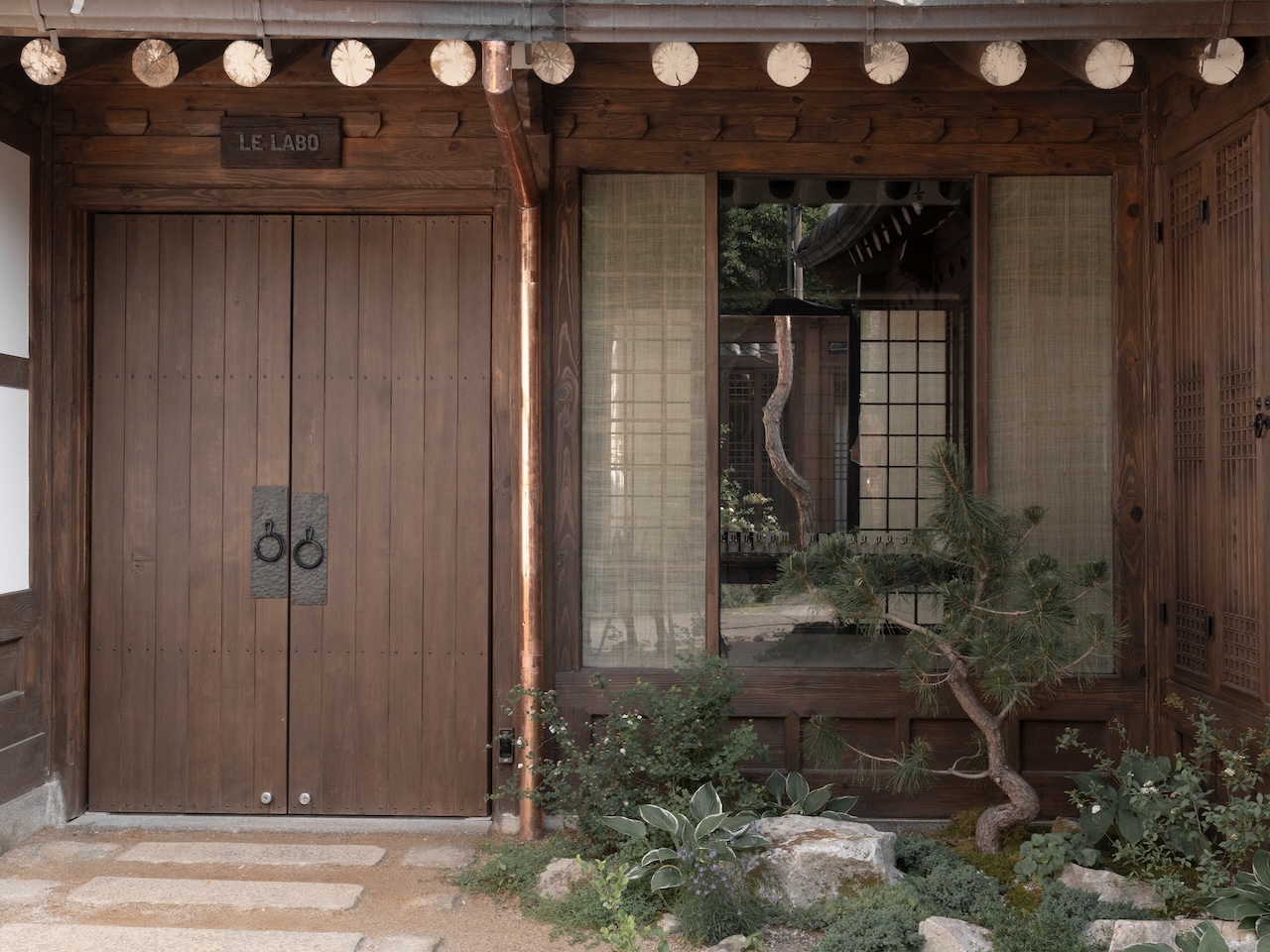
In Seoul, the brand’s flagship within Bukchon Hanok Village inhabits two joined hanok houses. Here, traditional building materials are honored: walls lined in hanji (mulberry paper), sambe (hand-dyed hemp) panels that soften light and sound, and a transparent wooden “organ” booth where perfumers blend scents. As in Kyoto, a quiet courtyard café invites customers to linger, turning the act of buying a bottle into a slow, meditative experience.

The Seoul boutique’s fragrance lab sits gently within the timber framework of two joined hanok houses

Hanji-lined walls and sambe textures infuse softness into Le Labo’s signature industrial palette

Natural materials and diffused light bring a meditative stillness to the Seoul lab
Le Labo’s Beijing presence moves even deeper into tradition, nestled in a restored siheyuan (courtyard mansion). The layout mirrors classic Chinese spatial logic, with rooms dedicated to its various product lines. There's a “Qi Shi” room evoking an old apothecary, a “Habitat” lounge for home fragrance, and a “Jian Di” dressing-room area. The central courtyard, framed by wooden columns and native plants, feels like a retreat, where scent, craft, and calm converge.

Le Labo’s Beijing laboratory unfolds within a restored siheyuan, echoing centuries of courtyard living

Classic roof tiles and timber pillars frame the entrance, creating a poetic threshold between heritage and contemporary perfumery

The Beijing lab’s interiors merge utilitarian craftsmanship with the poise of classical Chinese architecture
Over in Barcelona, in the heart of the Eixample district, Le Labo revives local Modernisme in its boutique. The store preserves Catalan-style ceilings with terracotta tiles and exposed beams, and incorporates hand-painted local tiles. Vintage furniture and floral artworks draw from Catalan craft traditions, all while maintaining the brand’s laboratory-like blending counter and signature slow ceremony.

Le Labo’s Barcelona storefront sits gracefully within an Eixample block, framed by Modernisme-era architecture

Subtle textures and earthy tones evoke the artisanal spirit of Catalan ateliers
Shanghai adds another compelling chapter to this story. Le Labo’s first mainland China store is housed in a historic Shikumen building on Xintiandi, once part of a 1920s “Open House” museum. Rather than modernize aggressively, Le Labo preserved the original wood ceiling, decorative windows, and a sense of Shanghai’s early 20th-century urban fabric. The two-story building divides into a classic showroom on the ground floor and a perfumer’s lab above, complete with essential oil bottles, tools, and a “Fragrance Organ” corner. But the Shanghai store goes beyond scent: it also includes a café serving vegan treats, a reading lounge with curated lifestyle books, and design touches that nod to old Shanghai, like a vintage typewriter and rotary telephone.

Le Labo’s Shanghai boutique pairs its quiet modern identity with the textured brick and stone of a preserved Shikumen house

Original wooden ceilings and period details set the tone for a fragrance lab steeped in Shanghai nostalgia

The Shanghai store’s interiors layer nostalgic elements - from patinated metal to monochrome tile - with meticulous fragrance tools
More recently, Le Labo deepened its local integration by collaborating with the Chinese artisan label Gathering to open a concept store in a heritage villa on Wukang Road. There, perfume and porcelain share the same cabinet: one wall displays traditional calligraphy reading “Shi Yi” (a Shanghainese phrase meaning “at ease”), grounding the space in local sentiment.

At Wukang Road, a heritage villa houses a concept store where scent meets local craftsmanship

Muted light and vintage décor invoke a bygone era, turning the fragrance experience into a quiet narrative of the city
The Strategy & Meaning Behind Le Labo’s Localized Stores
Authenticity through architecture
By choosing historic buildings rather than generic retail spaces, Le Labo aligns its own values - craftsmanship, time, imperfection - with the architecture that carries local memory. These stores feel authentic, not staged.
Sensory storytelling
The brand doesn’t just sell perfume; it crafts experiences. Walking into the Kyoto machiya or Beijing courtyard isn’t just shopping, it’s a sensory journey through place, history, and craft. The architecture becomes part of the narrative.
Cultural respect & dialogue
Le Labo’s approach shows respect: they preserve original materials, collaborate with local artisans, adapt to local customs (like in Kyoto, negotiating where shoes are removed), and integrate traditional spatial practices.
Brand cohesion, local variation
Despite the differences in architecture, each store still feels “Le Labo” - raw materials, vintage touches, blending labs, and minimal branding are consistent. Yet, each architecture reflects its context. This balance between global brand identity and local character is powerful.
Emotional connection
For customers, visiting these boutiques is not transactional. The spaces invite reflection, calm, and intimacy. That emotional connection strengthens brand loyalty and elevates the act of buying perfume into a ritual, not just commerce.
Le Labo’s retail philosophy is more than design-led branding - it’s a deeply cultural strategy. By embedding itself within historic buildings across different regions, the brand honors local traditions, archives, and spatial memories. At the same time, Le Labo’s DNA - its industrial minimalism, its slow-perfumery ethos - remains intact, creating a bridge between heritage and modern craft. These stores are not just shops; they are laboratories of memory, where scent, time, and place converge.
Save this story. A free account keeps your reading list and the 07:00 email in one place.
CREATE FREE ACCOUNT →SIGN IN