Abstract
As the world faces mounting pressure to reduce carbon emissions and reimagine material lifecycles, the promise of recycled plastics in architecture and structural engineering has emerged as both a sustainability beacon and a source of skepticism. This journal explores the myths and realities surrounding recycled plastics as structural materials, tracing their evolution, mechanical potential, limitations, and the lessons they offer to contemporary design practice. Through case studies and comparative analyses, it interrogates whether recycled plastics can truly shift from waste to worth.
Introduction: Beyond the Bin
The global plastics crisis has reached unprecedented scale. With over 400 million tons of plastic produced annually, only about 9% is recycled - the rest ending up in landfills or oceans. Yet, as sustainability narratives deepen in architecture and design, recycled plastics are increasingly positioned not as pollutants, but as potential building blocks.
This shift is more than a material trend; it reflects a transformation in design thinking. No longer are architects confined to conventional materials like steel, concrete, or timber. The question now is: Can recycled plastics stand structurally and symbolically alongside them?
Myth 1: Recycled Plastics Are Structurally Weak
The Belief:
Plastics, especially recycled ones, are perceived as too weak, too brittle, or too inconsistent for load-bearing applications.
The Reality:
While it’s true that most plastics exhibit lower stiffness and compressive strength compared to traditional structural materials, advancements in composite engineering and polymer reinforcement have redefined their capabilities.
For instance, recycled HDPE (High-Density Polyethylene), derived from everyday containers, demonstrates high impact resistance, low moisture absorption, and impressive flexibility. When reinforced with glass or natural fibers, its tensile strength can rival that of timber.
Example:
The EcoARK Pavilion in Taipei, constructed from 1.5 million recycled PET bottles, stands as a lightweight yet structurally stable exhibition hall. Its wall system - made of interlocking POLLI-Bricks - showcases how plastic waste, when re-engineered through modular geometry and compressive interlocking, can serve as a viable structural medium.


A pavilion of air and plastic: EcoARK demonstrates how modular design amplifies the structural potential of low-strength materials
Photo Credit: Miniwiz
Design Lesson:
Strength is not only a property of material - it is a property of system design. Through intelligent form-finding, modular logic, and structural redundancy, designers can transform weaker materials into robust frameworks.
Myth 2: Recycled Plastics Degrade Over Time
The Belief:
Exposure to UV radiation, heat, and humidity will cause plastics to degrade, warp, or leach harmful compounds, compromising long-term performance.
The Reality:
Degradation is a legitimate concern, particularly for unmodified plastics. However, stabilized formulations and surface treatments now extend plastic lifespans beyond 50 years.
Recycling processes that involve controlled sorting and homogenization (such as single-polymer recovery systems) also produce more reliable material behavior over time.
Example:
In the “Plastique Fantastique” urban installations across Europe, pneumatic structures made from recycled PVC have endured multiple reuse cycles without significant material fatigue, thanks to UV-resistant coatings and careful material stewardship.


Photo Credit: Plastique Fantastique
Soft structures, strong message: recycled plastics reimagined as playful, transportable architecture
Design Lesson:
Durability in recycled materials depends not merely on chemical stability, but on maintenance protocols, lifecycle planning, and designing for disassembly. Architects must treat plastic components as living systems within a circular material loop.
Myth 3: Recycled Plastics Can’t Compete Aesthetically
The Belief:
Plastic looks cheap. It lacks the authenticity, warmth, and texture associated with “real” materials like wood, stone, or concrete.
The Reality:
Designers are redefining aesthetic expectations through tactile reinvention. Projects such as The New Raw’s “Print Your City!” initiative in Amsterdam uses large-scale 3D printing to transform municipal plastic waste into sculptural urban furniture, each object carrying the visual narrative of its recycled origin.


Through large-scale additive manufacturing, The New Raw transforms discarded plastics into vibrant civic artifacts
Photo Credit: Stefanos Tsakiris
In many cases, the imperfection of recycled plastic becomes its beauty. Speckled surfaces, layered translucencies, and irregular colorations serve as a visible archive of reuse, aligning perfectly with the values of contemporary sustainable design.
Design Lesson:
Aesthetic innovation lies in embracing material truth. Designers must not hide the recycled identity of plastics, they should celebrate it as texture, story, and manifesto.
Myth 4: Recycling Itself Is Unsustainable
The Belief:
Plastic recycling consumes more energy than it saves, and downcycling limits long-term reuse potential.
The Reality:
Traditional mechanical recycling does reduce polymer quality over cycles, but emerging chemical recycling and closed-loop manufacturing techniques offer pathways toward upcycling.
For example, PureCycle Technologies converts polypropylene waste into virgin-equivalent resin using solvent purification, reducing energy use by up to 35% compared to virgin production.
In architectural contexts, the use of thermoformed modular panels from local waste streams drastically reduces embodied carbon by minimizing transport and virgin material demand.
Example:
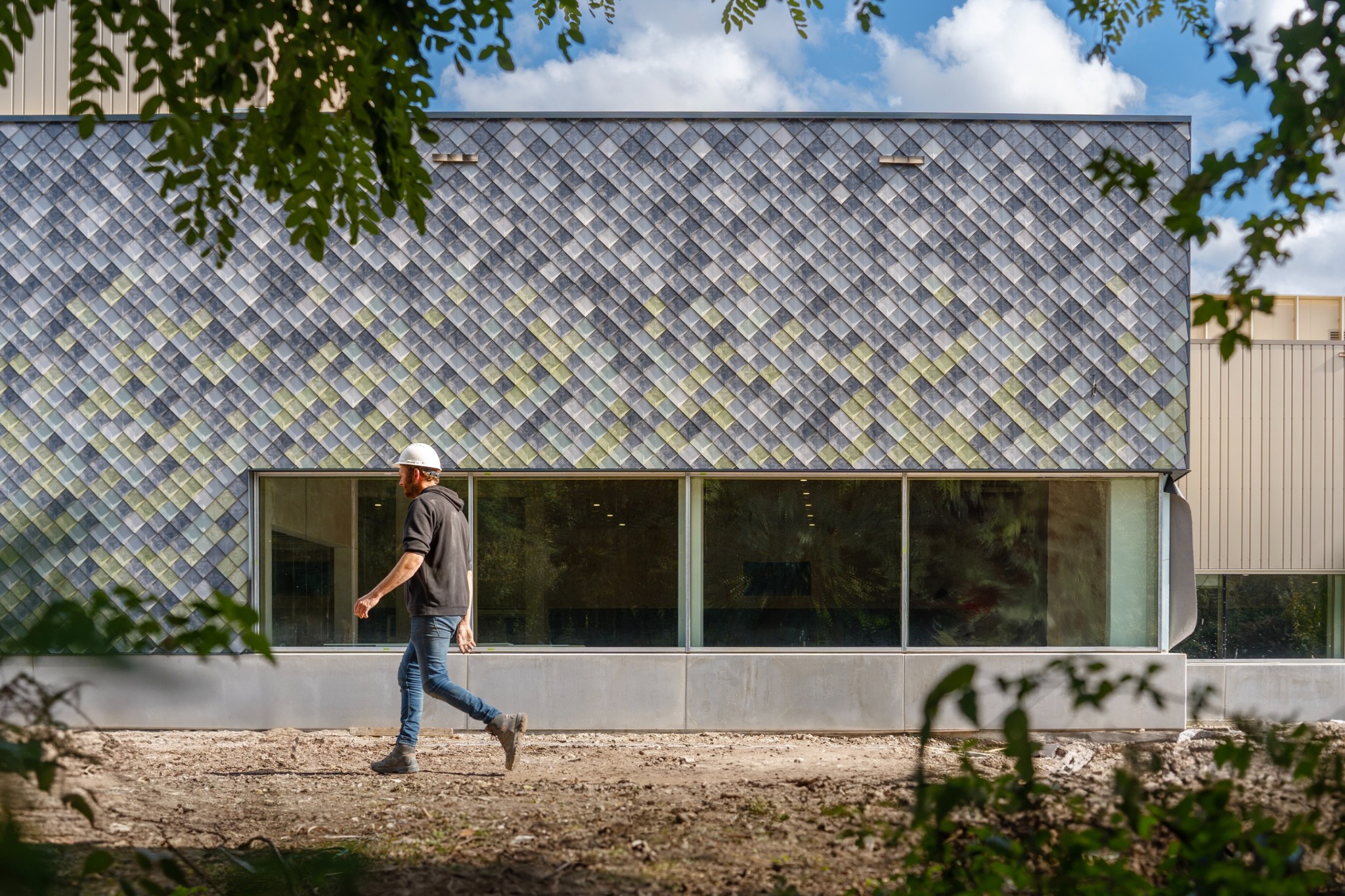
The Howest Campus Bruges in Belgium demonstrates how recycled plastics can achieve both durability and design finesse. Its façade, clad entirely in 100% recycled PVC tiles by FRONT® Materials, transforms post-consumer waste into a sleek, weatherproof surface - proving that circular materials can define a building’s modern architectural identity.

Recycled plastics redefined - the Howest Campus Bruges façade combines resilience, texture, and sustainability in every tile
Photo Credit: Jolien Chielens
Design Lesson:
Circularity is not an aesthetic constraint - it is a design opportunity. When materials are chosen with disassembly and reuse in mind, recycled plastics can transcend their origins as waste and become enduring elements of architectural identity.
Toward a New Structural Ethic
The conversation around recycled plastics isn’t simply about whether they “work” - it’s about rethinking the definition of structural integrity. Traditional architecture valorizes permanence; sustainable design seeks adaptability and regeneration.
Recycled plastics embody this paradigm: they are flexible, reprocessable, and inherently post-industrial. They urge architects to design with temporality, reversibility, and empathy for material afterlife.
Conclusion: From Myth to Material Culture
The myths surrounding recycled plastics stem not from science, but from cultural inertia. As technology advances and design intelligence deepens, these materials are stepping beyond experimental art and into the fabric of construction reality.
Recycled plastics are not the answer to all structural challenges, but they are a mirror to our evolving relationship with waste, form, and responsibility. The real question is no longer whether plastics can build - but whether we can build differently.
Save this story. A free account keeps your reading list and the 07:00 email in one place.
CREATE FREE ACCOUNT →SIGN IN