In architecture and design, pattern is often understood as surface decoration - a graphic layer applied after form is resolved. Yet some of the most compelling spaces emerge when repetition moves beyond ornament and becomes the very logic of structure. In these works, motifs are not applied; they are built, scaled, and inhabited. Repetition becomes a spatial strategy, shaping how buildings stand, breathe, and are experienced.
Pattern as Load-bearing Logic
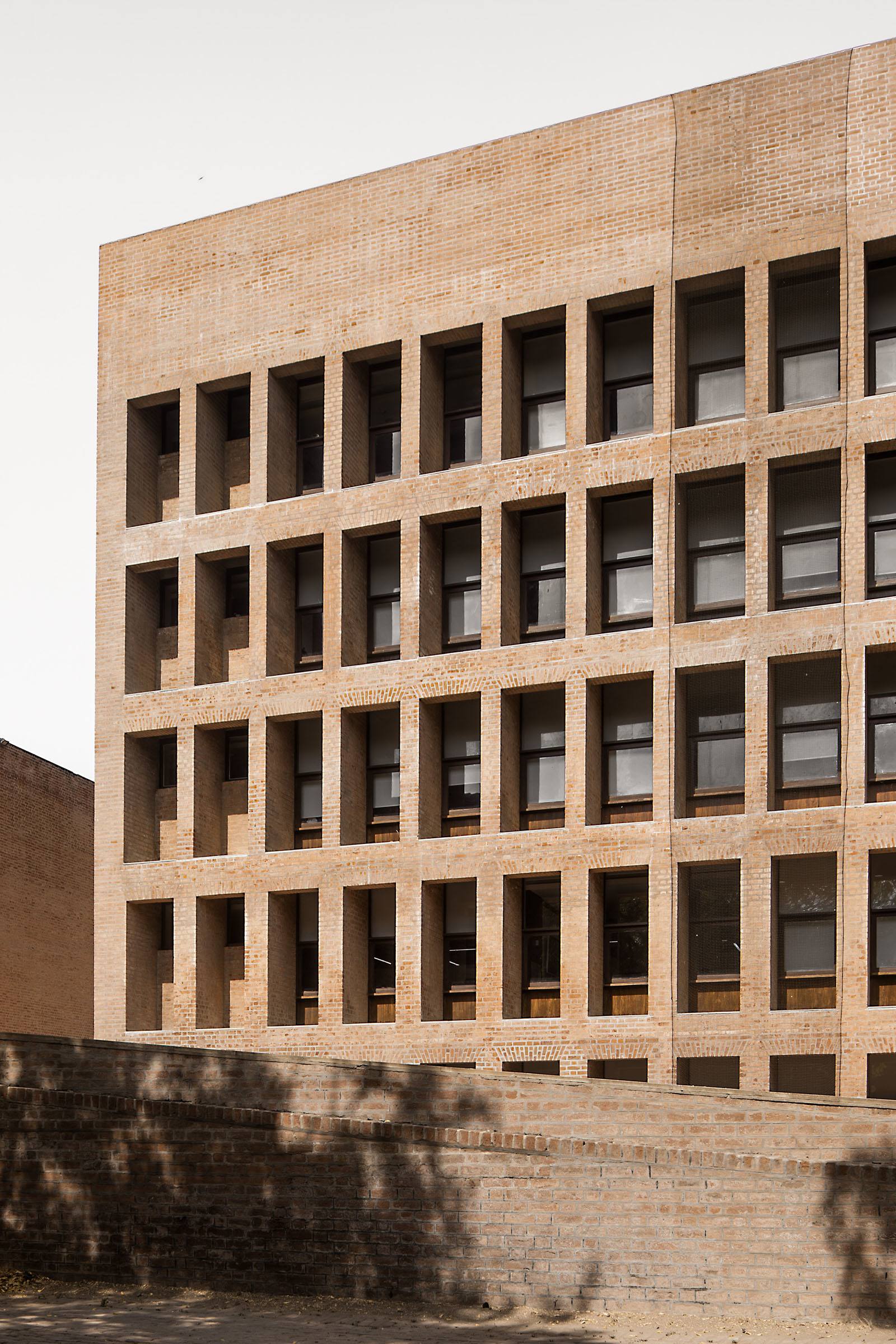
Few architects have explored repetition as rigorously as Louis Kahn. At the Indian Institute of Management Ahmedabad, brick arches and circular openings repeat across facades and corridors. These geometric motifs are not decorative gestures; they define structural bays, modulate light, and establish a rhythmic order that organizes the entire campus. The repetition creates coherence at an urban scale while allowing subtle variations in use and atmosphere.

Repeating brick arches establish a rhythmic structural order, shaping circulation, light, and campus identity
Photo Credit: Jeroen Verrecht
Similarly, Peter Zumthor’s Kolumba Museum in Cologne uses a repeating perforated brick pattern to form walls that are simultaneously enclosure, structure, and filter. The motif allows light and air to pass through while maintaining mass and solidity, turning repetition into a mediator between past and present, inside and outside.

Perforated brick walls repeat as structure and filter, mediating light, air, and historical layers
Photo Credit: Rasmus Hjortshøj - COAST
Modular Systems and the Power of Accumulation
In contemporary architecture, repetition often appears through modular systems. Sou Fujimoto’s Serpentine Pavilion 2013 was composed of repeated steel elements arranged in a loose grid. The motif - a simple cubic frame - gained architectural meaning through accumulation, blurring boundaries between wall, roof, and furniture. Structure dissolved into pattern, and pattern became space.

A grid of repeated steel elements blurs structure, enclosure, and furniture into a single spatial system
Photo Credit: Iwan Baan
At a more permanent scale, Habitat 67 by Moshe Safdie demonstrates how repeated concrete modules can form a complex, inhabitable structure. Each unit is identical, yet their stacked repetition produces terraces, voids, and a sculptural urban form. Here, pattern operates three-dimensionally, shaping both structure and lifestyle.

Stacked concrete modules repeat to form a three-dimensional pattern of dwellings, terraces, and voids
Photo Credit: Safdie Architects
Facades as Structural Pattern
Some buildings express repetition most clearly at the facade, where pattern becomes a structural and environmental device. Herzog & de Meuron’s Elbphilharmonie in Hamburg features a repeating glass motif that responds to acoustic, structural, and climatic requirements. While visually rhythmic, each panel is technically calibrated, proving that repetition does not imply uniformity.

A repeating glass facade motif balances structural logic, acoustic performance, and visual rhythm
Photo Credit: Maxim Schulz
Likewise, Al Bahr Towers in Abu Dhabi reinterpret the traditional mashrabiya as a kinetic structural skin. Repeating triangular units open and close in response to sunlight, transforming a cultural pattern into an active, performance-driven facade that reduces heat gain while defining the building’s identity.

Responsive mashrabiya units repeat across the facade, transforming traditional pattern into kinetic structure
Photo Credit: AHR
Interior Systems: When Detail Defines Space
In interior design, repeating motifs often become spatial frameworks. Kengo Kuma frequently employs repetition of timber elements to dissolve solid form into texture. In the Yusuhara Wooden Bridge Museum, layered wooden slats repeat to form walls, ceilings, and structure, creating continuity between architecture and material expression.

Layered timber slats repeat to dissolve mass into texture, merging structure with material expression
Photo Credit: Takumi Ota
Retail and exhibition design also leverage repetition structurally. Aesop’s stores worldwide often use repeated bricks, shelves, or arches as both display systems and spatial organizers. The motif governs circulation, lighting, and tactility, reinforcing brand identity through architectural logic rather than graphic signage.

Repeated interior elements act as display, structure, and spatial organizer
Photo Credit: Studio Periphery
In domestic interiors, rhythmic structural elements can define space without relying on supergraphics or bold surface patterns. Relámpago House in Barcelona, designed by h3o Architects, uses zigzagging geometries and repeating angular elements to shape rooms, circulation, and built-in features. These repeated spatial cues - from jagged wall planes to integrated shelving and fixtures - create a dynamic yet coherent interior sequence that visually organizes space and evokes a sense of movement and continuity.

Angular interior planes repeat in soft pink tones, using rhythm and color contrast to define spatial movement within a compact home
Photo Credit: José Hevia
Repetition as Meaning, Not Redundancy
When pattern becomes structure, repetition is no longer redundant, it is intentional, legible, and meaningful. Small units gain power through consistency, while slight deviations introduce hierarchy and surprise. These projects demonstrate that architecture does not always need expressive forms; sometimes, clarity emerges from restraint and rhythm.
In an era increasingly defined by parametric complexity, repeating motifs offer an alternative path: one rooted in logic, material honesty, and human perception. When pattern becomes structure, architecture speaks not through singular gestures, but through systems - quietly powerful, endlessly adaptable, and deeply resonant.
Save this story. A free account keeps your reading list and the 07:00 email in one place.
CREATE FREE ACCOUNT →SIGN IN