The Greenwashing Mirage
Type "sustainable architecture" into any search engine and the results follow a predictable pattern: towering structures dressed in vertical gardens, balconies spilling over with foliage, glass facades softened by climbing vines. The aesthetic has become so pervasive that it now defines public perception of environmental responsibility in building. Yet the equation is fundamentally flawed. Surface-level vegetation cannot offset the carbon embedded in concrete frames, steel skeletons, and the complex mechanical systems required to keep large mixed-use developments operational year-round.
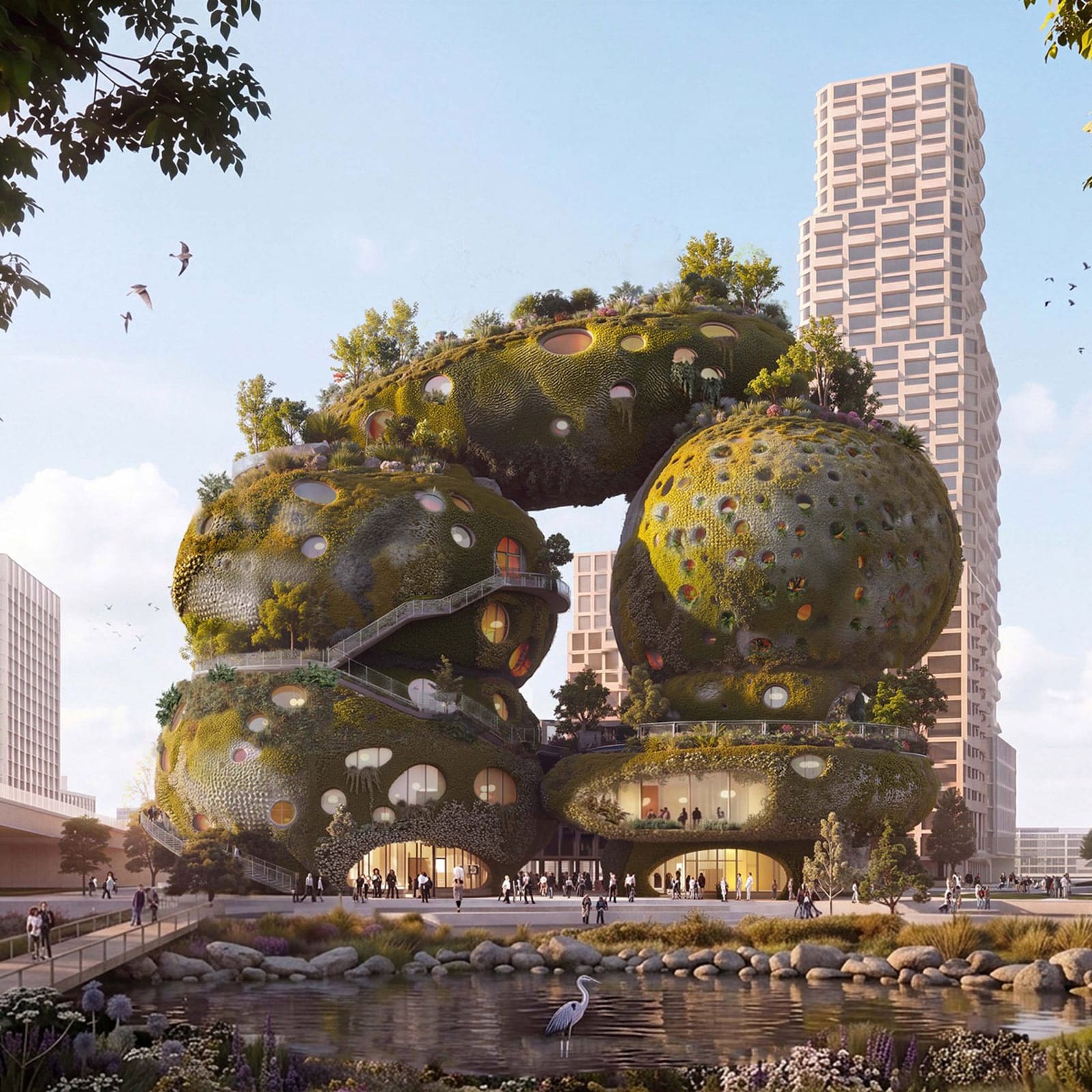
A recently announced project in Rotterdam crystallizes this tension. The Shift Embassy, designed through an international competition, proposes a 200-bed hotel, restaurant, offices, and 5,000 square meters of exhibition space intended to inspire visitors toward more sustainable lifestyles. The building's exterior features rock-like forms and abundant planting. Its client, social enterprise Shift, articulates a clear-eyed critique of fossil-fuel dependency and perpetual growth economics. The disconnect between that philosophy and the project's physical reality reveals how deeply conventional thinking still governs architectural ambition, even among organizations explicitly committed to ecological restraint.
Material Realities Beneath the Foliage
The rock-like surfaces turn out to be concrete. Project materials reference low-carbon concrete formulations, likely involving ground granulated blast-furnace slag or similar industrial byproducts as partial cement replacements. These substitutions can reduce the carbon intensity of individual mixes, but supply constraints complicate the broader calculus. The Institution of Structural Engineers notes that GGBS availability already approaches capacity limits. When one project sources these materials, another may be forced back to conventional high-carbon cement. The net environmental benefit across the construction sector becomes marginal or nonexistent.
Similarly, the structural system relies on reclaimed steel. Reusing existing beams avoids the energy cost of remelting, and in isolated cases offers genuine carbon savings. Yet the global steel economy already reclaims or recycles most available scrap. Roughly 70 percent of new steel still originates from virgin ore because secondary sources cannot meet demand. A project that claims reclaimed steel as an environmental victory often merely redirects a finite resource that would otherwise serve a different building. The material choice reflects good intention but limited systemic impact.
These are not trivial distinctions. In an industry responsible for 37 percent of global carbon emissions when construction and building operations are combined, marginal improvements risk becoming alibis for business as usual. The architectural profession has grown adept at deploying technical language around embodied carbon, circular economy principles, and biophilic design. The terminology can obscure a simpler question: should this building exist at all?
The Programmatic Paradox
Shift's stated mission critiques the logic of perpetual economic growth and warns of ecological catastrophe. The organization's proposed building program, however, embraces mechanisms that depend on exactly that growth. A 200-bed hotel and international exhibition space designed to attract 25 million visitors over 50 years implies massive tourist flows. The assumption requires continued expansion of global travel infrastructure,航空 capacity, and the disposable income that enables leisure mobility. These systems are themselves among the most carbon-intensive aspects of contemporary life.
The Shift Embassy sits within Rotterdam's Waterkant development, a new district where no existing structure could be adapted for the organization's needs. That constraint is revealing. Choosing to locate in a greenfield urban expansion effectively predetermined the need for new construction. An alternative approach might have prioritized neighborhoods with underutilized building stock, where renovation could achieve programmatic goals without adding to the built environment's material footprint.
The project does incorporate some thoughtful operational strategies. Exhibition spaces will tolerate broader temperature ranges across seasons, reducing heating and cooling loads. The restaurant will serve only plant-based food, addressing the significant carbon footprint of animal agriculture. Extensive planting around the site could provide localized cooling and habitat. These measures matter. Yet they function as mitigation within a framework that remains fundamentally extractive, adding thousands of tonnes of embodied carbon to the atmosphere before a single visitor arrives.
The Influence Equation
Shift has attempted to quantify the project's net impact through visitor behavior change. The organization estimates that 20 percent of attendees will reduce their personal carbon footprints by two tonnes annually as a lasting result of their visit. Over 50 years, this behavioral shift would theoretically offset the building's construction and operational emissions by a factor of 10,000. The calculation rests on pilot programs where participants achieved an average 30 percent emissions reduction.
The methodology raises questions. Behavioral change research consistently shows that short-term interventions produce effects that decay over time. Attribution becomes especially difficult when participants self-select into sustainability programs or visit purpose-built educational venues. Even if the 30 percent reduction holds among pilot participants, extrapolating that figure to millions of casual visitors assumes a level of engagement and follow-through that few museums or interpretive centers achieve.
More fundamentally, the calculation ignores the building's cultural influence. Architecture communicates through form, material, and scale. A prominent concrete and steel structure, however well-intentioned, reinforces public perception that serious sustainable design involves large new buildings with advanced technical systems and decorative greenery. This message reaches far beyond the 25 million projected visitors. It shapes how developers, planners, and policymakers understand environmental responsibility in the built environment. The symbolic impact may ultimately dwarf any measurable visitor behavior change, and it points in the wrong direction.
What Sustainable Architecture Actually Requires
The most effective climate action in architecture often involves decisions not to build. Adaptive reuse of existing structures avoids the massive upfront carbon cost of new construction. Even modest interventions such as improved insulation, window upgrades, or passive ventilation strategies can dramatically reduce operational energy use in older buildings. These approaches lack the visual drama of signature projects, which may explain their absence from design competitions and architecture media. Yet their cumulative environmental benefit far exceeds that of showcase buildings with marginal material improvements.
We have documented projects across Europe and Asia where careful renovation of postwar housing, obsolete industrial buildings, and underperforming commercial blocks achieved net-zero operational carbon at a fraction of the embodied cost required by new construction. A 1960s office building in Manchester, stripped to its frame and reclad with high-performance envelopes, now operates with 80 percent less energy than comparable new builds. A Amsterdam warehouse conversion into affordable housing reused 90 percent of existing structure and skin, adding only targeted thermal and acoustic upgrades. These projects receive less attention than green-draped towers, but they represent architecture's most credible response to climate breakdown.
Shift's pilot programs reportedly cost a small fraction of the 240 million euros projected for the Embassy building. If those programs genuinely produce 30 percent emissions reductions among participants, scaling them up without the building would deliver greater climate benefit at lower cost. The organization could fund hundreds of community-scale interventions, distributed across regions and demographics, testing and refining approaches to behavior change without the carbon penalty of a major construction project. This would align with degrowth principles in ways a tourist-oriented landmark cannot.
The Courage to Cancel
Architectural projects gain momentum through competitions, funding commitments, and public announcements. Reversing course after a design wins international attention requires institutional courage. Yet abandoning the Shift Embassy now, with full transparency about the reasoning, could serve as a more powerful educational intervention than the building itself. The decision would demonstrate that sustainability means prioritizing measurable environmental outcomes over institutional visibility, and that degrowth applies to building programs as much as to consumption patterns.
Other precedents exist. In 2019, a proposed expansion of London's Design Museum was shelved after carbon accounting revealed the embodied emissions could not be justified against the modest programmatic gains. A university in Oslo canceled a new research facility in 2022, redirecting funds toward renovating and densifying existing campus buildings. These decisions attracted less media coverage than the original proposals, but they signal a maturing understanding of architecture's role in climate mitigation.
The Shift Embassy's cancellation would carry particular weight because the client has already articulated a sophisticated critique of growth economics and environmental harm. The organization is positioned to lead by example, showing that genuine commitment to sustainability sometimes means stepping back from projects that would enhance visibility and prestige. That narrative, widely shared, could influence how other institutions evaluate proposed buildings, shifting the calculus from "How can we make this new project less bad?" toward "Do we need to build at all?"
Redefining Iconicity
Architecture's cultural authority has long derived from the power to create monuments, landmarks, and iconic forms. The profession's self-image remains tied to signature projects that reshape skylines and attract international attention. This framework persists even as climate science makes clear that the material and energy intensity of new construction cannot continue at current scales.
A genuine shift in architectural values would recognize that the most iconic projects of the next decades may be those that demonstrate restraint: brilliant adaptive reuse, strategic demolition to reduce urban cooling loads, landscapes that replace redundant parking infrastructure. These interventions require as much design intelligence as any new building, but they operate from a fundamentally different premise about architecture's purpose and impact.
Rotterdam already contains hundreds of underutilized structures. The city's postwar housing estates, aging commercial districts, and obsolete industrial zones represent enormous latent potential. A sustainability organization committed to challenging conventional growth logic could pioneer new models of incremental urban transformation within that existing fabric, creating spaces for education, collaboration, and demonstration without adding to the material burden. The approach would be less visually striking in renderings, but far more credible as a response to ecological crisis.
The Basil Leaf on the Steak
The comparison is apt. Superficial gestures toward sustainability, whether in diet or design, can provide psychological comfort without addressing underlying systems. A plant-based garnish does not transform animal agriculture's climate impact. Similarly, vegetation on building facades does not fundamentally alter the carbon calculus of large-scale new construction in concrete and steel.
The architectural profession has become skilled at deploying these gestures. Green roofs, living walls, and atrium gardens serve legitimate functions in specific contexts: managing stormwater, moderating building microclimates, providing urban habitat. But when such features become the primary visual and rhetorical strategy for claiming environmental responsibility, they function as distraction. They allow designers, clients, and the public to avoid harder questions about program, scale, and whether a project should proceed.
At World Archi Design, we have seen this pattern repeat across continents and building types. A mixed-use tower in Singapore wraps balconies in cascading plants while its core remains a conventional concrete tube with energy-intensive climate control. A cultural center in São Paulo features a green facade that requires irrigation infrastructure and maintenance regimes as complex as the building's mechanical systems. These projects may represent incremental improvements over purely conventional designs, but they do not constitute the paradigm shift that climate science demands.
The shift that matters involves different design questions, different metrics for success, and different definitions of architectural achievement. It prioritizes longevity over novelty, adaptation over replacement, and collective benefit over individual authorship. It recognizes that in an age of ecological breakdown, the most responsible architecture may be invisible, working within existing structures to extend their life and improve their performance. This is not an aesthetic agenda. It is a reckoning with material reality and atmospheric limits.
Rotterdam's proposed Embassy could still serve a purpose, but not as a building. Its cancellation, transparently explained and widely publicized, would constitute a more significant contribution to sustainable architecture than any amount of low-carbon concrete or reclaimed steel could achieve. The question is whether Shift has the institutional courage to make that choice, and whether the architecture profession is ready to celebrate restraint as much as it has traditionally celebrated ambition.
Save this story. A free account keeps your reading list and the 07:00 email in one place.
CREATE FREE ACCOUNT →SIGN IN