In recent years, architecture has undergone a subtle yet profound shift away from rigid orthogonality toward a language of softness. Curves replace corners, surfaces appear draped rather than assembled, and geometry becomes a tool for comfort as much as construction. This movement - often described as soft architecture - does not reject precision or technology; it uses them to produce spaces that feel intuitive, sensorial, and deeply humane.
Beyond the Right Angle
Modernism’s legacy of straight lines and hard edges was born from industrial logic and efficiency. Soft architecture responds to contemporary needs: emotional well-being, spatial fluidity, and adaptability. Gentle geometry encourages movement rather than direction, continuity rather than separation. Curves guide the body subconsciously, reducing visual tension and creating spatial calm.
Advances in digital modeling and fabrication have made these forms not only possible but precise. Parametric tools allow architects to design complex curvatures that are structurally efficient and materially economical, transforming what once felt expressive or sculptural into an everyday architectural language.
Draped Forms: Architecture as Fabric
One of the most compelling aspects of soft architecture is its resemblance to textiles - walls that ripple, canopies that float, and volumes that seem wrapped rather than built.
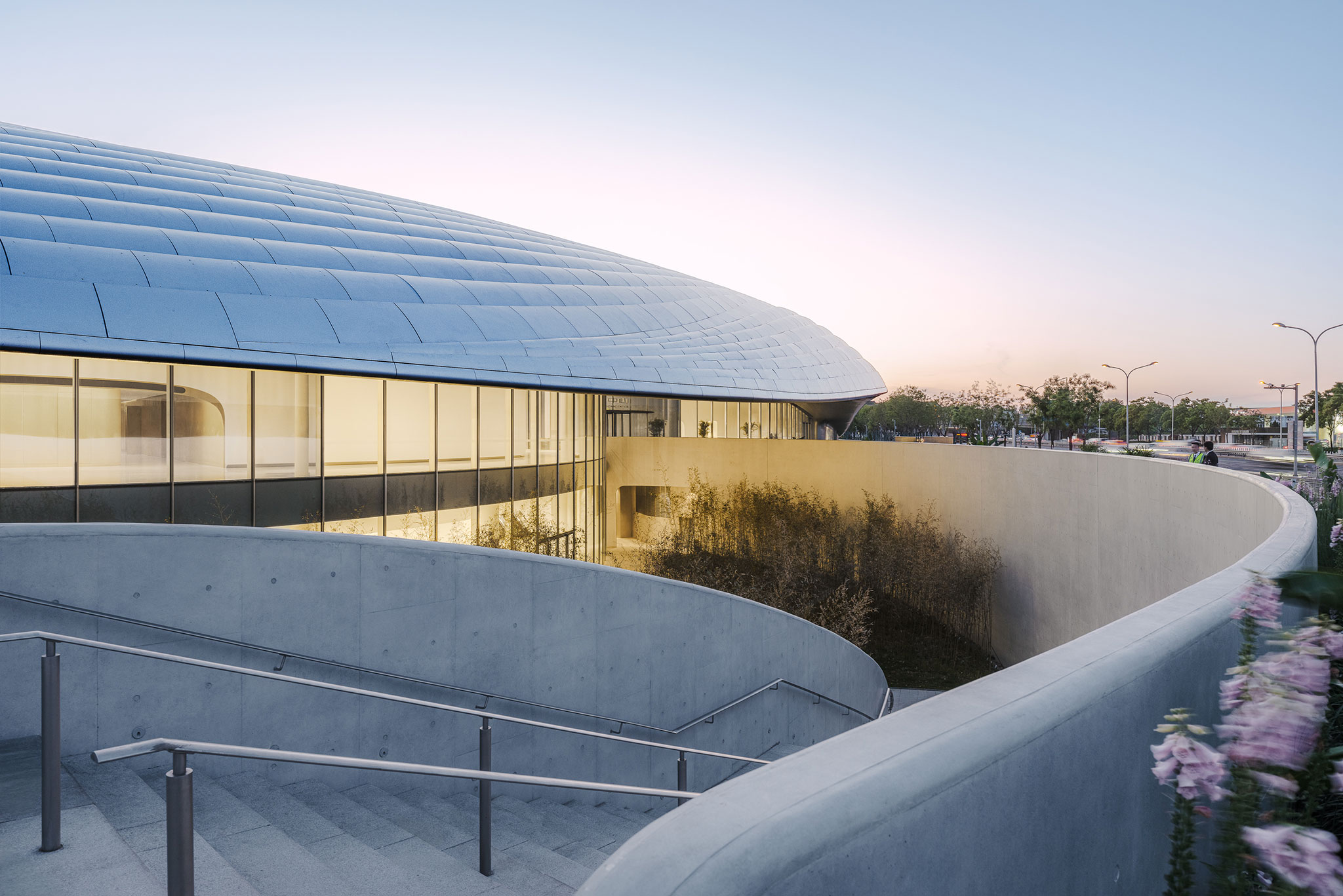
ZGC Innovation Center (Beijing) - Designed by MAD Architects, this recently completed innovation campus features a wide, floating roof with overlapping, “clover-leaf”-like forms that hover above open public spaces. Its draped overhangs provide shade and shelter while visually connecting landscape and structure in a fluid, organic gesture - a contemporary iteration of architecture as cloth in space.

ZGC Innovation Center. Photo Credit: Arch Exist
Thallo Boutique Hotel (China) - The Thallo Boutique Hotel, designed by BUZZ/Büro Ziyu Zhuang, embraces a sinuous, almost wave-like exterior that references the surrounding mountainous topography. Its fluid façade and gently curved massing integrate the building into its natural context, dissolving rigid boundaries between structure and site.

Thallo Boutique Hotel. Photo Credit: BUZZ/Büro Ziyu Zhuang
Taichung Green Museumbrary (Taiwan) - Opening in late 2025, this hybrid museum-library by SANAA embraces permeability and softness through interlocking volumes wrapped in an ethereal mesh façade that floats above a park setting. The interplay of light, air, and curved circulation paths dissolves traditional thresholds and creates an environment that feels continuous, open, and gently enfolding.

Taichung Green Museumbrary. Photo Credit: YHLAA
In each of these projects, the architecture behaves less like a machine and more like a fabric - responsive to context, inclusive in movement, and expressive in its continuous surfaces.
Curves in Domestic Space
Soft architecture has found particular resonance in residential design, where emotional comfort is paramount.
In Barcelona, Cometa Architects’ Éventail Apartment reinterprets a traditional chamfered corner through a radial plan. The apartment unfolds like a hand fan: curved partitions radiate from a central living space, creating fluid transitions between rooms while maximizing light. Here, curvature is not decorative, it reorganizes domestic life around movement, openness, and shared experience.

Éventail Apartment. Photo Credit: José Hevia
At a smaller scale, Atelier Matteo Arnone’s House for Two Musicians uses curved walls and arched thresholds to soften spatial transitions. The gentle geometry enhances acoustics and reinforces the rhythm of daily rituals, proving that softness can be both sensory and functional.

House for Two Musicians. Photo Credit: Federico Cairoli
Gentle Geometry as Spatial Ethics
Beyond aesthetics, soft architecture reflects a growing awareness that space shapes emotional and social behavior. Research in environmental psychology shows that curved forms and gradual transitions are perceived as calmer and more welcoming than sharp, rectilinear environments. Gentle geometry reduces visual stress, supports intuitive movement, and encourages interaction, turning architecture into an ethical act of care rather than mere form-making.
This approach is increasingly visible across public and institutional projects. Studio Gang’s David Rubenstein Treehouse at Harvard University uses rounded volumes, warm materials, and a central, open stair to foster informal exchange and a sense of belonging within an academic setting. In healthcare, North Zealand Hospital in Denmark organizes its large campus through sinuous circulation routes and green promenades, softening the institutional scale and reducing anxiety for patients and visitors alike.

David Rubenstein Treehouse at Harvard University. Photo Credit: Studio Gang

North Zealand Hospital. Photo Credit: Herzog & de Meuron
Even workplace environments benefit from these principles. Bloomberg’s European Headquarters in London, designed by Foster + Partners, employs sweeping ramps, rounded circulation paths, and soft-edged interiors to encourage movement and support engagement across its large workforce.
Together, these projects demonstrate that gentle geometry is more than a visual preference, it is a spatial ethic, shaping environments that are inclusive, calming, and fundamentally human.

Bloomberg’s European Headquarters. Photo Credit: Philippe Fragnière
Toward a More Human Architecture
Soft architecture is not a trend of excess or spectacle. It is a recalibration - an acknowledgment that buildings are experienced with the body as much as the eye. Through curves, draped forms, and gentle geometry, architecture becomes less about assertion and more about embrace.
In an increasingly complex world, these softened spaces offer clarity, comfort, and continuity, reminding us that the most advanced architecture may also be the most tender.
Save this story. A free account keeps your reading list and the 07:00 email in one place.
CREATE FREE ACCOUNT →SIGN IN