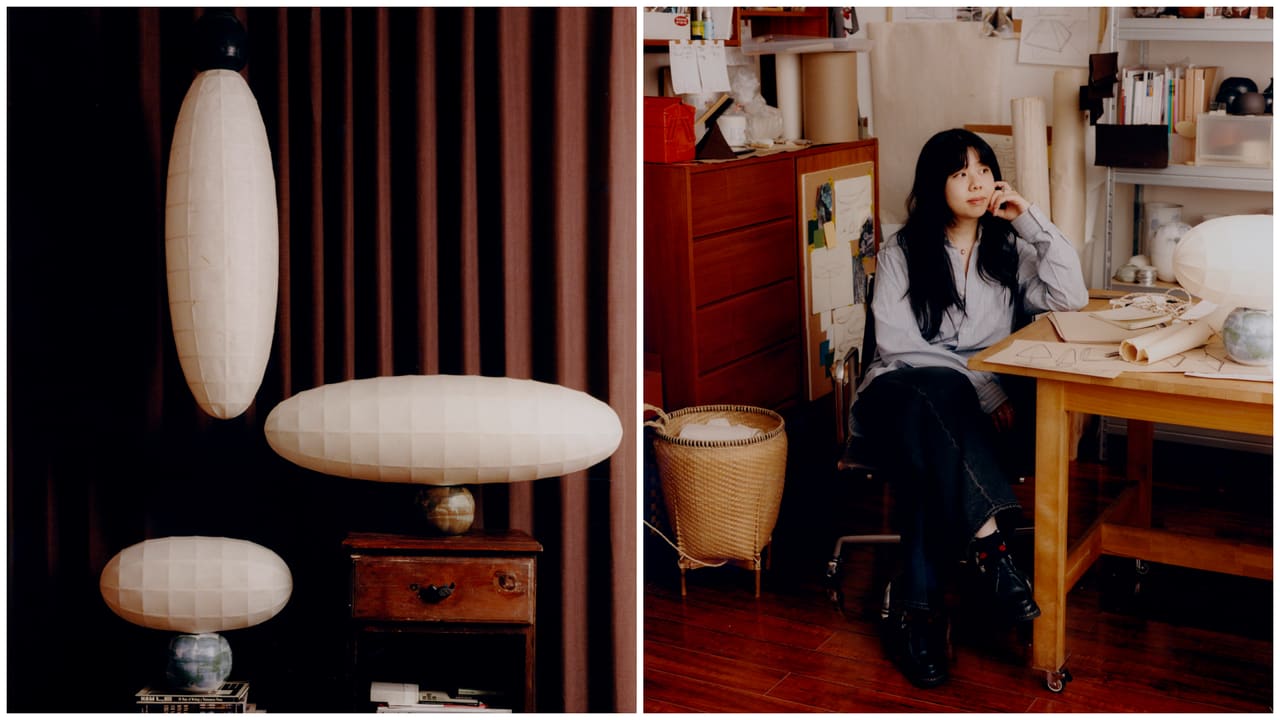
A Practice of Material Archaeology
When most designers speak of research, they mean mood boards and trend forecasts. Steffany Tran's version involves flying to Vietnam, sitting in archives, and interviewing anthropologists. The Vietnamese-American designer, who leads the New York studio Vy Voi, describes her methodology as akin to sweeping a metal detector across terrain others have walked past. What she unearths are material traditions with eight centuries of lineage, techniques that never entered the Western design canon, and formal languages that resist easy classification within the East Asian aesthetic umbrella.
Her most recent lamp collection draws its silhouettes from the way banana leaves fold when used to wrap bánh chưng, a traditional Vietnamese sticky rice cake. The reference is domestic, culinary, ephemeral - yet the resulting forms carry a sculptural weight that holds its own in a contemporary interior. This is the through-line in Tran's work: she isolates a vernacular gesture, a craft process, or a material innovation and translates it into objects that function as both lighting and cultural argument.
Between Saigon and San José
Tran's binational upbringing shaped her capacity to move fluidly between cultural contexts without adopting the distancing lens of an outsider. Born to refugee parents, she spent her childhood oscillating between San José, California, and summer months in Saigon with extended family. That duality - neither fully assimilated nor entirely rooted in a single place - became a creative asset. She learned to code-switch not just linguistically but materially, understanding how objects carry different meanings depending on who holds them and where.
After completing her industrial design degree in the San Francisco Bay Area, Tran relocated to New York and entered the corporate design pipeline, working at firms including Lippincott and Smart Design. The pace was relentless, the briefs problem-centric, the outputs often iterative refinements of existing typologies. It was competent work, but it left little room for the slower, more exploratory practice she craved. She began taking ceramics classes at a community centre, initially as a pressure valve. The focus there was Vietnamese pottery, specifically the loose, gestural glazing techniques that had been refined over generations. What started as a creative outlet gradually overtook her day job.
The Dó Paper Investigation
One material became a turning point: dó paper, a textured sheet made from the bark of the rhamnoneuron balansae tree. The technique has been practiced in Vietnam for more than 800 years, yet it remains largely unknown outside specialist circles. Tran tracked down one of the few families still producing it, spending time understanding the bark-harvesting process, the soaking and beating required to create pulp, and the drying methods that give the paper its distinctive surface quality.
She used dó to construct lamp shades, forming oblong shapes inspired by traditional Vietnamese kites - another overlooked design lineage. The paper's natural texture diffuses light in a way that feels both warm and architectonic, avoiding the overly precious quality that often accompanies handmade lighting. The forms are welcoming, rounded, and domestic in scale, but they carry a material specificity that resists easy replication. You cannot walk into a big-box retailer and find a dó lamp; the supply chain does not exist. That scarcity is part of the point.
Expanding the Decorative Canon
Tran's current obsession is 17th-century Vietnamese lacquer, a technique historically applied to musical instruments and furniture with inlaid decoration. Lacquer work in Vietnam developed along a parallel track to Japanese urushi and Chinese qiqi, but it employed different resins, different inlay materials, and different aesthetic priorities. Yet when Western collectors and institutions discuss lacquer, the Vietnamese tradition is often omitted from the narrative. Tran is working on a new body of work that foregrounds this material history, not as ethnographic artifact but as live design language.
Her argument is straightforward: if the design world has made room for Korean moon jars, Japanese joinery, and Murano glass, there is no structural reason why Vietnamese lacquer art or Lao weaving cannot occupy similar cultural real estate. The issue is not quality or historical depth - both are abundant - but visibility and advocacy. Tran positions her studio as a kind of material embassy, making the case through objects rather than essays.
The Anthropological Turn in Design Practice
What distinguishes Vy Voi from the broader wave of heritage-inspired design is the rigor of Tran's research apparatus. She does not rely on secondary sources or generalized "Asian" aesthetics. Each project begins with primary material: she visits libraries, consults with historians, and meets with artisans who hold institutional knowledge that has never been digitized or translated. This ethnographic method is more common in academic anthropology than in studio practice, but it produces objects with a different kind of authority.
The banana-leaf lamp collection, for instance, is not simply "inspired by nature" in the vague way that term is often deployed. It references a specific culinary technique, one tied to Lunar New Year traditions and regional variations in wrapping methods. The folds are not decorative - they are structural, a way of containing and steaming rice that has been optimized over centuries. Tran abstracts the geometry but retains the logic, so the final object carries a trace of its origin without becoming costume.
Reception and the Politics of Representation
Tran has noted that some of the most meaningful responses to her work come from people who recognize the references - Vietnamese diaspora communities who grew up with dó paper in school projects, or who remember the specific way their grandmother folded banana leaves. For these audiences, the objects function as a form of material recognition, a signal that their design traditions are not confined to the past or to the margins but can occupy the same cultural space as mid-century Danish furniture or Italian postmodern lighting.
This is not nostalgia. Tran is not attempting to recreate historical objects or preserve craft in amber. She is interested in what happens when you take a material technique out of its original context and place it in conversation with contemporary lighting typologies, with New York apartments, with the visual language of design media. The result is a hybrid practice - rooted in specificity but not bound by it.
What Comes Next
Vy Voi operates at a scale that allows for slow development and deep material engagement. Tran is not chasing trend cycles or licensing deals. Each collection emerges from a period of research that can span years, followed by prototyping that often involves collaboration with artisans in Vietnam. The studio model is closer to that of an artist or a small-batch ceramicist than a conventional product design firm.
The lacquer project currently in development will likely follow a similar trajectory: extensive research, material experimentation, and a final collection that introduces a historical technique to audiences who have never encountered it. If the pattern holds, the work will be formally restrained, materially confident, and historically grounded. It will also, almost certainly, prompt someone to ask why they have never heard of Vietnamese lacquer before. That question is part of the design.
Credit: Jingyu Lin
Save this story. A free account keeps your reading list and the 07:00 email in one place.
CREATE FREE ACCOUNT →SIGN IN