A Graphic Sensibility, Translated into Three Dimensions
There is a moment, when light strikes a fluted surface at a particular angle, when what lies behind begins to multiply. Edges soften, forms blur, and a single plane fractures into countless parallel planes. It is this precise optical phenomenon that Luca Ricci has made the organizing principle of his recent furniture work, two custom pieces that sit at the boundary between functional object and scenographic device.
Ricci's background spans art direction, branding, and graphic design, disciplines that train the eye to understand how images are constructed, how surfaces communicate, and how perception can be deliberately manipulated. His transition into furniture design carries that training forward. Rather than abandoning his earlier practice, he has extended it into objects that occupy physical space while retaining the visual logic of two-dimensional composition.
The first piece, Plissè Block, was commissioned for Fivefourfive's flagship store in Milan's Brera district. The second, Flower Block, was built for a collaborative performance at the Sanremo Music Festival. Though conceived for entirely different contexts, a menswear boutique and a televised music event, both pieces share a formal vocabulary rooted in transparency, repetition, and the controlled distortion of light.
Borrowing from Modernism, Rebuilding with Glass
Plissè Block began with a reference point familiar to anyone versed in twentieth-century furniture history: Le Corbusier's LC2 sofa. Ricci did not replicate the design. Instead, he extracted its underlying proportions, the ratios that give the LC2 its particular sense of balance and weight, and then rebuilt those proportions using an entirely different material system.
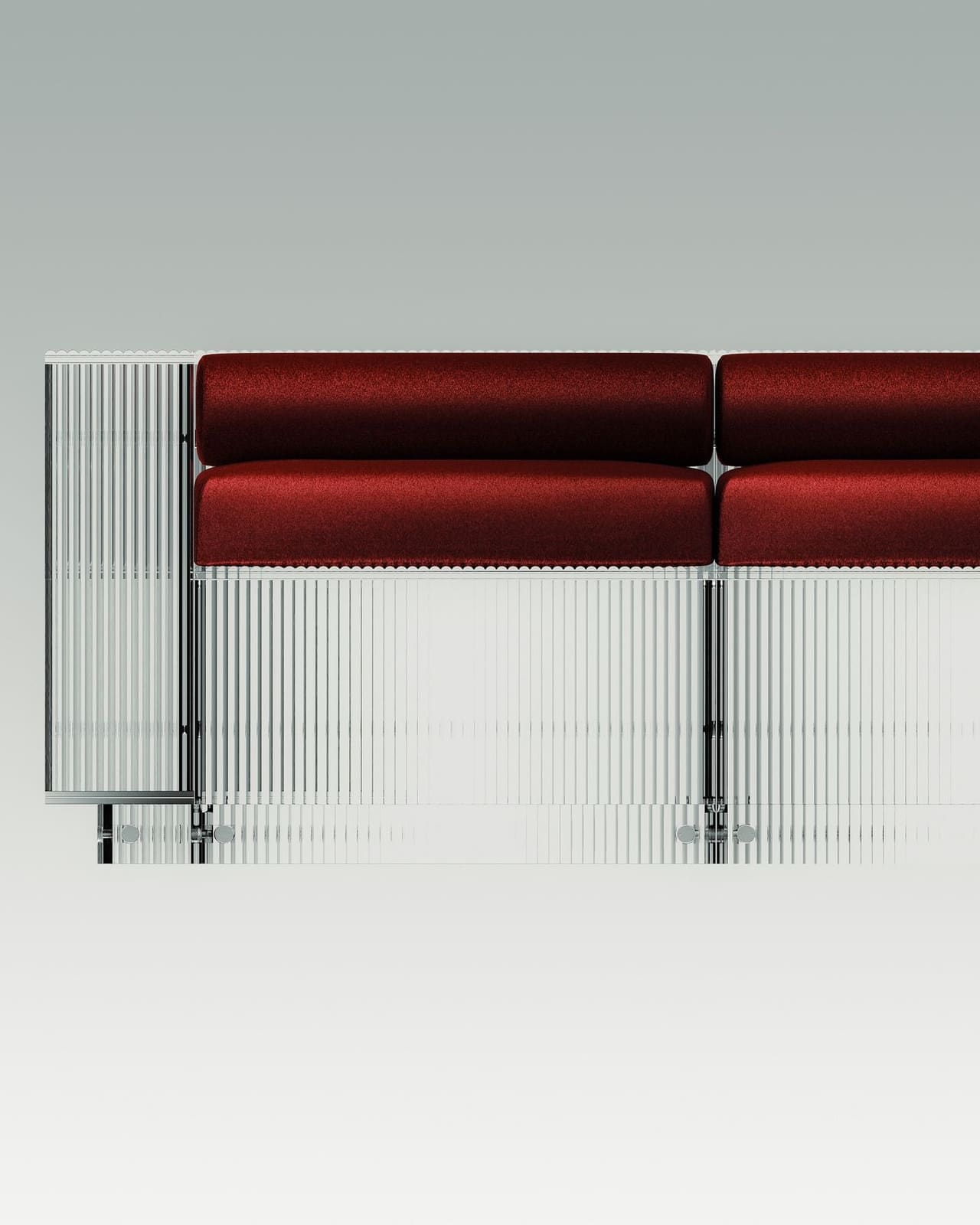
The result is a modular sofa composed of three sections, two side blocks and a central element, all mounted on hidden castors. The structure is made entirely of glass. An inner smooth layer provides the necessary structural support, while an outer fluted layer wraps each module in a pleated optical skin. The fluting creates a surface that reads as fabric, despite being rigid and transparent. Light passing through the ribbed glass bends and fragments, softening whatever lies behind and making the object appear to shift depending on the viewer's position and the quality of ambient illumination.
Against this cool, refractive shell, Ricci introduced six red velvet cushions: three rectangular seats and three cylindrical backrests. The velvet serves multiple functions. It offers the tactile warmth that glass cannot, it introduces a note of theatricality that anchors the piece in its retail context, and it sharpens the graphic contrast between hard and soft, transparent and opaque, cool and warm. The red is not incidental. It is a deliberate punctuation mark, a gesture toward the visual language of branding and identity that Ricci knows intimately.
The name Plissè, derived from the French term for pleating, underscores the material logic at play. Pleated fabric achieves its visual effect through repetition and controlled tension, folding a single plane into a rhythmic sequence of ridges and valleys. The fluted glass operates on the same principle, translating textile logic into a rigid, architectural medium.
A Console Built Around Flowers
Flower Block emerged from a different brief but employs a similar strategy. Commissioned for a performance by Shablo, Guè, Joshua, and Tormento at the 2025 Sanremo Music Festival, the piece is a DJ console constructed from transparent fluted plexiglass. It consists of two primary volumes: a long horizontal block and a vertical support column, both hollowed out to accommodate floral arrangements.
The choice of flowers is site-specific. Sanremo has hosted an annual flower festival for more than a century, earning it the designation "Città dei Fiori." By integrating flowers directly into the console's structure, Ricci linked the piece to the city's cultural identity while simultaneously transforming the flowers into an optical event. Seen through the ribbed plexiglass, the blooms appear blurred, multiplied, and abstracted, their forms fracturing across the fluted surface to create a continuously shifting tableau.
Functionality is embedded rather than appended. Hidden wheels allow the console to move without disrupting its clean silhouette. A raised perimeter ledge conceals cables from the DJ equipment, and rear access panels make it possible to arrange and replace the flowers without disassembling the structure. The design accommodates the practical demands of live performance while maintaining a visual coherence that reads clearly from a distance, a necessity for an object intended to be seen by thousands of festival attendees and broadcast to a television audience.
Material as Medium, Surface as Subject
What links these two pieces is not their function, retail display versus live performance, but their shared understanding of how materials shape perception. Both Plissè Block and Flower Block use transparency not as a neutral property but as an active tool. The fluted surfaces do not simply reveal what lies behind them; they transform it, bending light and multiplying images to create an atmospheric effect that changes with every shift in viewpoint or illumination.
This approach reflects a sensibility more common in graphic design than in furniture, where form typically follows structural logic rather than optical effect. Ricci treats the fluted surface as a filter, a medium through which content, whether red velvet or fresh flowers, is mediated and reinterpreted. The objects function as intended, you can sit on the sofa, you can operate the console, but they also function as images, compositions designed to be read as much as used.
The precedent here is not necessarily furniture design but rather the work of designers who have moved fluidly between two-dimensional and three-dimensional practice. One thinks of the Memphis Group's willingness to treat furniture as graphic object, or the way contemporary practices like Formafantasma integrate material research with a rigorous attention to surface and finish. Ricci's work sits within this lineage, emphasizing the constructed nature of the image and the ways in which materials can be manipulated to produce specific visual effects.
From Branding to Built Object
At World Archi Design, we have been tracking the increasing fluidity between disciplines, particularly the ways in which designers trained in graphics, branding, or digital media bring those skills into spatial and object-based practice. Ricci's furniture work is a clear example of this phenomenon. His approach to form is informed by an understanding of composition, contrast, and visual rhythm that originates in two-dimensional design. The result is furniture that operates as much through its photographic presence as through its physical utility.
This is not to say the pieces are non-functional. Both Plissè Block and Flower Block were designed to meet specific programmatic requirements, seating for a retail space, a working console for a live performance, and both fulfill those requirements effectively. But functionality is absorbed into a broader visual strategy, one that treats the object as a scenographic element, a device for shaping atmosphere and directing attention.
The use of fluted surfaces is particularly telling. Fluting has a long history in architecture and design, from classical columns to mid-century modernist experiments with textured glass. But in Ricci's hands, it becomes a tool for optical manipulation, a way of introducing movement and depth into otherwise static volumes. The effect is subtle but persistent, a reminder that what we see is always mediated by the surfaces through which we see it.
The Scenographic Turn
There is a broader shift underway in contemporary furniture design, one that Ricci's work exemplifies. As retail environments, hospitality spaces, and cultural venues increasingly prioritize visual impact and social media legibility, furniture is being asked to perform new roles. It must still function, but it must also photograph well, create a distinct atmosphere, and contribute to a legible brand identity.
Ricci's pieces respond to this demand without sacrificing formal rigor. They are theatrical without being gratuitous, visually striking without relying on arbitrary ornamentation. The theatricality emerges from the material logic itself, from the way light behaves when it passes through fluted glass or plexiglass, and from the careful calibration of contrast, color, and proportion.
This approach aligns with a broader tendency in contemporary design to treat objects as part of a larger visual ecosystem, one that includes photography, social media, and event design. The furniture does not exist in isolation but as part of a curated environment, and it is designed with that context in mind.
What Lies Ahead
Ricci's work raises questions about the future of object design in an image-saturated culture. As designers become increasingly attuned to how their work will be photographed, shared, and circulated, what new formal strategies will emerge? How will the demands of visual legibility shape the evolution of furniture, lighting, and spatial design?
These are not new questions, but they are becoming more urgent. Ricci's answer, at least in these two pieces, is to embrace the image while maintaining a commitment to material honesty and functional clarity. The fluted surfaces are not applied decoration; they are integral to the structure and the experience of the object. The theatricality is not superficial; it emerges from the way materials interact with light and space.
Whether this approach will scale beyond custom commissions remains to be seen. Both Plissè Block and Flower Block were designed for specific sites and specific clients, and their effectiveness is tied in part to that specificity. But they suggest a direction, a way of thinking about furniture that draws equally from graphic design, material research, and scenographic practice. It is a hybrid mode, one that reflects the increasingly fluid boundaries between disciplines and the growing importance of the image in shaping how we understand and engage with the built environment.
Photo: Luca Ricci
Save this story. A free account keeps your reading list and the 07:00 email in one place.
CREATE FREE ACCOUNT →SIGN IN