There is something inherently paradoxical about stone furniture. It is heavy, ancient, and immovable, yet in the hands of contemporary designers, it becomes expressive, fluid, and unexpectedly intimate. Positioned between architecture and object, stone furniture dissolves the boundary between utility and sculpture, transforming interiors into spaces of quiet monumentality.
The Return of a Primordial Material
Stone is among the oldest materials in human making, long associated with permanence and ritual. Today, its resurgence in furniture design reflects a broader shift toward tactility and material honesty. Marble, travertine, limestone, and volcanic rock are no longer confined to floors or façades, they are carved, assembled, and composed into inhabitable forms.
What distinguishes contemporary stone furniture is not just the material itself, but how it is treated: polished to mirror-like smoothness, fractured to reveal raw strata, or shaped into volumes that feel almost geological. As design platforms have noted, recent collections explore everything from modular marble systems to expressive terrazzo compositions, emphasizing the natural variation and “accidents” within stone.

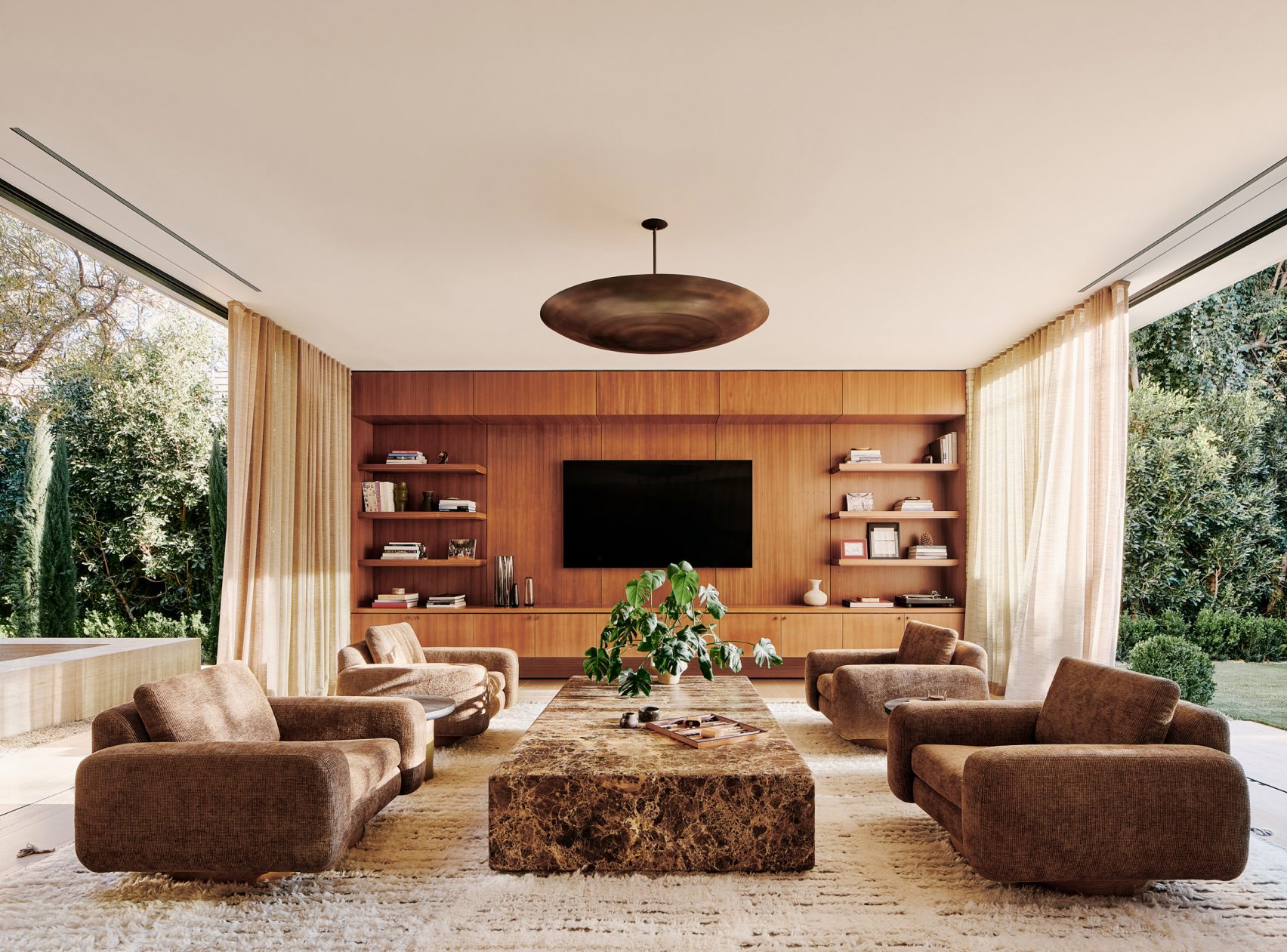
A low marble table anchors the living space, its veining unfolding like a natural landscape across a quiet, sculptural surface
Photo Credit: Norm Architects
Stone in Interior Space: From Surface to Object
In residential projects, stone furniture has shifted from accent to anchor, quietly defining space through mass, texture, and a sense of permanence. No longer treated as decoration, these pieces are conceived as extensions of the architecture itself.
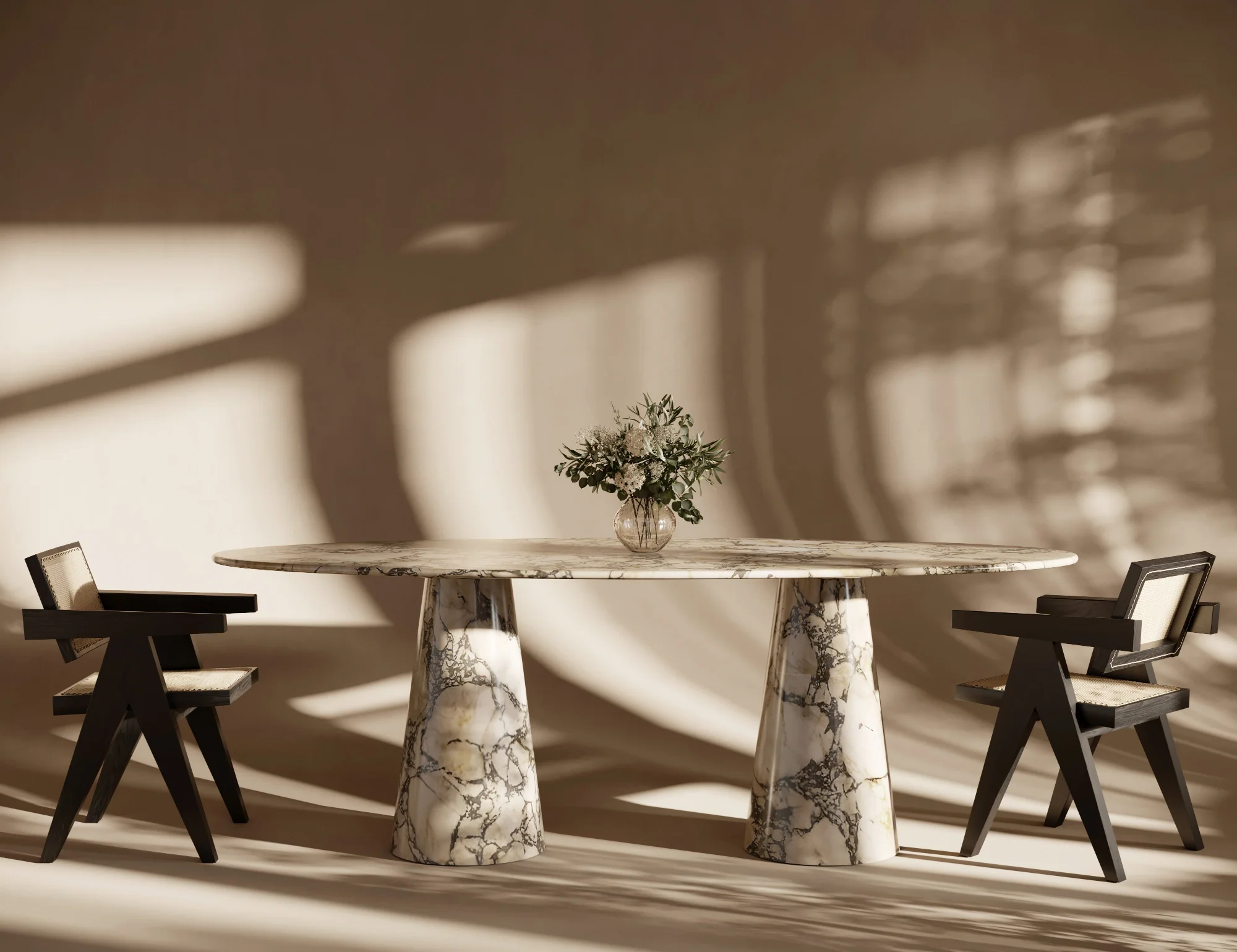
In furniture by Soho Home, pieces like the Rosaline dining table, crafted from richly veined marble with softly rounded edges, introduce both tactility and elegance, where natural variation in the stone ensures each piece feels singular while anchoring the dining space as a quiet focal point.
The Rosaline dining table by Soho Home balances softness and weight, with rounded marble edges and rich veining elevating everyday dining into a tactile experience
Photo Credit: Soho Home
A more restrained expression emerges in the work of Norm Architects, where stone is approached with quiet tactility. Carved basins, pedestal tables, and integrated shelving sit within soft palettes of wood and plaster, creating interiors that feel balanced rather than contrasted where density is offset by warmth, and materiality unfolds gently.

A monolithic marble island defines the kitchen, where clean geometry meets subtle material variation, bringing depth to an otherwise restrained palette
Photo Credit: Norm Architects
In contrast, interiors shaped through Galerie Philia embrace a more sculptural language. Here, marble consoles, onyx side tables, and irregular stone seating act as focal points, carrying a visual gravity that borders on the monumental while remaining firmly within the realm of use.

A raw stone slab by Galerie Philia rests on cylindrical supports, its fractured edges preserving a sense of geological memory while forming a quietly sculptural table
Photo Credit: Galerie Philia
Across 2025-2026 interiors, a clear shift toward mixed stone applications is emerging. Kitchens layer multiple marbles within a single island, living spaces juxtapose polished and raw finishes, and bathrooms become immersive compositions of carved volumes. This approach moves beyond minimal uniformity, introducing a richer, more tactile spatial experience.
Projects like La Casa Rosa by Arent&Pyke in collaboration with Luigi Rosselli Architects further illustrate this evolution. Here, stone is not simply applied but shaped into curved islands, fluted surfaces, and monolithic forms that organize and anchor the interior.

A curved marble island emerges as a sculptural centerpiece, softening the kitchen’s geometry while anchoring the space with quiet material weight

Carved stone bathtub and monolithic surfaces define the bathroom in La Casa Rosa, elevating daily rituals into a serene, architectural experience
Photo Credit: Prue Ruscoe
These interventions transform everyday functions into spatial moments: a kitchen island becomes a carved volume, a vanity takes on a ritualistic presence. Stone no longer frames the space, it defines it. Even in more layered interiors, where it sits alongside wood and textiles, stone maintains its role as both artifact and utility, grounding the home in a material language that feels at once ancient and immediate.
Between Nature and Abstraction
One of the most compelling qualities of stone furniture is its ability to oscillate between the natural and the abstract. Designers often draw inspiration from geological formations, erosion patterns, or marine fossils, translating them into forms that feel both organic and deliberate.
Collections inspired by shells, bones, or sediment layers push this idea further, creating pieces that seem unearthed rather than fabricated. The question becomes ambiguous: is this design, or is it a fragment of landscape brought indoors?
Weight, Stillness, and Emotional Presence
Unlike conventional furniture, stone objects resist mobility. They are not easily rearranged, replaced, or ignored. Instead, they impose a sense of permanence and gravity within a space.
This physical weight translates into emotional resonance. A stone bench or table becomes a point of pause where time feels slowed, where the user becomes more aware of material, texture, and presence.
In an era dominated by speed and disposability, stone furniture offers a counterpoint: durability, continuity, and silence.
Conclusion: Living with Sculpture
Stone furniture ultimately challenges how we define both furniture and sculpture. It invites a slower, more deliberate relationship with objects where function is inseparable from material and form.
As designers continue to explore its possibilities, stone is no longer just a building material. It becomes a medium of expression, capable of holding memory, weight, and meaning within the everyday.
In these pieces, we do not simply use furniture. We live alongside it.
Save this story. A free account keeps your reading list and the 07:00 email in one place.
CREATE FREE ACCOUNT →SIGN IN