The Problem of Light at Height
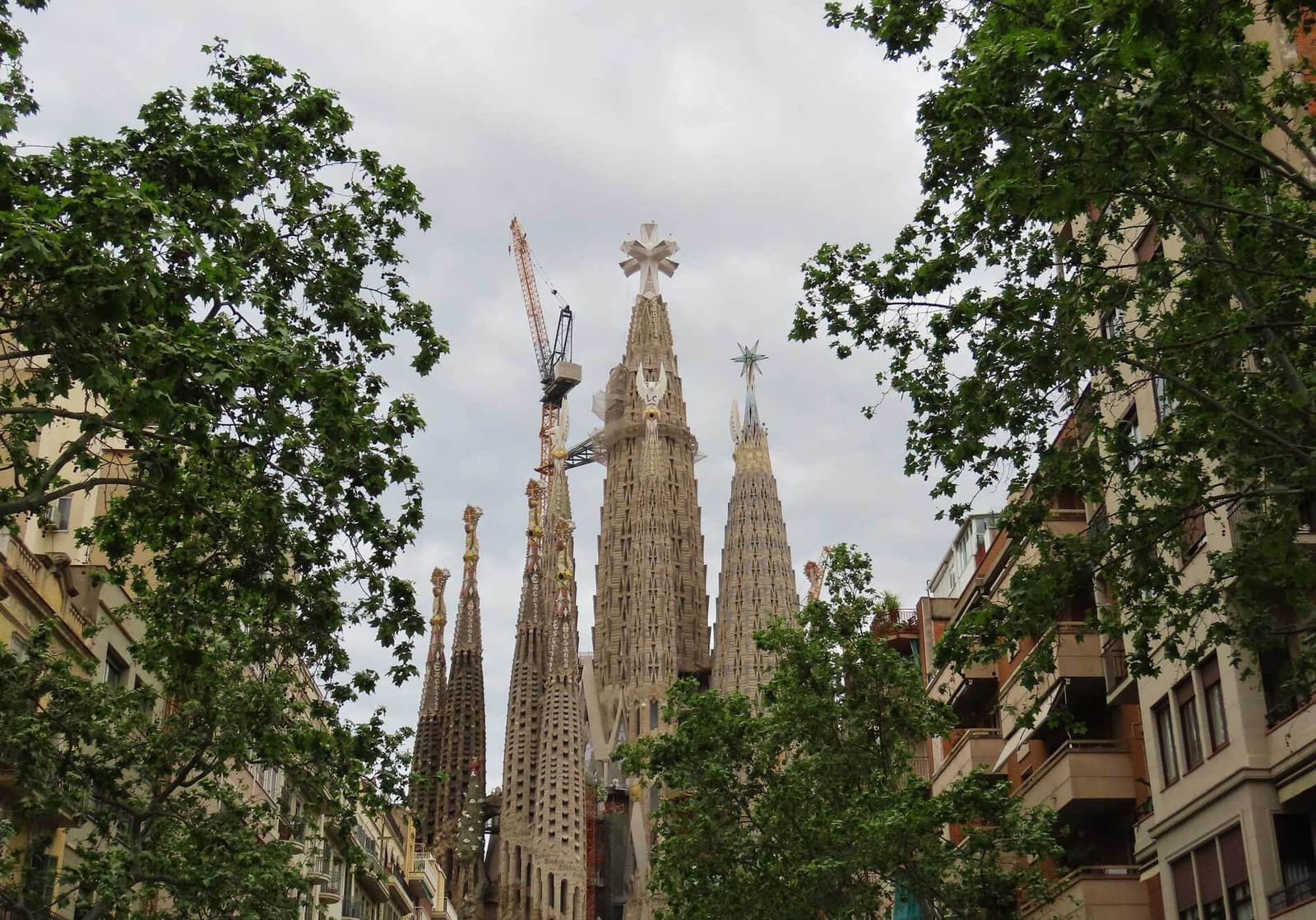
There is a particular challenge in illuminating sacred art: the moment a visitor perceives the mechanism of light rather than the object itself, the spell breaks. This problem intensifies when the artwork sits 172 meters above ground, visible from across a city, and must honor a vision laid out more than a century ago. At the apex of the Sagrada Família's Tower of Jesus Christ, that challenge has produced an unusual solution: a sculpture that appears to generate its own luminescence, with no discernible source, wiring, or technological apparatus.
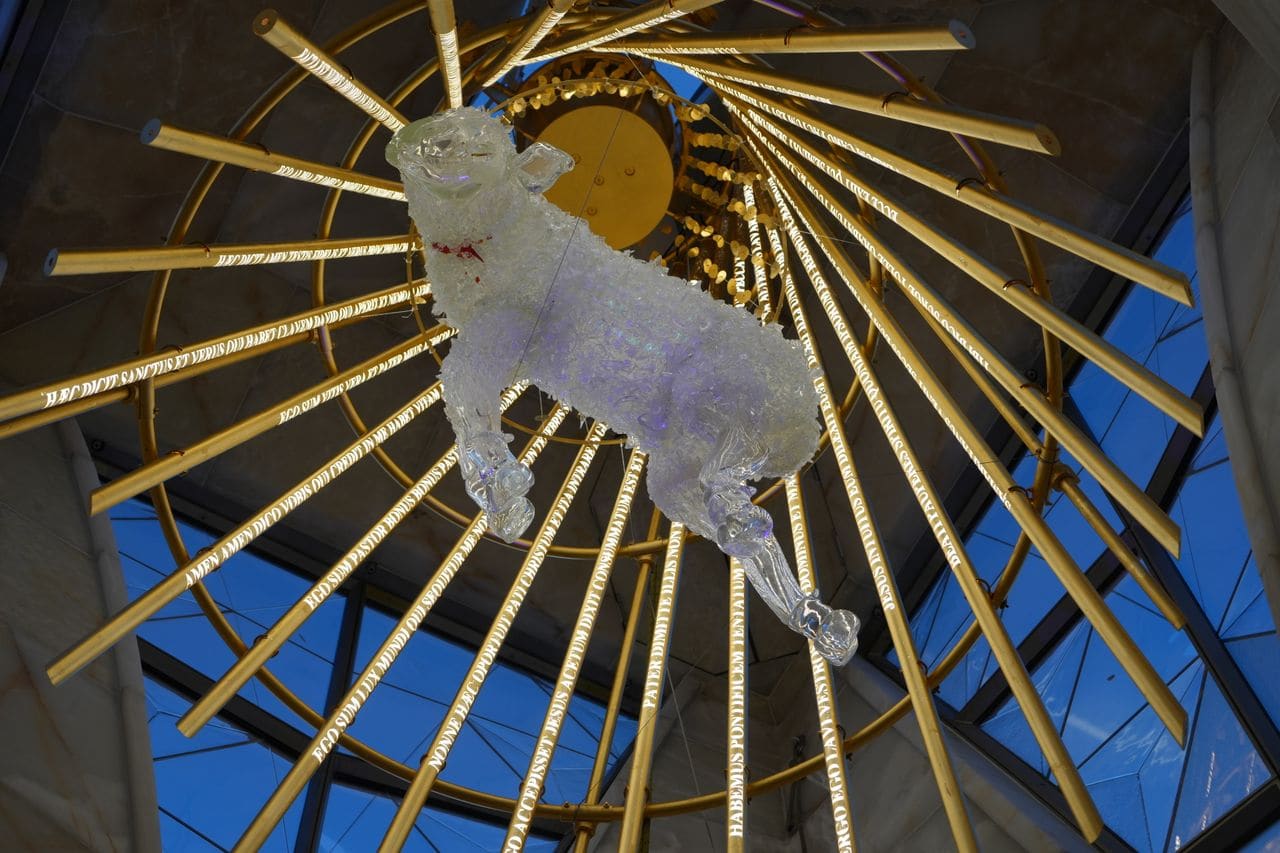
The hand-crafted glass lamb created by Andrea Mastrovito occupies the symbolic heart of the basilica's vertical axis. Commissioned by the Junta Constructora de la Sagrada Família, the work completes Antoni Gaudí's original design intent for the tower, whose construction concluded this year after beginning in 1882. Surrounding the lamb, gilded rays carry Latin inscription from the Gospel of John, verse 1:29: "The next day, John saw Jesus coming toward him and said, 'Behold the Lamb of God, who takes away the sin of the world.'" The text emerges only after darkness falls, when the sculpture begins its nightly transformation.
Phosphorescence as Architectural Strategy
Moritz Waldemeyer, the London-based designer and self-described "art engineer" responsible for the illumination system, approached the commission by inverting conventional thinking about architectural lighting. Rather than projecting light onto the surface of Mastrovito's sculpture, he embedded concealed ultraviolet sources that charge phosphorescent pigments within the glass itself. The result is a form of stored radiance: after absorbing high-energy UV during the transition to evening, the lamb releases a sustained glow that reads as intrinsic to the material.
This technique draws from automotive lighting research, where focused, high-intensity sources have become smaller and more efficient. Waldemeyer adapted that engineering lineage to produce a system invisible to the viewer. No fixtures interrupt the silhouette of the cross. No conduit traces the tower's exterior. The technology, in the studio's framing, "disappears entirely."
The choice of phosphorescence also aligns with the medieval precedent of materials that seem to hold light within themselves: the grisaille glass of Gothic cathedrals, the gold-leaf halos of Byzantine icons, the luminous pigments derived from crushed minerals. Gaudí himself favored trencadís mosaics and polychrome ceramic, surfaces that refracted and scattered daylight in unpredictable ways. Waldemeyer's intervention extends that material sensibility into the electromagnetic spectrum, using wavelengths invisible to the human eye to activate visible glow.
The Disappearance of the Engineer
Studio Waldemeyer, co-founded by Moritz Waldemeyer and Nazanin Farhabod, has built a practice around this paradox: the more sophisticated the technology, the less it should announce itself. Previous projects include responsive lighting for performance contexts, luminous wearables, and installations that mimic the flicker and warmth of candlelight through algorithmic control. In each case, the goal is to produce an effect that feels organic, even when the underlying system is highly engineered.
In the case of the Sagrada Família, that philosophy took on additional weight. The basilica is not a neutral gallery space; it is a pilgrimage site, a UNESCO World Heritage monument, and the unfinished masterwork of a architect whose design language resists straightforward replication. Any contemporary intervention must negotiate Gaudí's vocabulary of hyperbolic paraboloids, catenary arches, and biomorphic ornamentation without deferring entirely to historicism. The lamb sculpture itself, rendered in glass by Mastrovito, occupies a liminal zone between craft tradition and contemporary art. Waldemeyer's lighting had to honor that ambiguity.
The studio describes the outcome as "pure magic," a phrase that gestures toward Arthur C. Clarke's observation that sufficiently advanced technology becomes indistinguishable from enchantment. But the framing also reflects a deliberate design strategy: if visitors perceive the glow as mysterious rather than explained, the installation succeeds. The Latin inscription, emerging only in darkness, reinforces this effect. Text and light become mutually dependent, neither fully legible without the other.
Precedents in Immaterial Illumination
The idea of light without visible source has precedents in both sacred and secular architecture. James Turrell's Roden Crater and skyspace installations isolate natural light to create perceptual phenomena that feel otherworldly. Dan Flavin's fluorescent tube works dematerialize the gallery wall through chromatic saturation. More recently, Olafur Eliasson's atmospheric interventions use mist, mirrors, and monochromatic lamps to produce environments where light itself becomes the primary material.
Waldemeyer's approach differs in scale and context. The Sagrada Família installation must function as both architectural accent and devotional object, visible from street level but legible in detail only from the tower's viewing platform. It must withstand Barcelona's coastal climate and the structural movement inherent in a building still settling into its final form. And it must integrate with Mastrovito's sculpture in a way that reads as inevitable, as though the glow were always part of the glass.
The use of UV activation also has ecological and maintenance advantages. Because the phosphorescent pigments store energy and release it gradually, the system requires less continuous power than conventional floodlighting. The absence of external fixtures reduces wind load on the tower and eliminates the visual clutter of mounting hardware. And because the light source is diffuse rather than directional, it avoids the harsh shadows and glare that can flatten three-dimensional form.
Completing the Vision
Gaudí died in 1926, leaving behind detailed models and drawings but no single blueprint for the Sagrada Família's completion. Successive generations of architects, engineers, and craftspeople have interpreted his intentions through evolving materials and methods: reinforced concrete, computer-aided design, CNC milling. The tower's recent completion represents both fidelity to historical vision and pragmatic adaptation to contemporary building standards.
The lamb sculpture and its illumination system extend that dual logic. Mastrovito's hand-crafted glass honors Gaudí's preference for artisanal techniques and symbolic imagery. Waldemeyer's UV technology introduces a method unavailable in the early 20th century but consistent with Gaudí's fascination with natural phenomena: the way light filters through foliage, the bioluminescence of deep-sea organisms, the iridescence of insect wings. The result is a synthesis that neither replicates the past nor abandons it.
From a distance, the glowing lamb functions as a vertical marker, a point of orientation within Barcelona's skyline. Up close, it reveals layers of craft and engineering: the texture of hand-formed glass, the precision of gilded lettering, the subtle gradations of phosphorescent glow. The inscription, emerging only after dark, adds a temporal dimension. The sculpture becomes legible in stages, inviting sustained attention rather than instant comprehension.
The Limits of Invisibility
Waldemeyer and Farhabod describe their role as making technology disappear, but that invisibility is itself a form of design. The choice to conceal rather than display the UV sources reflects assumptions about what constitutes appropriate intervention in a sacred space. A more overt lighting system might emphasize the modernity of the installation, creating dialogue or tension with Gaudí's historical framework. The concealed approach instead suggests continuity, as though the glow were a property of the material rather than an applied effect.
This raises questions about authorship and authenticity in long-duration architectural projects. If the technology is invisible, does it matter who designed it? If the effect feels magical, does the engineering recede into irrelevance? Studio Waldemeyer's framing suggests otherwise: the success of the installation depends precisely on the sophistication of the hidden system. The "disappearance" of technology is not an absence but an achievement, requiring close collaboration between lighting designer, sculptor, and structural engineers.
The Sagrada Família has always been a building that demands multiple scales of attention. From across the city, it reads as silhouette and massing. From the street, its facades reveal narrative programs carved in stone. Inside, the forest of branching columns creates spatial effects that shift with the movement of the sun. The glowing lamb adds another register: a detail visible only at specific times, from specific vantages, under specific atmospheric conditions. It rewards patience and repeat visits, qualities increasingly rare in an era of instant documentation and rapid consumption.
Light as Material and Metaphor
The project also invites reflection on the symbolic weight of light in sacred architecture. In Christian iconography, the lamb represents sacrifice, redemption, and divine presence. Light, in turn, signifies revelation, truth, and transcendence. By making the lamb itself a source of glow, Waldemeyer's design collapses symbol and substance. The sculpture does not merely represent something luminous; it enacts luminosity.
This approach has roots in medieval theology, where light was understood not as mere illumination but as a manifestation of the divine. Abbot Suger's renovation of Saint-Denis in the 12th century prioritized stained glass and open structure to flood the interior with colored light, creating what he described as a foretaste of heaven. Gaudí, deeply influenced by Gothic precedent, pursued similar effects through his use of hyperboloid vaults and strategically placed apertures. The glowing lamb extends that tradition into the 21st century, using phosphorescence where Suger used glass and Gaudí used ceramic.
At the same time, the installation operates within a contemporary discourse about sustainability and dematerialization in architecture. By minimizing visible infrastructure and reducing energy consumption, it aligns with broader efforts to create buildings that tread lightly on their environment. The glow, sustained by stored energy rather than continuous input, becomes a model for how technology might integrate with historical fabric without overwhelming it.
As the Sagrada Família enters its next phase, no longer under construction but still evolving through maintenance and interpretation, projects like the illuminated lamb will test how much innovation the building can absorb while remaining recognizably itself. The answer, it seems, lies not in rejecting new methods but in deploying them with enough restraint that they feel inevitable rather than imposed. Waldemeyer's invisible light, charged by ultraviolet and released as a gentle glow, suggests one path forward: technology that serves the architecture, rather than the other way around.
Credit: Studio Waldemeyer
Save this story. A free account keeps your reading list and the 07:00 email in one place.
CREATE FREE ACCOUNT →SIGN IN