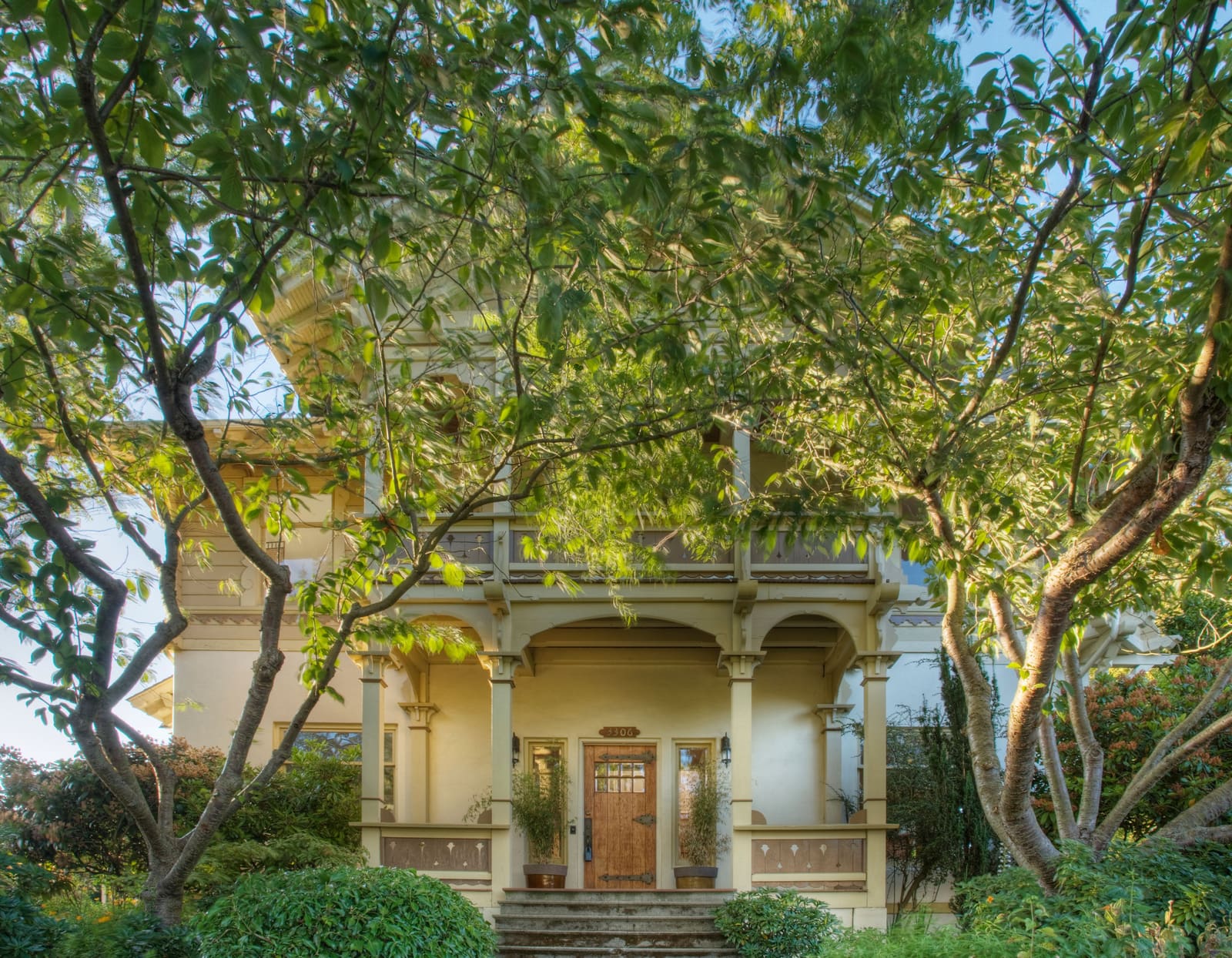
The Problem of Transition
The front porch exists in a peculiar state of spatial ambiguity. It is neither fully exterior nor truly interior, neither public nor entirely private. This liminal quality makes it one of the most challenging elements of residential architecture to design well, yet it remains the first spatial experience visitors encounter. At World Archi Design, we have observed across projects featured in recent years that porches often suffer from a fundamental disconnect: homeowners and even some designers treat them as decorative afterthoughts rather than intentional architectural gestures that mediate between the domestic realm and the street.
Jennifer Hunter of Jennifer Hunter Design in New York frames the porch as an opportunity for personal expression, a space where weather-resistant materials allow interior sensibilities to extend outward. The challenge lies in executing this concept with the same rigor applied to interior spaces. Too often, the porch becomes a repository for mismatched furniture and seasonal decoration rather than a considered architectural sequence.
The question worth asking is not how to make a porch look inviting, but how to design a threshold that genuinely functions as a transition between two distinct worlds. This requires attention to proportion, material continuity, and the choreography of approach.
Scale Mistakes and Fixture Disproportions
One of the most common failures in porch design involves lighting. Ginger Curtis of Urbanology Designs in North Richland Hills, Texas, identifies a recurring error: undersized fixtures that fail to correspond with the elevation of the home. She notes that exterior lights smaller than twelve inches in vertical dimension rarely achieve the visual weight necessary to anchor a facade. This is not merely an aesthetic concern but a question of tectonic honesty. A light fixture that reads as an accessory rather than an integral element of the composition undermines the architectural coherence of the entrance.
The same principle applies to planters. Cathy Purple Cherry of Purple Cherry Architects in Annapolis, Maryland, advocates for large-scale vessels, particularly urn forms that carry historical precedent in classical and neoclassical architecture. Undersized planters scattered across a porch create visual clutter rather than deliberate punctuation. The most successful examples we have encountered employ a restrained number of substantial containers, each with enough mass to hold its place within the composition.
Proportion extends beyond objects to spatial divisions. Linda Mauck Smith of BLDC Design in Shaker Heights, Ohio, discusses the utility of porch swings in segmenting longer porches into defined zones: one for informal seating, another for dining or solitary retreat. This zoning strategy acknowledges that porches, particularly those wrapping multiple elevations, benefit from the same spatial logic applied to interior floor plans. A single undifferentiated porch reads as leftover space; a porch divided into areas of use becomes a sequence of rooms without walls.
Material Continuity and Surface Treatment
Eilla Pradier of Eilla Adi Design in Newport Beach, California, argues for flooring that transcends generic concrete, suggesting tile, wood, or stone as materials that signal intention. The most compelling approach, she notes, involves extending interior flooring materials outward, creating a visual and tactile continuity that blurs the boundary between inside and outside. This strategy has precedent in mid-century California modernism, where terrazzo and flagstone often traveled seamlessly from entry halls onto exterior terraces.
Eddie Maestri of Maestri Studio in Dallas employed graphic black-and-white tile on his own porch, a bold pattern that transforms an otherwise minimal facade into a moment of visual emphasis. Patterned tile, whether geometric or organic, introduces a layer of craft and detail that elevates the porch from functional necessity to architectural statement. The risk, of course, lies in selecting patterns that either clash with the broader architectural language or date quickly. Timeless geometrics, Moorish motifs, or simple checkerboard compositions tend to endure better than trendy encaustic designs.
Concrete, often dismissed as utilitarian, offers surprising flexibility when approached creatively. Lucinda Loya of Lucinda Loya Interiors in Houston points to concrete overlays that allow for tinting, stamping, or etching, techniques that introduce texture and variation without the cost of stone or tile. Pavers, whether concrete or natural stone, break up the monolithic quality of poured slabs and introduce modular rhythm. The choice between poured and modular surfaces affects not only appearance but also drainage, maintenance, and long-term durability.
Ceiling treatments represent another overlooked surface. Painting porch ceilings, particularly in soft blues, has regional precedent in the American South, where the practice was believed to deter insects and evoke the sky. Whether or not the deterrent effect holds, the visual impact is undeniable: a painted ceiling draws the eye upward and defines the porch as a room with a fifth plane. Exterior-grade paint formulated to withstand moisture and UV exposure is essential in climates with significant weather variation.
The Door as Focal Point
If the porch is a room, the door is its altar. Liz Walton of Liz Walton Home in Phoenixville, Pennsylvania, emphasizes the door as the primary opportunity to establish tone. A bold color, a distinctive material, or an unusual shape signals the architectural attitude of the home. Yasmine El Sanyoura, a home design expert based in Toronto, cites Sherwin Williams Evergreen Fog as a versatile choice that complements both brick and painted siding, offering a contemporary alternative to traditional blacks and reds.
Loya advocates for darker tones, particularly Sherwin Williams Caviar and Black of Night for warmer undertones, and Inkwell for cooler palettes. Dark doors possess a quality of permanence and weight; they recede visually, allowing architectural detail around the frame to emerge. Glass inserts introduce light into entry halls while maintaining security, though privacy concerns may necessitate frosting or reflective film. The choice between solid and glazed doors ultimately depends on the orientation of the entrance and the quality of natural light within the adjacent interior.
Replacing a door entirely, particularly with a model that includes beveled glass or custom joinery, represents a more substantial intervention but one with immediate impact. Unfinished doors offer the flexibility of custom staining or painting, allowing homeowners to calibrate the final appearance to the architectural context. For traditional homes, deep walnut or mahogany stains reinforce historical character; for contemporary projects, high-contrast paint in saturated hues provides graphic punch.
Screening, Seating, and Spatial Definition
Lucy Small of State and Season Home Design in Blue Ridge, Georgia, makes a practical case for screening. Modern screen systems, sleek and minimalist, transform porches into livable spaces protected from insects without the visual weight of traditional screen doors. Screening effectively doubles the usable season of a porch in temperate climates and makes the space functional year-round in regions with mild winters. The addition of retractable screens offers flexibility, preserving open views when conditions allow while providing protection when needed.
Seating defines the porch as a place of pause rather than mere passage. Walton describes the porch swing as an emblem of hospitality, a piece of furniture that invites lingering. Swings require careful placement to avoid contact with surrounding elements; Purple Cherry stresses the importance of clearance on all sides to accommodate movement and wind. Fixed benches, built into porch railings or walls, offer another seating strategy, one that integrates furniture into the architecture rather than treating it as movable decoration.
Jenna Schumacher of Insert Design in Costa Mesa, California, describes a project where folding doors connect an interior living room to an open courtyard, allowing the porch to function as an extension of the interior during temperate months. This approach, common in Mediterranean and tropical climates, acknowledges that the porch need not be a static space but can adapt to seasonal and functional needs. Folding or sliding partitions enable the porch to oscillate between enclosed and open, interior and exterior, depending on use and weather.
Annemarie Schumacher, founder of the lifestyle platform Make Every Day an Event in St. Louis, advocates for layering outdoor rugs and mats to define zones and introduce pattern. Rugs, often overlooked in exterior spaces, provide visual warmth and tactile comfort. Durable outdoor textiles resist fading and moisture, making them practical as well as aesthetic additions. The key is selecting rugs that correspond in scale to the porch dimensions; undersized rugs create the same proportional awkwardness as undersized light fixtures.
Ornamentation and Cultural Signifiers
Ornamentation on porches ranges from the subtly symbolic to the overtly decorative. Purple Cherry describes a project where Tibetan talismans flank the front door, objects collected by the homeowners and believed to bless the home and its visitors. Such elements, whether religious, cultural, or purely personal, add layers of meaning that transcend aesthetics. A mezuzah affixed to a doorpost, a horseshoe mounted above a lintel, or a carved panel from a distant region each introduces narrative and specificity.
Greenery functions as both ornament and environmental mediator. Jessica Nelson of Etch Design Group in Austin employed nearly a dozen ferns as a focal point, a cost-effective strategy that introduces movement and seasonal variation. Hanging plants, potted specimens, and climbing vines soften hard architectural edges and provide a transition between built form and landscape. The choice of plantings should reflect regional climate and maintenance capacity; drought-tolerant species in arid regions, shade-loving ferns in humid climates, and evergreens in areas with harsh winters ensure year-round presence.
Karen Ray of Our Blissful Cottage in Fernandina Beach, Florida, describes wrapping existing posts in PVC column wraps as an efficient upgrade. Cellular PVC, virtually seamless and requiring no caulking or painting, mimics traditional millwork without the maintenance burden of wood. This approach reflects a broader trend toward synthetic materials that replicate historical detailing while resisting rot, warping, and insect damage. The trade-off lies in authenticity: PVC lacks the grain and patina of wood, a compromise some designers accept and others reject.
Rethinking the Porch as Architectural Sequence
The most successful porches we have studied do not function as isolated elements but as integral components of a larger architectural sequence. They mediate between the scale of the street and the intimacy of the home, between public visibility and private enclosure. This mediation requires careful calibration of proportion, material, and detail.
Designers who approach porches with the same rigor they apply to interior spaces, who consider lighting as part of the tectonic system rather than an accessory, who select materials for continuity rather than contrast, and who choreograph the approach as a deliberate spatial experience, produce porches that transcend decoration. These are thresholds that acknowledge the symbolic and functional weight of entry, spaces that prepare the visitor for what lies beyond while offering a moment of pause in the journey from street to hearth.
The porch, in this reading, is not a luxury but a necessity, not an afterthought but a prelude. It deserves the same attention to proportion, material, and spatial logic that defines the best residential architecture. As we continue to document projects that wrestle with the threshold condition, the lesson remains consistent: the quality of the arrival shapes the perception of everything that follows.
Save this story. A free account keeps your reading list and the 07:00 email in one place.
CREATE FREE ACCOUNT →SIGN IN