In contemporary architecture, geometry is no longer a hidden structural logic - it is the main visual language. Across the globe, a new generation of buildings is transforming pure shapes into expressive identities, where cubes float, lines bend, and volumes collide with sculptural confidence. These ten projects show how geometry can communicate culture, innovation, and emotion. From record-breaking cantilevers to fluid, parametric forms, each building below proves that architecture today is as much about visual poetry as it is about function.
1. Taichung Green Museumbrary – Taichung, Taiwan
Designed by SANAA and recently opened in December 2025, the Taichung Green Museumbrary merges a public library and art museum into a constellation of interconnected cubic volumes. Wrapped in translucent metal mesh, the building dissolves solid boundaries, allowing light, greenery, and movement to flow through. The seemingly simple geometry becomes dynamic as ramps, bridges, and terraces overlap, turning circulation into spatial art. The project redefines the cube as a soft, civic form.


A constellation of translucent volumes blurs the boundary between architecture, landscape, and public life
Photo Credit: YHLAA
2. One Za’abeel – Dubai, UAE
Completed in 2024, One Za’abeel is a bold exercise in geometric tension. Two sleek towers are dramatically linked by “The Link,” one of the world’s longest cantilevered structures. The horizontal bar appears to float in midair, challenging gravity and redefining skyscraper composition. By interrupting verticality with a strong lateral gesture, the project transforms basic forms into a striking urban sculpture that commands Dubai’s skyline.


A dramatic horizontal gesture slices through the skyline, redefining the language of the skyscraper
Photo Credit: Koji Horiuchi, Hufton + Crow
3. Fondation Louis Vuitton – France
Frank Gehry’s Fondation Louis Vuitton in Paris resembles a cluster of glass sails captured by wind. Delicate curved panels intersect in complex, expressive geometry. The building appears weightless and dynamic, a crystalline structure anchored in the Jardin d’Acclimatation. Its innovative use of geometry and glass pushes the boundaries of architectural form, creating spaces that feel both futuristic and harmonious. This masterpiece is a celebration of geometry’s ability to animate light and movement.


Glass “sails” unfold in motion, turning structure into a composition of light and reflection
Photo Credit: Iwan Baan
4. BEEAH Headquarters – Sharjah, UAE
Zaha Hadid Architects’ BEEAH Headquarters translates desert landscapes into flowing architectural geometry. Two dune-like volumes intersect, forming a continuous, aerodynamic shape that appears sculpted by wind. The building’s fluid lines blur the distinction between architecture and landform, while advanced sustainability strategies reinforce its forward-thinking vision. Here, geometry becomes organic, expressive, and deeply connected to place.


Wind-sculpted forms echo desert dunes, merging environmental performance with futuristic expression
Photo Credit: Hufton + Crow
5. NOT A HOTEL Okinawa - Okinawa, Japan
Set to open soon, NOT A HOTEL Okinawa showcases Zaha Hadid Architects’ signature biomorphic geometry in a coastal setting. Curving forms sweep across the site, echoing waves and topography rather than rigid grids. The architecture feels carved rather than constructed, with continuous surfaces that blur inside and outside. Geometry here is sensual and immersive, redefining luxury hospitality as a sculptural, spatial experience.


Flowing contours rise from the coastline, shaping architecture that feels carved by sea and wind
Photo Credit: Negativ
6. National Museum of Qatar – Qatar, UAE
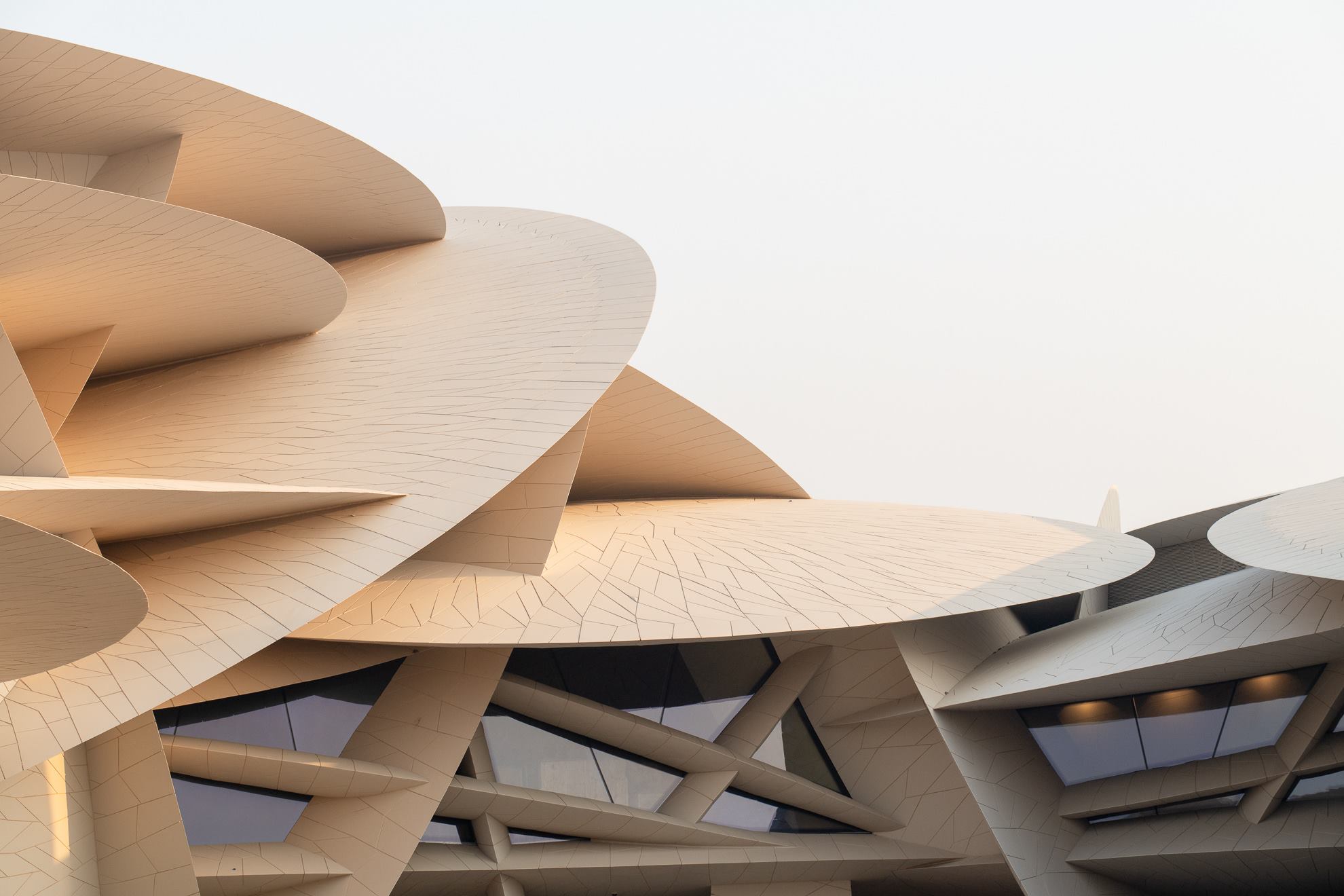
Jean Nouvel’s design for the National Museum of Qatar draws inspiration from the desert rose crystal, transformed into a complex geometric assembly of interlocking disks. These radial forms intersect at varying angles, creating intricate shadows and sculptural mass. The building’s geometric logic resonates with natural forms and cultural identity. As a monumental yet intimate space, it demonstrates how geometry can articulate narrative, memory, and landscape through architectural form.


Interlocking discs form a monumental landscape, where cultural memory is expressed through geometry
Photo Credit: Iwan Baan
7. Shenzhen Science & Technology Museum – Shenzhen, China
Opened in 2025, this museum by Zaha Hadid Architects features a futuristic, layered geometry inspired by planetary forms and digital networks. Its smooth metallic skin and complex curvature reflect light dynamically, reinforcing Shenzhen’s identity as a technology hub. The building reads as a single sculptural object, where advanced geometry becomes a visual metaphor for innovation and scientific exploration.


A seamless, metallic form captures the spirit of innovation through fluid, digital-age geometry
Photo Credit: Virgile Simon Bertrand
8. V&A East Storehouse – London, UK
Part of the newly opened V&A East complex, the Storehouse transforms an industrial structure into a monumental geometric interior. Stacked volumes, exposed grids, and vast voids create a dramatic spatial composition. The architecture celebrates structure itself, allowing beams, platforms, and storage systems to define the aesthetic. Geometry becomes both archive and exhibition, redefining how cultural institutions can be experienced.


Exposed structure and stacked volumes transform storage into a powerful spatial experience
Photo Credit: Hufton + Crow
9. Ismaili Centre – Houston, USA
Opened in 2025, the Ismaili Centre Houston reinterprets traditional Islamic geometry through contemporary architecture. Repeating patterns, precise proportions, and carefully aligned volumes create a serene and contemplative environment. Rather than decorative excess, the building relies on rhythm and symmetry to shape its identity. The result is architecture that feels timeless, where geometry carries cultural meaning and spiritual calm.


Precise lines and patterned surfaces translate tradition into contemporary architectural calm
Photo Credit: Iwan Baan
10. Qasr Al Hokm Metro Station – Riyadh, Saudi Arabia
Part of Riyadh’s newly opened metro network, Qasr Al Hokm Station elevates infrastructure through bold geometric expression. Parametric forms, layered surfaces, and expansive spans create a sense of movement and flow. Drawing inspiration from Islamic geometry while embracing modern engineering, the station transforms transit architecture into a civic landmark where function and form meet artfully.


Parametric forms and monumental spans elevate transit architecture into civic sculpture
Photo Credit: Royal Commission for Riyadh City
Together, the above projects reveal how geometry has become one of the most powerful creative tools in contemporary architecture. Whether rigid or fluid, minimal or complex, geometric forms now shape identity, storytelling, and experience. As these buildings show, geometry is no longer just the framework behind architecture - it is the art itself, defining how we see, move through, and emotionally connect with the built world.
Save this story. A free account keeps your reading list and the 07:00 email in one place.
CREATE FREE ACCOUNT →SIGN IN