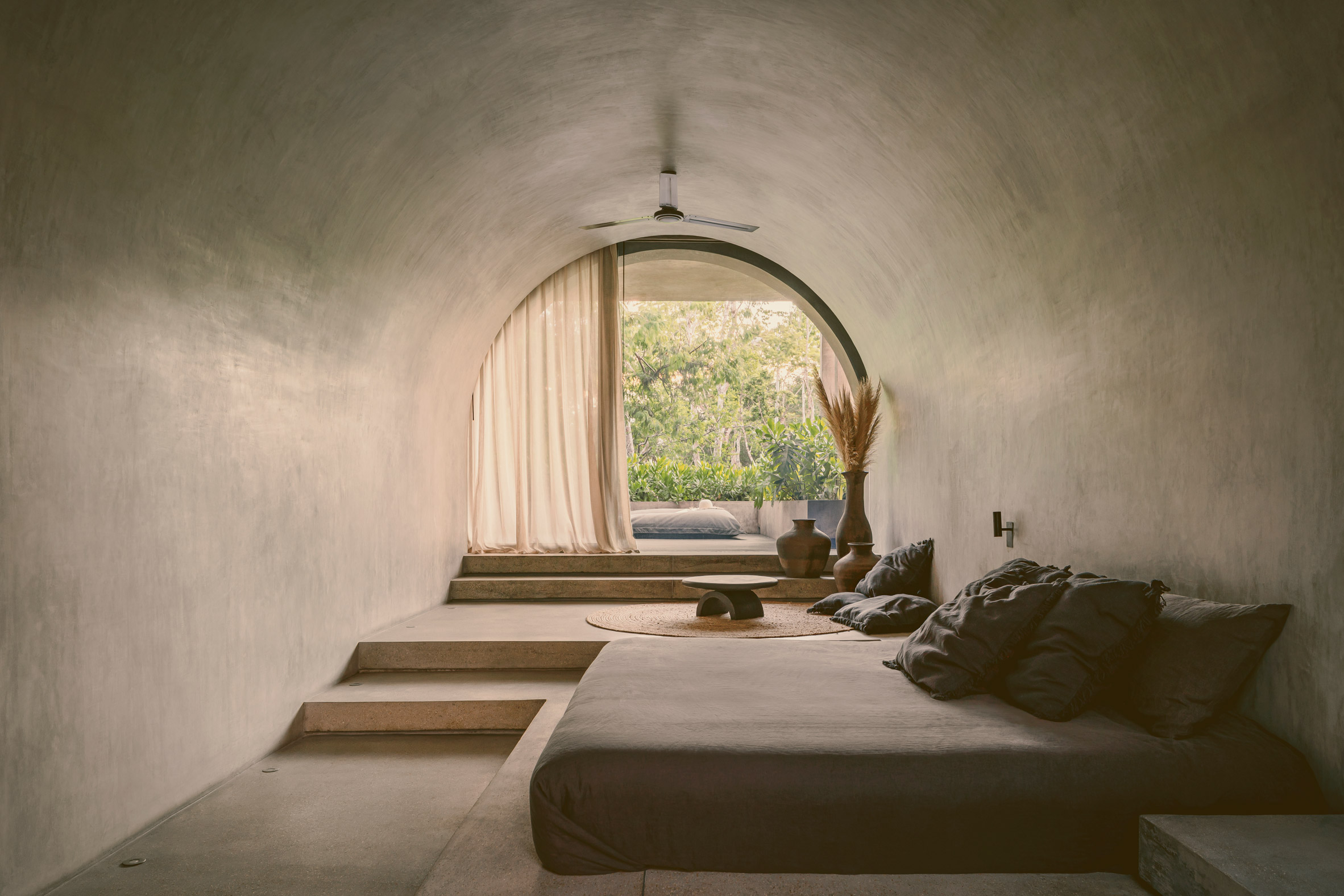
Some of the most memorable sleeping spaces aren’t furnished at all, they’re formed. When beds are embedded into walls, floors, and structural volumes, rest becomes a spatial experience. These seven projects show how architecture can cradle the body, turning niches, platforms, and carved alcoves into places to sleep. Each bedroom blurs the line between building and furniture, creating rooms that feel protective, sculptural, and deeply tied to their setting.
1. Wooden Cave Suites, Hyades Mountain Resort, Greece
Carved from layered timber, these cave-like rooms shape the bed as a continuation of the curving walls. The sleeping platform emerges from the same wood that lines the interior, forming a cocoon that softens sound and light. The built-in design heightens the sense of refuge, as if the room itself is holding you. Warm grain, rounded edges, and concealed lighting make the bed feel grown from the space rather than placed inside it.

A carved timber sleeping alcove curves out of the wall, turning the bed into part of the room’s cave-like interior
Photo Credit: Spyros Hound Photography
2. Casa Alférez, Mexico
In this brutalist home, the bed is cast into the architecture, appearing as a solid extension of concrete planes and stepped platforms. Recessed sleeping areas sit within sculptural volumes, giving privacy without enclosure. The monolithic forms create a grounded, almost ceremonial place to rest, while careful openings pull in daylight and air. It’s a study in turning heavy material into intimate shelter, where the structure becomes the furniture.

The bed is cast into stepped concrete platforms, dissolving the boundary between structure and furniture
Photo Credit: Rory Gardiner
3. Forest Retreat, Sweden
Minimal interiors tuck the bed into built-in cabinetry and wall niches, letting the room read as one calm composition. The sleeping area feels carved from the cabin’s timber shell, with integrated storage and subtle partitions that keep the footprint clean. Framed views of forest soften the geometry, and natural materials keep the space warm. The result is a bed that belongs to the architecture, quietly anchoring a serene, nature-forward retreat.

A built-in sleeping niche is tucked into the cabin’s minimalist timber shell, framed by forest views
Photo Credit: Norm Architects
4. Villa Petricor, Mexico
Here, the bed rises from a continuous concrete surface that flows through the room and toward outdoor terraces. The platform is shaped as part of the floor, blurring sleep, lounge, and circulation into one fluid plane. Soft edges and textured finishes temper the material’s weight, while the tropical garden seeps in through openings. The built-in bed becomes a vantage point - half sanctuary, half stage for breezes, light, and greenery.

The platform bed rises from a continuous concrete surface that flows toward the tropical garden
Photo Credit: César Béjar
5. Chestnut House, Portugal
Compact living turns the bed into a mezzanine carved within the cabin’s volume. Built-in plywood walls hold storage and steps, guiding you up to a snug sleeping platform tucked beneath the roofline. The architecture choreographs daily life vertically, with the bed acting as a structural pause between living and sky. Windows frame the surrounding landscape, so the embedded bed feels perched within the building, quietly suspended between interior and canopy.

A mezzanine bed is integrated into the cabin’s volume, creating a compact sleeping perch above the living space
Photo Credit: José Campos
6. Miao Miao Micro-apartment, Taiwan
In just 23 square meters, the bed becomes part of a stacked system of work, storage, and circulation. The sleeping platform is integrated into the upper volume, carved from cabinetry and structure to free the floor below. This built-in approach turns constraints into clarity: every surface works twice. The bed reads as architecture - precise, compact, and purposeful - making small-space living feel intentional rather than improvised.

In just 23 square meters, the bed is embedded into the upper structure to free space below
Photo Credit: Hey!Cheese
7. NCaved House, Greece
Carved into rock, the sleeping niches are literal extensions of the landscape. Beds sit within stone alcoves shaped by excavation, their contours echoing the hillside outside. Built-in platforms follow the cave’s geometry, creating cool, dim sanctuaries by day and hushed cocoons by night. The architecture doesn’t host the bed, it becomes the bed. It’s an ancient idea refined for modern comfort, where geology and rest meet.

The sleeping platform is carved directly into the rock, forming a recessed alcove shaped by the hillside
Photo Credit: Yiorgis Yerolympos
When beds are embedded into the fabric of a building, sleep becomes architectural, shaped by curves, planes, and materials that guide how we rest. These projects prove that the most intimate spaces can also be the most spatially bold. Whether carved from stone, cast in concrete, or grown from wood, built-in beds turn bedrooms into experiences, quietly reminding us that how we sleep is inseparable from where we sleep.
Save this story. A free account keeps your reading list and the 07:00 email in one place.
CREATE FREE ACCOUNT →SIGN IN