A Historic Convergence
What does it mean when a country's most prestigious architectural recognition goes to two practitioners whose work sits at opposite ends of the disciplinary spectrum? In late July, the Colegio de Arquitectos de Chile made an unusual decision: rather than single out one figure for the 2026 National Architecture Prize, the institution's five-member board awarded it jointly to Alejandro Aravena and Smiljan Radić Clarke. Both hold Pritzker Prizes - Aravena since 2016, Radić as of this year - and both have become synonymous with Chilean architecture's international visibility. Yet their practices could hardly be more different.
The joint award signals something deeper than institutional compromise. It acknowledges that Chilean architecture, historically shaped by seismic risk, economic constraint, and geographic isolation, has produced not one but multiple trajectories of significance. Aravena's incremental housing and participatory processes occupy one pole; Radić's enigmatic, materially driven pavilions and residences occupy another. Together, they form a dialectic that defines the country's contemporary architectural identity.
The Prize and Its Context
Established in 1969, the National Architecture Prize is Chile's highest professional distinction for registered architects. Unlike state-sponsored honors, it is conferred by the Colegio de Arquitectos, a voluntary professional body that has shaped the country's architectural discourse for decades. The selection process begins with a public call for nominations, followed by evaluation by a search committee that produces a shortlist. The final decision rests with the institution's national board.
Awarded biennially since 1979, the prize honors career achievement and ethical conduct across any domain of practice - built work, academic contribution, public service, or professional advocacy. Past recipients include modernist figures such as Fernando Castillo Velasco, Alberto Cruz Covarrubias, and Miguel Lawner Steiman. Notably, only one woman has received the honor: Antonia Lehmann, who shared the 2004 prize with Luis Izquierdo. The award's gender imbalance reflects broader systemic issues within Chilean architectural institutions, though this year's decision to recognize two male laureates does little to address that legacy.
Rodolfo Jiménez, national president of the Colegio de Arquitectos, framed the dual recognition as a reflection of a "historic moment" for Chilean architecture, one in which local practice has managed to engage global conversations without losing its territorial specificity. The work of both architects, he noted, demonstrates that it is possible to remain "deeply connected" to Chilean geography, culture, and material traditions while influencing architectural discourse far beyond the Andes.
Aravena: Incremental Urbanism and the Politics of Housing
Alejandro Aravena's trajectory has been defined by his work with ELEMENTAL, the Santiago-based collective he co-founded in 2001. The studio's most recognized projects - Quinta Monroy in Iquique (2004), Monterrey Housing in Mexico (2010), and Villa Verde in Constitución (2013) - are exercises in what Aravena calls "half of a good house." Rather than delivering finished, minimal dwellings, ELEMENTAL designs frameworks that residents can expand over time, acknowledging both economic reality and the agency of inhabitants.
This approach is grounded in a specific reading of Chilean urbanism. Informal settlements have long been a feature of the country's cities, where rapid urbanization and limited state capacity produced self-built neighborhoods that evolved incrementally. Aravena's work formalizes this logic, embedding flexibility into the initial architectural gesture. The result is a housing typology that resists obsolescence, adapting to changing family structures, income levels, and cultural practices.
At World Archi Design, we've observed how Aravena's model has influenced housing policy across Latin America and beyond. His 2016 Pritzker Prize citation emphasized his commitment to "addressing the global housing crisis," a framing that positioned architecture not as an aesthetic discipline but as a tool for social equity. Yet the incremental model is not without critique. Some scholars argue that it shifts responsibility for housing quality from the state to residents, effectively privatizing the burden of adequate shelter. Others note that the aesthetic of ELEMENTAL's projects - raw concrete, exposed structure, minimal finishes - risks romanticizing poverty rather than transcending it.
Still, Aravena's influence extends beyond housing. His curation of the 2016 Venice Architecture Biennale, titled "Reporting from the Front," called for architecture to confront urgent social and environmental challenges rather than retreat into formalism. The Siamese Towers in Santiago (2003), an early project, demonstrated his interest in structural innovation and programmatic hybridity, themes that recur throughout his career.
Radić: Material Alchemy and the Poetics of Place
Smiljan Radić's work occupies a different register entirely. Where Aravena engages systems and policy, Radić operates at the scale of the object - pavilions, houses, and small public structures that privilege material experimentation and tectonic expression. His projects are often described as sculptural, a term that risks flattening their architectural complexity but captures their resistance to typological convention.
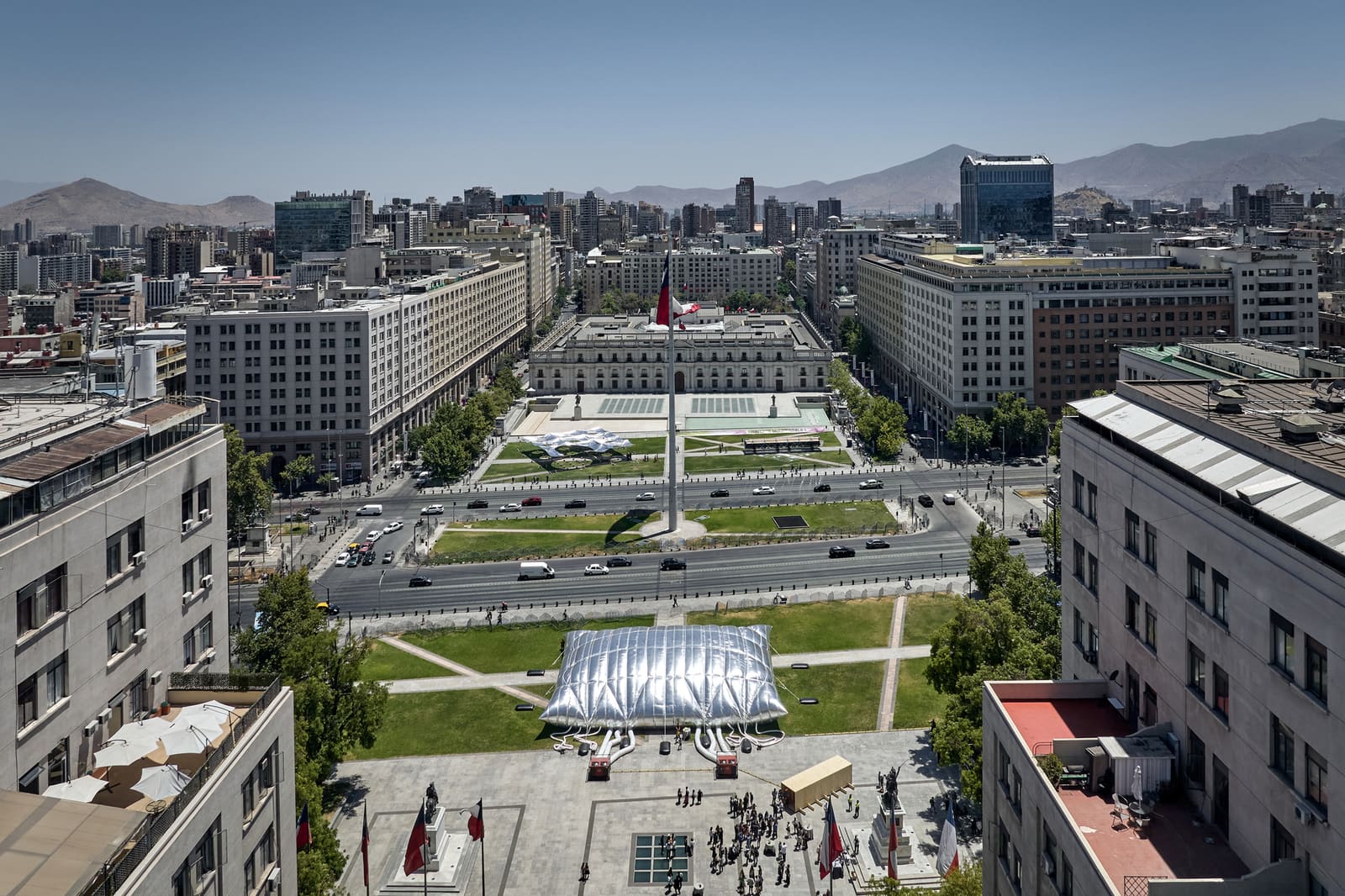
The Serpentine Pavilion in London (2014) remains one of his most widely recognized works. A translucent fibreglass shell resting on rough stone boulders, the pavilion juxtaposed industrial fabrication with geological time, creating a structure that felt both ancient and provisional. The Pite House (2005), perched on the Chilean coast, uses local stone and timber to create a dwelling that merges with its rocky surroundings, blurring the boundary between built form and landscape.
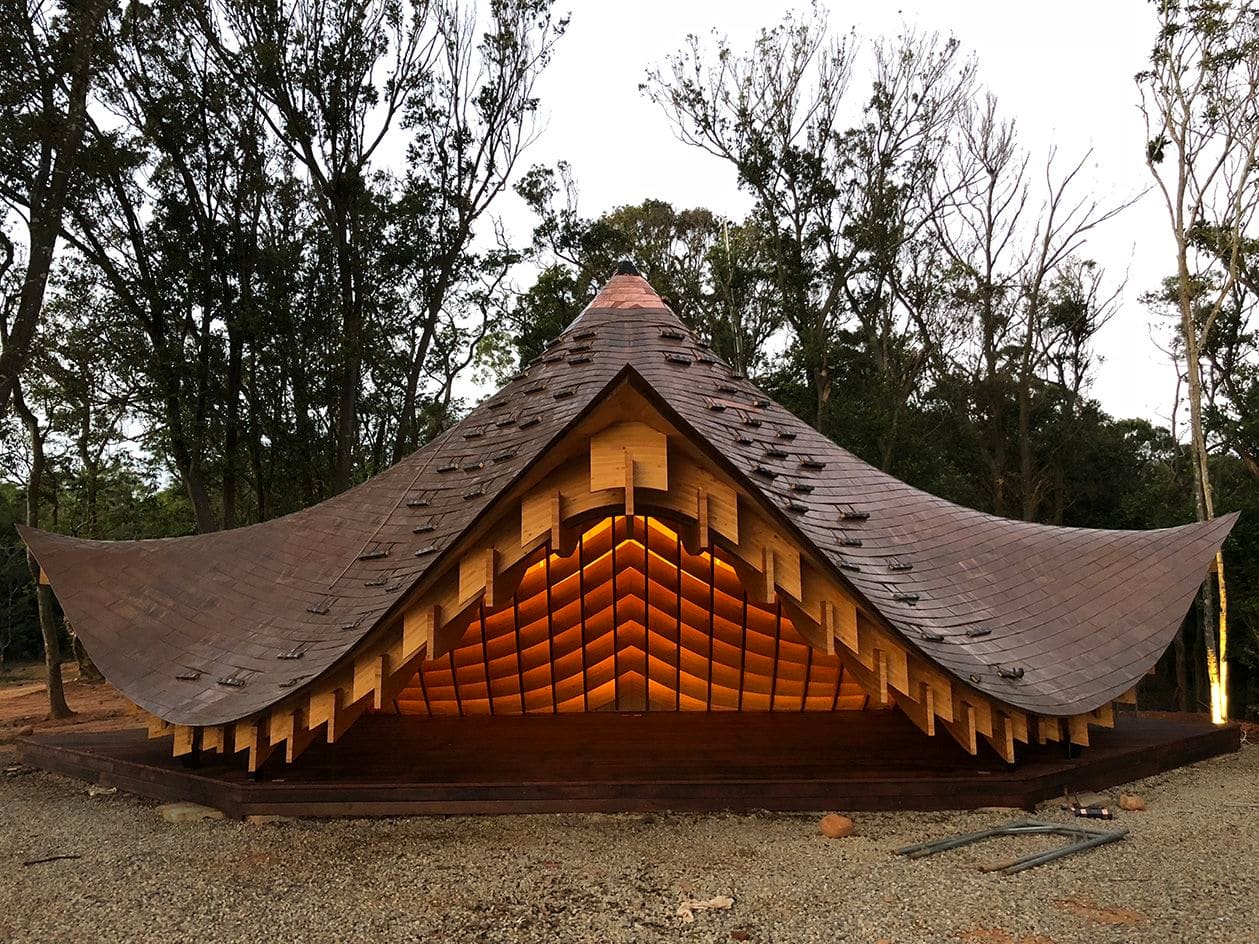
Radić's recent Pritzker Prize citation emphasized his ability to "distract" viewers from architecture's conventional concerns, redirecting attention toward material presence and spatial ambiguity. His work draws on vernacular construction techniques - stone masonry, timber framing, copper cladding - but recombines them in ways that resist easy categorization. The Guatero Pavilion, designed for the 2023 Chilean Architecture Biennial, exemplified this approach: a temporary structure clad in reflective copper, it functioned as both gathering space and perceptual device, refracting light and movement across its faceted surfaces.
Critics have noted parallels between Radić's practice and that of earlier Chilean architects such as Mathias Klotz and Germán del Sol, who also explored the relationship between material, landscape, and regional identity. Yet Radić's work is less concerned with sustainability or cultural authenticity than with the phenomenological experience of architecture. His buildings ask to be encountered physically, their rough textures and unexpected juxtapositions demanding haptic engagement.
Divergent Methods, Shared Terrain
The decision to award the National Architecture Prize jointly to Aravena and Radić reflects an institutional recognition that Chilean architecture cannot be reduced to a single narrative. Aravena's incremental housing and policy-oriented practice represent one strand of contemporary practice; Radić's material investigations and site-specific interventions represent another. Both, however, share a commitment to architectural production that engages local conditions - seismic, economic, geographic - without retreating into regionalist nostalgia.
Chile's architectural culture has long been shaped by its geography. The country's extreme length, spanning deserts, forests, and glaciers, produces a wide range of climatic and material conditions. Its position along the Pacific Ring of Fire demands seismic resilience, a constraint that has fostered innovation in structural systems and construction techniques. Both Aravena and Radić navigate these conditions, albeit through different means. Aravena's work emphasizes adaptability and resource efficiency; Radić's explores how architecture can respond to site through material specificity and tectonic invention.
The joint prize also highlights the global reach of Chilean architecture. Aravena's influence on housing policy and participatory design has extended across Latin America, Africa, and Asia. Radić's pavilions and residences have been exhibited and built in Europe, North America, and beyond. Their success has helped position Chile as a site of architectural innovation, a counterpoint to the historical dominance of European and North American practice in global discourse.
Gender and Recognition
The award's history reveals a persistent gender imbalance. Since its establishment in 1969, only one woman - Antonia Lehmann, in a joint prize with Luis Izquierdo in 2004 - has been recognized. This reflects broader patterns within Chilean architectural institutions, where women remain underrepresented in leadership roles, major commissions, and professional honors. The 2026 decision to award the prize jointly to two male architects, both already holding Pritzker Prizes, does little to address this gap.
Chilean architecture has produced significant work by women practitioners, including Cecilia Puga, whose housing and public projects demonstrate rigorous engagement with urban and social contexts, and Paula Velasco, whose research on informal settlements has informed housing policy. The absence of women from the National Architecture Prize's roster raises questions about how professional recognition is structured and whose contributions are deemed worthy of institutional honor.
Looking Forward
The work of both Aravena and Radić will be exhibited at the 24th Chilean Architecture and Urbanism Biennial in 2027, providing an opportunity to examine their practices in relation to one another and to the broader field of Chilean architecture. The biennial will open with a public lecture, offering both architects a platform to articulate their visions and to engage with emerging practitioners.
As Chilean architecture continues to navigate the pressures of globalization, climate change, and social inequality, the dual recognition of Aravena and Radić offers a useful reminder that disciplinary relevance can take multiple forms. Incremental housing and material experimentation, social engagement and phenomenological inquiry, policy intervention and tectonic invention - all are valid responses to the challenges facing contemporary practice. The question is not which approach is correct, but how they might inform and challenge one another in the ongoing evolution of Chilean architecture.
Credit: Cristobal Palma / The Pritzker Architecture Prize
Save this story. A free account keeps your reading list and the 07:00 email in one place.
CREATE FREE ACCOUNT →SIGN IN