The Unnoticed Consensus
There exists in Tokyo a visual agreement no one remembers signing. Walk through Shibuya, Shinjuku, or the quieter residential pockets of Setagaya, and you will encounter the same palette repeated with almost devotional consistency: beige ceramic tile, concrete left to weather into mottled gray, the occasional accent of brown or cream. The city's apartment buildings, despite their apparent randomness, converge on a strangely homogeneous aesthetic. No regulatory body mandated this. No master plan prescribed it. Yet here it is, layer upon layer of what might generously be called vernacular, or less charitably, visual noise.
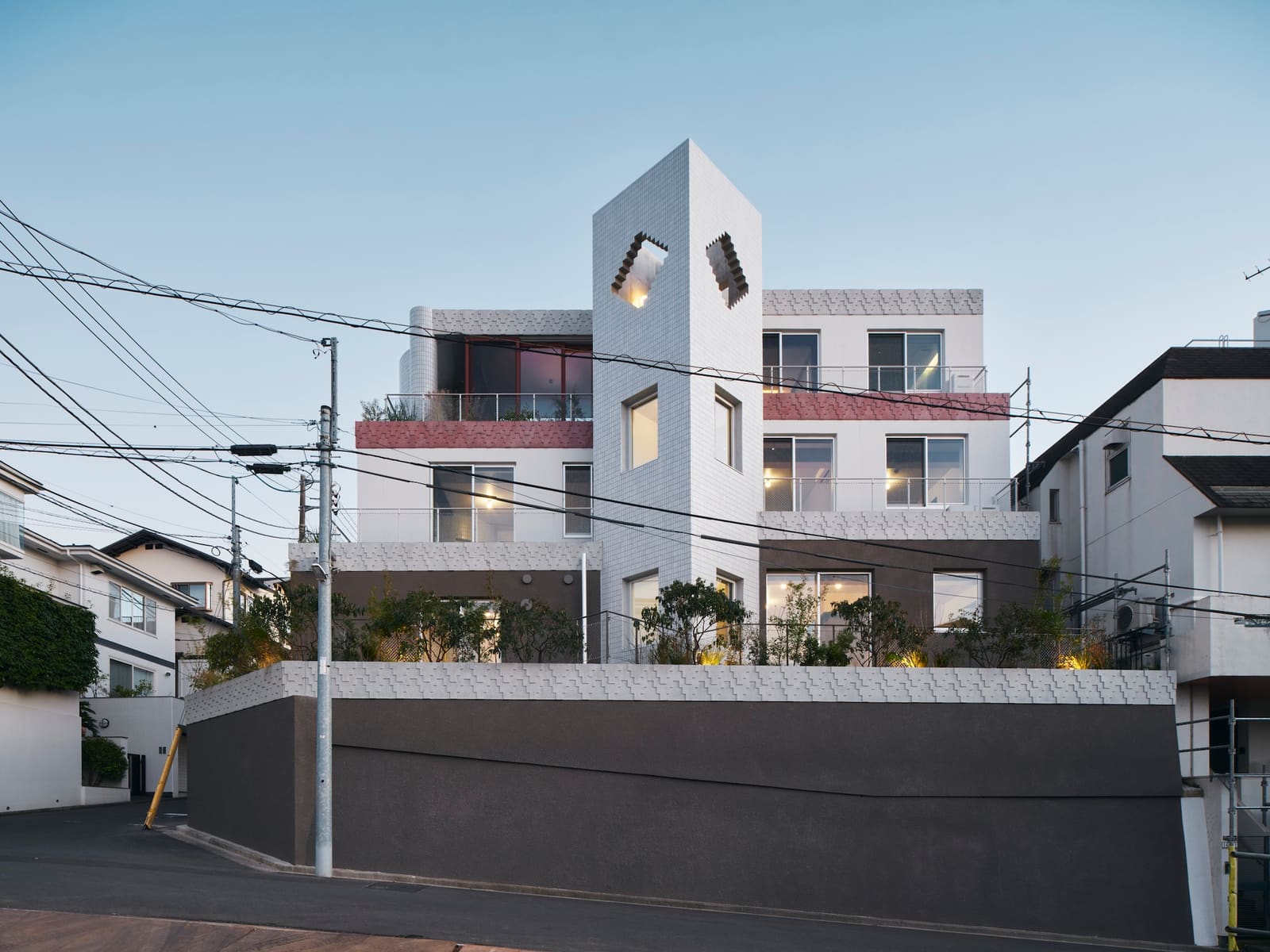
ULTRA STUDIO's recently completed apartment building in Uehara does not reject this condition outright. Instead, the 899-square-meter project, finished in 2025 under the direction of Yuji Mukaiyama and a team including Yushi Sasada, Alyssa Ueno, Daiyu Inoue, and Akito Ikeda, asks a more provocative question: what happens when you treat Tokyo's default aesthetic not as something to escape, but as raw material for design inquiry?
Arbitrary Freedom, Collective Monotony
The paradox of Tokyo's residential fabric lies in its simultaneous wildness and dullness. Each plot operates under minimal aesthetic constraint, developers free to pursue whatever logic - economic, spatial, stylistic - suits the moment. This freedom produces the chaotic streetscape often celebrated in architectural tourism: no two buildings quite alike, no overarching urban order, a kind of metabolist dream realized through market forces rather than manifesto.
Yet zoom out, and the chaos resolves into something far less exciting. The beige tile that clads so many mid-rise apartment blocks is not a conscious choice but an inherited default, a material decision made decades ago that has calcified into standard practice. Its origins remain murky. Was it a post-war pragmatism, a response to material availability and cost? An aesthetic borrowed from European modernism, filtered through Japanese construction culture? Or simply the path of least resistance, the thing everyone does because everyone does it?
At World Archi Design, we have seen similar phenomena in other dense Asian cities, where rapid development produces a kind of accidental uniformity. But Tokyo's version carries a particular inertia, a quality of having always been this way, even though historical photographs reveal it was not.
Material as Critique
ULTRA STUDIO's response does not announce itself with loud formal gestures. The massing remains legible within its neighborhood context, neither aggressively sculptural nor self-effacing. The facade engages the beige-tile tradition, but with a deliberate shift in texture, scale, and composition. Where typical apartment cladding reads as neutral backdrop, here the materiality is foregrounded, made strange through precision.
This is not pastiche. The project does not mock the vernacular it references. Instead, it operates through a kind of estrangement, using familiar elements in configurations that reveal their latent qualities. The tile becomes less a default and more a tectonic system, its modular logic exposed rather than buried under layers of habitual application. Structural collaboration with Ohno Japan ensures that the building reads as both contextually embedded and formally deliberate, a careful calibration between fitting in and standing apart.
Landscape work by Oryza and lighting design by Filaments further complicate the reading. These are not ornamental additions but integral components of the project's spatial and perceptual strategy. The lighting, in particular, shifts how the facade is understood at different hours, revealing texture and shadow that daylight alone would flatten.
Updating the Everyday
The question ULTRA STUDIO poses is not whether Tokyo's streetscape is good or bad, beautiful or ugly. It is whether this inherited condition can be engaged critically without abandoning it entirely. Can the beige tile, the generic massing, the banal repetition of form become productive constraints rather than failures of imagination?
This approach has precedents. Atelier Bow-Wow's studies of "pet architecture" treated Tokyo's odd, leftover spaces as design prompts rather than urban blight. Kazuyo Sejima's early housing projects worked within tight budgets and conventional typologies, extracting unexpected spatial richness from limited means. ULTRA STUDIO's Uehara apartment continues this lineage, treating the city's default aesthetic not as something to transcend but as a material condition worth interrogating.
The risk in such work is that it becomes indistinguishable from what it critiques. A facade that references the beige-tile vernacular might simply read as another beige-tile building, its conceptual framework invisible to anyone not versed in architectural discourse. This is the tightrope of contextual practice: how to engage the everyday without disappearing into it.
The Streetscape We Inherit
Tokyo's residential landscape is not static, though it often feels that way. The beige tile that dominates today replaced earlier materials - wood, stucco, corrugated metal - that once defined the city's appearance. Those materials, too, were probably considered banal in their time, unremarkable until they were gone. What seems "natural" in any urban context is simply what has persisted long enough to feel inevitable.
ULTRA STUDIO's intervention suggests that this inevitability can be questioned without wholesale rejection. The project does not propose a radical departure from Tokyo's visual language but a subtle recalibration, a way of seeing the familiar with renewed attention. This is incremental urbanism at the scale of the single building, a shift in tone rather than a revolution in form.
Whether this approach can accumulate into broader change remains uncertain. A single apartment building, however thoughtfully conceived, cannot reshape a cityscape. But it can model a different relationship to that cityscape, one that acknowledges the aesthetic inheritance without treating it as fixed. The beige tile, in this reading, becomes less a symbol of Tokyo's blandness and more a medium for reflection - a surface that, when handled with care, reveals the assumptions embedded in what we take for granted.
Beyond Praise and Criticism
The discourse around Tokyo's urban form tends toward two poles: celebration of its anarchic energy or lament for its lack of coherence. Both responses assume the city's appearance is either a virtue or a failure, something to defend or correct. ULTRA STUDIO's Uehara apartment offers a third position: acceptance without resignation, engagement without nostalgia.
This is not an easy stance to occupy. It requires resisting the impulse to impose order on chaos or to romanticize disorder as freedom. It means working within the city's existing logic while subtly shifting its terms, using the materials and typologies already in circulation but deploying them with intention. The result is architecture that neither blends in nor stands out, but hovers in the productive space between.
In a city where the next building is always different yet somehow the same, where wild freedom and banality coexist in every block, this kind of nuanced practice may be the most radical position available. Not a rejection of the everyday, but a patient, attentive reworking of it - one facade, one material decision, one building at a time.
Credit: Kenya Chiba
Save this story. A free account keeps your reading list and the 07:00 email in one place.
CREATE FREE ACCOUNT →SIGN IN