The Aesthetic of Absence
There is something clarifying about encountering a building that no longer serves anyone. Stripped of the noise of occupation, a structure becomes legible in a different way. Its massing reads more clearly. Its relationship to landscape sharpens. The decisions embedded in fenestration, material choice, and spatial hierarchy come forward, unmediated by the clutter of use.
Across the projects we have covered this year at World Archi Design, the question of permanence surfaces again and again. How long should a building last? What does it mean when it outlives its program? In abandoned settlements worldwide, these questions take on physical form. The towns and cities explored here span mining booms, Cold War ambitions, and ancient cliff-dwelling cultures. What unites them is not tragedy alone, but the clarity with which their architecture speaks once the inhabitants have gone.
Ancestral Ingenuity in Stone: Mesa Verde
In the late twelfth century, the Ancestral Pueblo people of what is now southwest Colorado began an extraordinary architectural shift. They moved from mesa-top dwellings into alcoves carved into natural cliff faces. The resulting structures ranged from single-room granaries to multi-story complexes housing over a hundred residents. Cliff Palace, the largest of these settlements, demonstrates sophisticated spatial planning within severe topographic constraints.
The masonry techniques employed are worth noting. Stone blocks were shaped by hand and set with adobe mortar, creating walls that have endured more than eight centuries. The placement of these dwellings within alcoves provided thermal mass and protection from the elements, a passive environmental strategy that prefigures contemporary concerns with climate-responsive design. By the mid-thirteenth century, the inhabitants had migrated south, leaving behind what is now Mesa Verde National Park, a preserved record of pre-Columbian architectural achievement.
Extraction Economies and Their Built Remnants
The architecture of resource extraction follows a predictable arc. A discovery is made. Capital flows in. Infrastructure rises rapidly, often with little regard for long-term planning. Then the resource depletes, and the settlement empties. What remains is a snapshot of industrial optimism, frozen at the moment of abandonment.
Bodie, California, exemplifies this pattern. Following the discovery of gold near Mono Lake in 1859, the town swelled to over 10,000 residents by the 1870s. The vernacular architecture of Bodie reflects the haste of its construction: wood-frame structures with minimal ornamentation, built to house miners and merchants during the boom. When the ore ran out in the early twentieth century, the town depopulated rapidly. Fires in 1892 and 1932 destroyed much of the settlement, but what survives is remarkably intact, preserved by the dry climate and protected as a state historic park.
A similar trajectory unfolded in Kolmanskop, Namibia. After diamonds were discovered in 1908, a full town materialized in the Namib Desert. At its peak in 1912, the settlement accounted for nearly twelve percent of global diamond production. The architecture reflected this sudden wealth: German colonial style buildings with high ceilings, ornate detailing, and even a ballroom. Kolmanskop also housed the southern hemisphere's first x-ray machine, installed in the town hospital. By the 1950s, the diamond fields were exhausted. Residents departed, and the desert began its slow reclamation. Today, sand fills the interiors of these structures, dunes spilling through doorways and rising to window height, a process of material return that is both destructive and strangely generative.
Further north, in Chile's Atacama Desert, Humberstone tells a parallel story. Founded in 1872 and named for English engineer James Humberstone, the town extracted saltpeter for use in fertilizer and explosives. The settlement included a theater, company housing, and a swimming pool fashioned from a ship's hull. The invention of synthetic nitrate in the 1930s rendered natural saltpeter obsolete. By 1960, operations had ceased. The town is now a UNESCO World Heritage Site, its wooden storefronts and rusted machinery preserved by one of the driest climates on Earth.
Soviet Ambitions, Post-Soviet Decay
The architectural legacy of the Soviet Union includes not only monumental civic structures but also entire planned towns built around specific industries. These settlements, often constructed rapidly with prefabricated components, were designed to support workers in remote or strategically important locations. When the political and economic systems that sustained them collapsed, many were abandoned.
Tskaltubo, Georgia, was once a premier health resort, celebrated for its mineral springs and grand sanatoriums. Built during the Soviet era, these facilities featured sweeping arcs, decorative motifs, and expansive public bathing halls. The town attracted visitors from across the Soviet Union seeking therapeutic treatments. Following the dissolution of the USSR in the early 1990s, Tskaltubo fell into neglect. The sanatoriums stand empty, their interiors marked by peeling murals and waterlogged floors, yet the architectural ambition remains legible.
Pyramiden, located in the Norwegian archipelago of Svalbard, presents a more extreme case. This Russian coal mining settlement was established to extract resources in one of the world's most inhospitable environments. At its peak in the 1980s, it housed over a thousand residents. The town included housing blocks, a cultural center, and recreational facilities, all designed to sustain a community far above the Arctic Circle. A plane crash in 1996, combined with declining coal prices, led to the settlement's closure in 1998. Residents departed abruptly, leaving behind personal belongings, furniture, and equipment. The Arctic climate has slowed decay, preserving the town in a state of arrested animation.
Pripyat, Ukraine, occupies a unique position in this category. Built in the 1970s to house workers at the Chernobyl Nuclear Power Plant, the city was home to nearly 50,000 people, most under the age of thirty. The urban plan prioritized schools, sports complexes, and public spaces, reflecting the demographic composition. An amusement park was scheduled to open in May 1986. On April 26, reactor four exploded. Residents were evacuated within days, told they would return shortly. They never did. Pripyat's architecture, typical of Soviet atomograds, consists of prefabricated high-rise apartment blocks and expansive public squares. The site remains contaminated, but its urban fabric offers insight into late Soviet planning priorities and the abrupt rupture caused by technological disaster.
Desert Reclamations: The Arabian Peninsula
In the United Arab Emirates, two abandoned settlements illustrate how modernization can render older communities obsolete. Al Jazira Al Hamra, located in Ras Al Khaimah, dates to the fourteenth century. It was a pearl-fishing and trading village, built with coral and mud-brick, featuring traditional wind towers for passive cooling. The oil boom of the 1960s prompted residents to relocate, leaving behind a well-preserved example of pre-industrial Emirati architecture. The carved wooden doors and narrow alleyways remain intact, a spatial logic adapted to both climate and community.
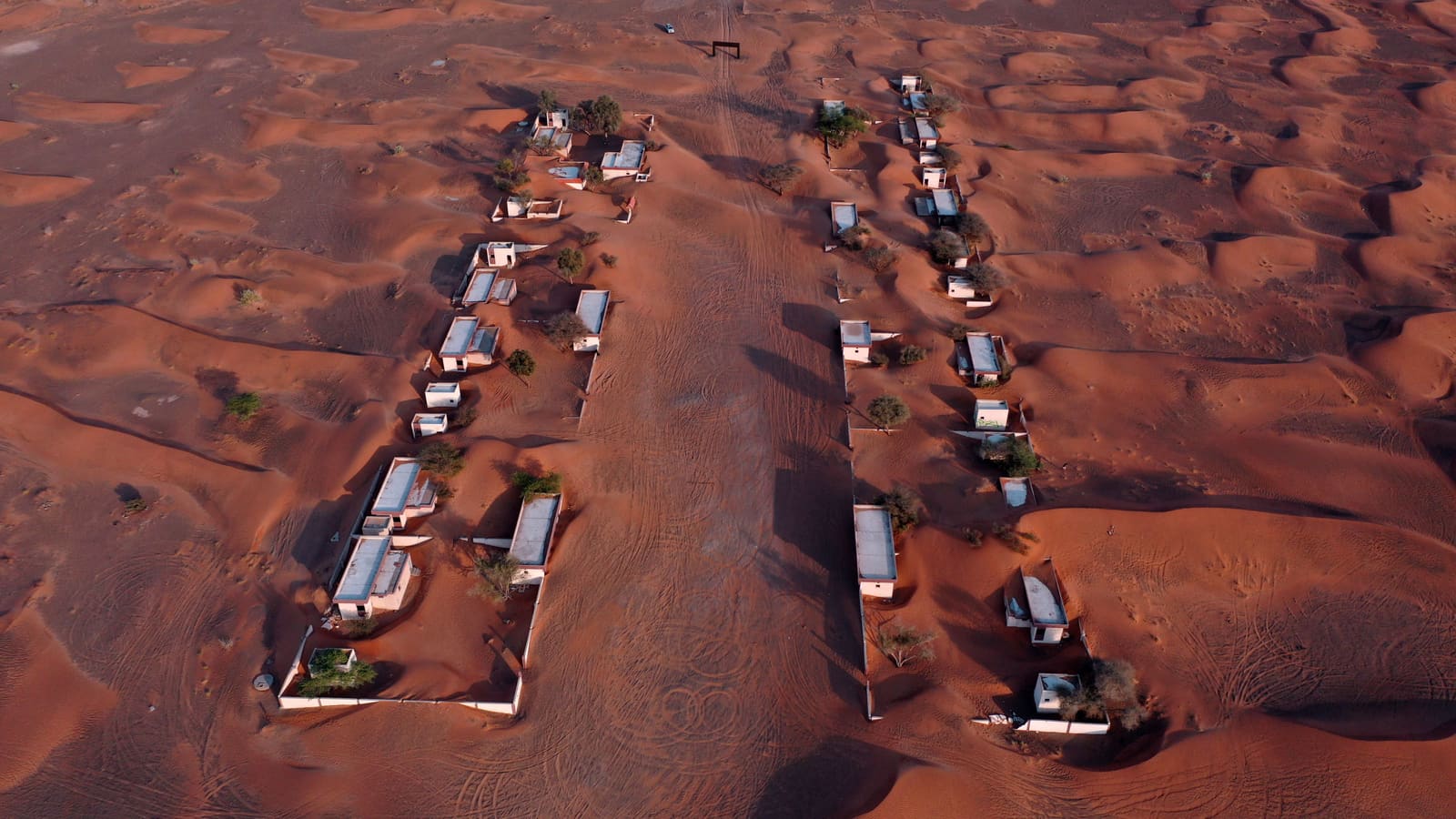
Al-Madam, in Sharjah, is more recent. Established in the 1970s as part of a government modernization initiative, the village included a dozen homes and a mosque, all constructed with mud and brick. The settlement was conceived to serve Bedouin communities, but the construction of modern highways bypassed the area, isolating it economically. By the 1990s, residents had departed. Sand has since buried much of the village, with dunes encroaching on interiors and obscuring rooflines.
Water as Catalyst and Destroyer
Villa Epecuén, Argentina, offers a different narrative of abandonment. This lakeside resort town near Buenos Aires thrived as a tourist destination, attracting visitors to its mineral-rich waters. In 1985, a dam failed, and the adjacent lake swelled, submerging the town under ten meters of water. For more than two decades, Villa Epecuén remained underwater. When the lake began receding in the early 2000s, the town reappeared, its structures encrusted with salt. The mineral deposits have both preserved and transformed the architecture, creating a ghostly white patina that coats walls, furniture, and streets.
Craco, Italy, faced a different set of challenges. Perched on a hilltop in Matera, the medieval town's architecture reflects Norman influences and local stone-building traditions. A series of natural disasters in the latter half of the twentieth century rendered the site uninhabitable. A landslide in 1963, followed by a flood in 1972 and an earthquake in 1980, prompted full evacuation. The town's fortified walls and carved stone details remain, but the unstable geology prevents re-occupation.
Fortresses and Palaces: Mandu
Mandu, in the central Indian state of Madhya Pradesh, is less a ghost town than an archaeological landscape. This fortified city served as a retreat for Afghan rulers and later the Mughal Empire. The architecture includes palaces, mosques, and tombs, many displaying intricate stonework and ornamental detailing. Jahaz Mahal, or Ship Palace, is perhaps the most striking structure, appearing to float between two artificial lakes. Political upheaval over centuries led to Mandu's gradual abandonment. The site remains significant not for a singular moment of desertion, but for the layered history embedded in its built fabric.
Industrial Silence: Kennecott
In the remote Wrangell-St. Elias region of Alaska, Kennecott stands as a monument to early twentieth-century copper mining. The town's architecture is defined by its crimson-painted mill buildings, constructed to process ore extracted from nearby mountains. At its peak, Kennecott housed hundreds of workers and included all the infrastructure necessary for a functioning community: housing, a hospital, schools, and recreational facilities. When the copper ran out in the 1930s, operations ceased. The harsh Alaskan climate has weathered the structures, but the isolation has also protected them from vandalism. Kennecott is now part of a national park, its rusted machinery and empty dormitories preserved as a record of the industrial ambitions that once electrified the United States.
What Remains
At World Archi Design, we return often to questions of durability and intention. These abandoned settlements complicate easy answers. They demonstrate that buildings can outlast their programs by centuries, yet they also reveal how quickly a thriving community can dissolve. The architecture in these places was not designed for contemplation. It was built to shelter, to extract, to govern. But in abandonment, it assumes a new role: as evidence, as ruin, as something approaching art.
The forces that empty these places vary, from economic collapse to environmental disaster to geopolitical rupture. What they share is a kind of clarity. Without inhabitants, the tectonic logic of a structure becomes visible. The relationship between building and landscape sharpens. We see not only what was built, but why it could not endure.
Credit: Giuseppe Cacace / Getty Images
Save this story. A free account keeps your reading list and the 07:00 email in one place.
CREATE FREE ACCOUNT →SIGN IN