The Paradox of Predictable Unpredictability
Fire captivates because it refuses to repeat itself. Each flicker, each leap of flame, presents a configuration that will never occur again. Øivind Slaatto built his newest lighting project around this observation, constructing a mathematical framework designed to simulate what cannot be calculated: the perpetual difference of natural phenomena.
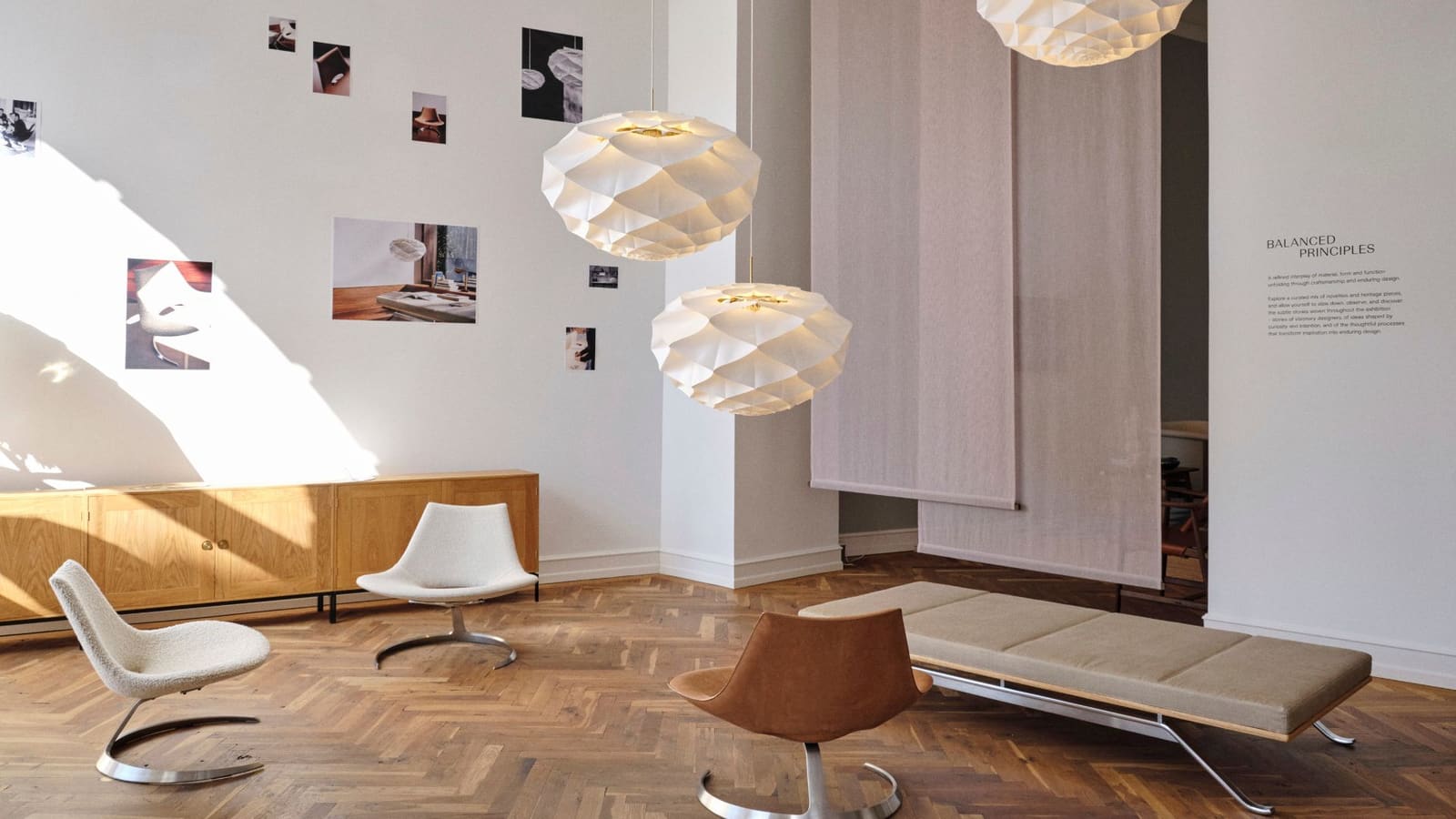
Begonya, unveiled during 3daysofdesign 2026 in Copenhagen, is a sculptural pendant that uses geometry to achieve the appearance of randomness. The lamp's elliptical shade, constructed from non-woven polyethylene that mimics paper, shifts visually depending on viewing angle and suspension height. The material dress wraps around an intricate aluminium skeleton finished in warm gold, a frame that holds together through 168 precision joints without adhesive or mechanical fasteners. Assembly requires up to seven hours per unit.
This is not efficient. It is not scalable in the ways contemporary manufacturing typically demands. Yet for Carl Hansen & Søn, the Danish furniture and lighting producer that commissioned the piece, the labor intensity is not an obstacle to overcome but a defining characteristic to preserve.
Structure Without Fixity
Slaatto, a Copenhagen-based designer whose early work centered on industrial and audio products, has spent recent years investigating how light behaves in relation to form. His approach for Begonya began with the question of replicating fire's visual instability within a static object. The solution involved creating a shade complex enough that human perception registers it as dynamic.
The name itself carries a deliberate distortion. "Begonya" replaces the botanical spelling of "begonia" with a "y," a typographic gesture that signals the fusion of organic inspiration and artificial construction. The lamp is not attempting to mimic nature directly; it is translating natural principles into industrial language.
The elliptical shade serves dual functions: distributing light evenly to surrounding spaces while concealing the source to prevent glare. The aluminium skeleton inside, with its jointed assembly, represents a level of mechanical precision that paradoxically enables the handmade quality of the final product. Each joint must align exactly for the polyethylene dress to attach correctly, a process that demands both engineering rigor and manual dexterity.
The Cost of Staying Local
Seven hours of assembly labor per lamp becomes economically legible only within a specific production philosophy. Carl Hansen & Søn manufactures nearly all of its catalog, excepting outdoor pieces, in Denmark, a country where wage levels have pushed much of the furniture industry offshore. The company's factory on the island of Funen employs approximately 500 workers and operates not only as a production facility but as a training academy for craftspeople entering the trade.
Knud Erik Hansen, the company's CEO and third-generation family owner, frames the commitment to hand production through an evolutionary argument: the human hand's movement while sanding wood results from millions of years of biological refinement. Machines, in this view, cannot access that accumulated knowledge embedded in muscle memory and tactile feedback.
This is not nostalgia masquerading as business strategy. The physical demands of handwork are significant enough that Carl Hansen & Søn employs a physiotherapist on staff and conducts morning warm-up sessions to prevent repetitive strain injuries among workers. The company has structured its operations around the reality that human bodies, when used as tools, require maintenance and care.
The decision to keep production in Denmark, despite higher costs, reflects a calculation about value that extends beyond unit economics. In an industry where provenance increasingly functions as brand differentiation, the ability to claim local manufacture becomes a market asset. But the commitment predates contemporary marketing trends; Carl Hansen & Søn has operated this way since its founding in 1908.
Balanced Principles as Curatorial Argument
Begonya debuted within an exhibition titled "Balanced Principles," staged at the company's Copenhagen flagship during the June design week. The show positioned the new lamp alongside historical pieces from the Carl Hansen & Søn archive, creating a dialogue between eras and design languages.
The Scimitar Chair by Fabricius & Kastholm, originally designed in 1963, appeared as a recently reedited piece. Erik Magnussen's Porcelight from 1982, a bone china pendant that exploits the material's translucency for diffused illumination, represented another archival revival. A leather-upholstered version of Hans Wegner's Wishbone chair, the company's most recognized design, offered a subtle material variation on an enduring form.
The curatorial strategy was straightforward: demonstrate continuity across decades by placing objects in conversation. Begonya, as the newest entry, had to prove it belonged in this lineage without simply replicating what came before. The lamp achieves this through material choice and fabrication method rather than formal mimicry. Where Wegner's Wishbone chair used steam-bent wood and woven cord, Slaatto's pendant employs aluminium and synthetic fiber. The aesthetic languages differ significantly, yet the underlying commitment to labor-intensive, hand-assembled construction remains consistent.
Material Honesty and Its Limits
Danish design's reputation rests partly on the principle of material honesty, the idea that objects should express their construction methods and material properties without concealment. Begonya complicates this principle. The polyethylene dress reads as paper, a deliberate illusion. The mathematical structure that generates the shade's visual complexity remains invisible to the user. The lamp does not announce how it was made; it performs an effect.
Yet the object remains legible within Danish design traditions because the fabrication process itself adheres to craft values. The seven-hour assembly time, the jointed aluminium frame, the manual attachment of the dress to the skeleton, all reflect a production ethos that prioritizes hand skill over automation. The material may deceive the eye, but the making does not compromise on method.
This distinction matters in an era when "handmade" has become a marketing term often detached from actual production realities. Carl Hansen & Søn's model depends on the claim being verifiable. The Funen factory, the craftsperson academy, the on-site physiotherapist, these operational details function as evidence that the company's stated values translate into concrete practice.
Precedent and Departure
Placing Begonya alongside mid-century Danish furniture reveals both inheritance and departure. Wegner, Mogensen, and other postwar designers working with Carl Hansen & Søn operated within a specific material vocabulary: solid wood, woven natural fibers, leather, materials that carried associations with craft traditions and domestic warmth. Their designs often emphasized structural clarity, making joinery visible and celebrating the mechanical intelligence of wood connections.
Slaatto's lamp uses synthetic materials and hides its structure. The visual effect takes precedence over legibility of assembly. This represents a shift in priorities, one that reflects broader changes in design practice over the past two decades. Contemporary designers frequently work with materials and fabrication methods that previous generations would have considered industrial rather than artisanal.
Yet the lamp's production process aligns with older craft values. The extensive hand assembly, the precision required at each joint, the time investment per unit, these factors connect Begonya to the furniture pieces surrounding it in "Balanced Principles." The object demonstrates that craft logic can migrate across material categories without losing its essential character.
The Question of Scale
Seven hours per lamp presents an obvious constraint on production volume. Carl Hansen & Søn is not attempting to compete in mass-market lighting. The company's business model depends on premium pricing justified by production method and brand heritage. Begonya will not appear in big-box retailers or fast-furniture showrooms. It occupies a market segment where buyers value the story of making as much as the object itself.
This raises the question of whether such a model can sustain itself as craft knowledge becomes scarcer and labor costs continue rising in high-wage economies. Carl Hansen & Søn's response has been to invest in training through its academy program, essentially building its own pipeline of skilled workers rather than relying on an external labor market that may not produce them.
The strategy works only if the company can maintain pricing power, which requires that the market continues to assign premium value to hand production. So far, that calculus has held. Whether it remains viable as younger consumers with different value systems enter the market is an open question.
What Persists
At World Archi Design, we have tracked numerous attempts by heritage brands to bridge historical identity and contemporary relevance. Most fail by either replicating past successes without adaptation or abandoning defining characteristics in pursuit of novelty. Carl Hansen & Søn's approach, as evidenced by Begonya, navigates this tension by holding production method constant while allowing aesthetic language to evolve.
The lamp does not look like mid-century Danish furniture. It does not need to. The connection operates at a deeper level: the commitment to hand assembly, the acceptance of labor intensity as a feature rather than a problem, the belief that human skill adds value that machines cannot replicate. These principles remain consistent even as materials and forms change.
"Balanced Principles," as an exhibition title, describes both the objects on display and the operational philosophy that produced them. Balance, in this context, does not mean compromise. It means identifying which elements must remain fixed and which can shift without collapsing the structure. For Carl Hansen & Søn, production method stays fixed. Everything else can move.
Begonya, with its seven-hour assembly time and deliberate material illusions, becomes legible as a Danish design object not because it resembles what came before, but because it was made the same way. In an industry increasingly dominated by speed and cost reduction, this insistence on slow, expensive fabrication functions as both market differentiation and ideological statement. The lamp proves that craft logic can inhabit new forms without diluting its essential character, as long as the making itself remains uncompromised.
Photo: Carl Hansen & Søn
Save this story. A free account keeps your reading list and the 07:00 email in one place.
CREATE FREE ACCOUNT →SIGN IN