The Federation That Never Quite Died
Central America's political map looks fragmented today, a collection of sovereign nations squeezed into a narrow isthmus. But this fragmentation is relatively recent. In 1823, the region briefly coalesced into the Federal Republic of Central America, a single entity that dissolved within two decades. Yet the ambition for integration persisted, resurfacing in 1951 with the Charter of San Salvador, which established ODECA, and again in 1991 with the Protocol of Tegucigalpa, which created SICA, the Central American Integration System that governs regional cooperation today.
Within this broader project, the Central American Bank for Economic Integration was founded in 1960 by Guatemala, El Salvador, Honduras, and Nicaragua. Its mandate was economic, but its symbolism extended further: a shared institution for a region that had never fully abandoned the dream of unity. The bank chose Tegucigalpa as its home, and for three decades it occupied scattered properties across the Honduran capital's historic center. By 1989, the institution recognized that its dispersed presence was no longer sustainable. It needed a single headquarters, a building that could consolidate its operations and, just as importantly, project coherence.
A Consortium Approach to Regional Architecture
The design commission went to a consortium that spanned borders and expertise. Prats Arquitectos, a Honduran firm, partnered with Miami-based Spillis Candela & Partners Inc. and Consultores Asociados de Honduras. The collaboration reflected the bank's own regional character: local knowledge paired with international technical capacity. Construction began in 1993, and the building opened in January 1998, bringing all administrative departments under one roof.
At World Archi Design, we have observed that institutional architecture in Central America often struggles with a tension between modernist internationalism and vernacular expression. The BCIE headquarters navigates this divide by grounding its materiality in place while allowing its form to remain legible within late-20th-century corporate typologies. The result is not revolutionary, but it is deliberate.
The Stone Argument
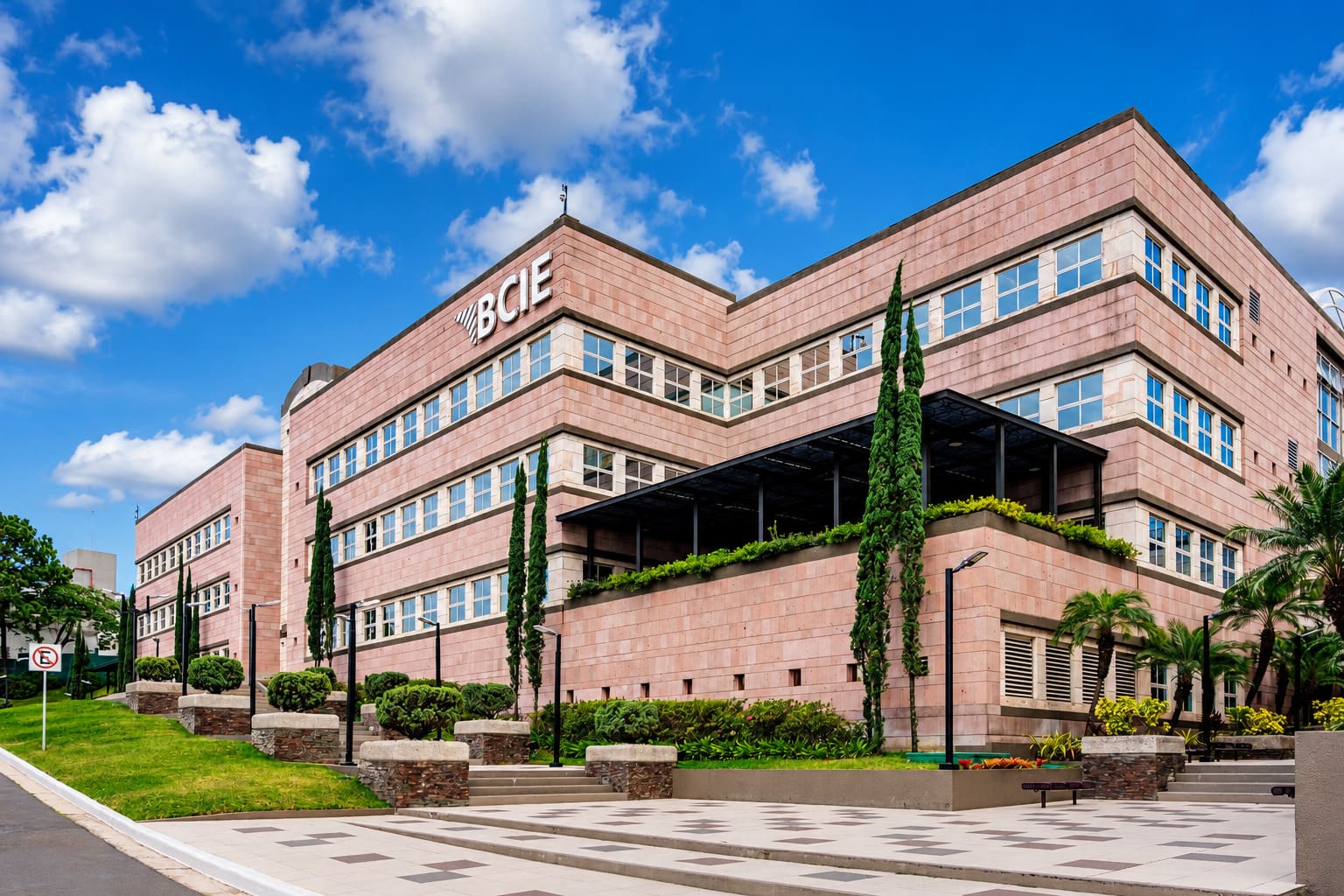
The most significant design decision is also the most visible: the façade is clad in pink quarry stone extracted from the hills surrounding Tegucigalpa. This choice is not decorative nostalgia. It is a tectonic statement that ties the building to its geographic context in a way that glass or precast concrete never could. The stone carries color variation, texture, and a sense of weight that signals permanence, an institution anchored in the region rather than floating above it.
Quarry stone has a long history in Central American construction, from colonial-era churches to early republican civic buildings. By deploying it on a contemporary office complex, the architects invoked that lineage without mimicking it. The stone reads as both traditional and modern, a material that belongs to the place but is not trapped in historicism. This is the kind of material intelligence that separates considered architecture from generic corporate shells.
The massing itself is restrained, a series of rectilinear volumes that avoid the gestural excess common in institutional projects of the 1990s. Fenestration is regular, suggesting hierarchy and order without rigidity. The building does not shout; it speaks through material honesty and proportional clarity.
Institutional Growth and the Question of Scale
Since its opening, the bank has expanded its membership beyond Central America. Today it counts fifteen member states, including South Korea, Taiwan, and Spain. This growth raises an interesting architectural question: does a building designed to represent regional integration still function symbolically when the institution becomes more global?
The answer may lie in the stone itself. As the bank's membership diversifies, the materiality of its headquarters remains rooted in Tegucigalpa. The pink quarry stone does not adapt or dilute; it holds its ground. In this way, the building asserts that institutional identity can expand without losing geographic specificity. The headquarters is not a neutral vessel; it is a place-based anchor for an evolving institution.
Precedents and Parallels
The BCIE headquarters invites comparison with other regional bank projects from the same era. The Inter-American Development Bank headquarters in Washington, D.C., designed by Skidmore, Owings & Merrill and completed in 1984, employed a different strategy: sleek curtain walls and a plaza that signaled international modernism. The African Development Bank headquarters in Abidjan, completed in the early 1980s, leaned into Brutalist monumentality. The BCIE building is quieter than both, less interested in making a statement about power and more focused on material authenticity.
This restraint may reflect the scale of the institution itself. The BCIE is not the World Bank; it does not need to project global dominance. Its mandate is regional, and its architecture reflects that modesty. The building is large enough to house consolidated operations but not so large that it overwhelms its urban context. It sits within Tegucigalpa without dominating it.
Material as Memory
There is a risk in over-romanticizing stone. It is, after all, a construction material with practical advantages: durability, thermal mass, and low maintenance. But in this case, the choice carries narrative weight. The stone was quarried from the same landscape that the building now occupies. It is a closed loop, a material economy that ties the institution to its environment in a literal sense.
This kind of material sourcing is increasingly rare in contemporary institutional architecture, where prefabricated systems and imported finishes dominate. The BCIE headquarters offers a counter-model: architecture that draws from its immediate surroundings and, in doing so, becomes inseparable from them. The building does not just sit on the land; it is made from the land.
What Remains
The BCIE headquarters is not a canonical work. It will not appear in surveys of late-20th-century architecture, and it does not push formal boundaries. But it demonstrates something more valuable: that institutional buildings can be both functional and meaningful, that they can serve administrative needs while also articulating identity.
Central America's dream of integration has taken many forms over two centuries, from short-lived federations to multilateral agreements. The BCIE building is one more expression of that dream, rendered in stone and concrete. It consolidates operations, yes, but it also consolidates meaning. The pink quarry stone is not just a surface; it is a position. It says that regional institutions can be rooted, that architecture can speak about place without retreating into pastiche, and that the ground beneath a building can be as important as the structure rising from it.
As the bank continues to evolve, adding members and expanding its reach, the headquarters remains fixed in Tegucigalpa, built from the hills that define the city. That permanence is not a limitation. It is a foundation.
Credit: Gabriela Zúniga Fu
Save this story. A free account keeps your reading list and the 07:00 email in one place.
CREATE FREE ACCOUNT →SIGN IN