The Fortress That Welcomed the World
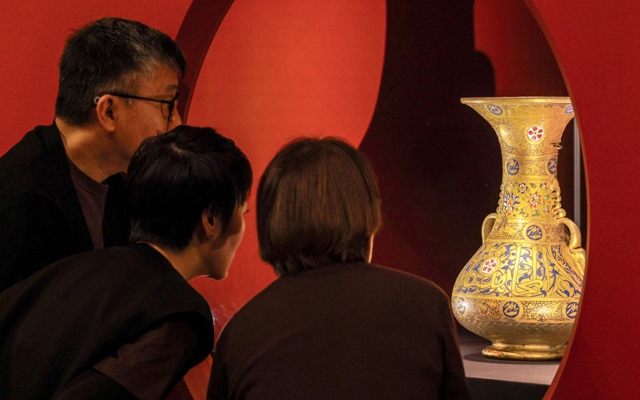
The Forbidden City endures in the popular imagination as an architecture of exclusion—a maze of vermilion walls and golden roofs designed to insulate imperial power from the outside. Yet a closer reading of the objects that filled its halls reveals a more porous reality: one in which court workshops synthesised Islamic jade-carving techniques, European clockmakers collaborated with Qing astronomers, and maritime trade routes fed an imperial appetite for foreign exotica. The Hong Kong Jockey Club Series: The Forbidden City and the World—Cultural Encounters, which opened June 3, 2026, at Hong Kong Palace Museum, argues through material culture that the imperial court was less fortress than crossroads—a place where objects carried ideas across continents, and where foreign craft traditions were absorbed, reinterpreted, and woven into the vocabulary of Chinese court art.
Presented by HKPM and the Palace Museum in Beijing, with artefacts drawn from both institutions as well as the Museum of Islamic Art in Doha, the exhibition gathers more than 130 objects—including 18 grade-one national treasures—spanning five centuries. Rather than narrate a linear story of influence, it maps overlapping networks: the overland Silk Routes and maritime spice lanes, the Jesuit missions and their transmission of Western mathematics, the Canton Customs system that regulated tea and porcelain exports during the Qing. The result is a portrait of the Forbidden City not as an endpoint of cultural diffusion, but as an active participant in transcontinental exchange.
Four Geographies of Encounter
The exhibition is structured around four thematic zones, each corresponding to a distinct mode of contact. The first section examines the Silk Routes and maritime trade during the Yuan and early Ming periods, when Mongol expansion and the voyages of Admiral Zheng He opened unprecedented channels for the movement of goods and craftspeople. Among the highlights is a rare Ming dynasty textile linked to Zheng He's expeditions—a fragment whose weave technique and motifs suggest contact with Southeast Asian or Indian workshops. The object is presented alongside ceramics and metalwork that travelled the same routes, material evidence of a court deeply engaged with the wider Islamicate and Indic worlds.
The second section turns to the phenomenon of imported treasures and their transformation within court workshops. A jadeite ruyi sceptre—carved from Burmese jade, a material prized for its translucency and colour—exemplifies the Qing fascination with foreign stones. Yet the form itself, a stylised lingzhi fungus, is thoroughly Chinese, a reminder that even when materials crossed borders, the grammar of court art remained rooted in indigenous symbolism. Nearby, Islamic-style metalwork and Persian carpets attest to the longstanding influence of Central Asian aesthetics on Ming and Qing decorative arts, a legacy of the Yuan period that persisted long after the Mongol court fell.
The third section addresses the Jesuit presence at court during the late Ming and Qing dynasties, a period when European missionaries served as astronomers, cartographers, and painters to the emperor. Here, a geometric model reflecting the Kangxi Emperor's engagement with Euclidean mathematics offers a window into the court's selective embrace of Western science. Kangxi, known for his intellectual curiosity, commissioned translations of mathematical texts and employed Jesuit scholars to reform the imperial calendar. Yet this was not a one-way transfer: Chinese craft techniques—particularly in porcelain and lacquer—were simultaneously flowing westward, shaping European tastes and spurring the development of chinoiserie.
The final section focuses on the Canton Customs system during the Qing, the institutional apparatus that mediated trade between China and Europe from the early eighteenth century onward. Objects connected to the tea trade—porcelain teapots designed for export, lacquered tea caddies, silver spoons bearing European hallmarks—document the commodification of Chinese culture for Western markets. Yet they also reveal how foreign demand reshaped domestic production: export porcelain often featured hybrid motifs, blending European heraldry with Chinese landscape conventions, a visual language legible to neither culture in isolation but intelligible within the transactional space of global trade.
Precedent: The Museum as Diplomatic Space
The exhibition's curatorial strategy recalls precedents in the display of cross-cultural exchange, particularly the Encompassing the Globe show at the Smithsonian's Freer and Sackler Galleries (2007), which used objects to map early modern trade networks, and the British Museum's Ming: 50 Years that Changed China (2014), which foregrounded the dynasty's maritime ambitions. Yet The Forbidden City and the World distinguishes itself by centring the imperial court as an agent, not merely a recipient, of exchange. Where earlier exhibitions often framed Asian objects within narratives of European exploration, this show reverses the gaze, asking how foreign materials and techniques were absorbed into indigenous systems of meaning.
The decision to stage the exhibition at HKPM, rather than in Beijing, is itself a curatorial statement. Hong Kong, a former entrepôt at the edge of the Qing empire, now serves as a site for reframing the Forbidden City's global entanglements. The museum, designed by Rocco Design Architects Associates and completed in 2022, sits in the West Kowloon Cultural District—a zone of land reclamation and state-sponsored cultural infrastructure. Its architecture, a series of interlocking volumes clad in bronze-toned aluminium, gestures toward traditional Chinese courtyard typology while remaining resolutely contemporary. The building's galleries, particularly Gallery 1 where this exhibition is installed, feature double-height ceilings and flexible wall systems that allow for both monumental display and intimate object study.
Material Diplomacy and the Question of Attribution
One of the exhibition's quiet achievements is its refusal to flatten the complexity of attribution. Many of the objects on view—particularly those from the Ming and Qing periods—were produced by workshops whose membership included foreign craftspeople: Islamic jade carvers, Jesuit painters, Tibetan metalworkers. Yet court records often efface individual authorship, crediting the workshop or the emperor who commissioned the piece rather than the artisan who made it. The exhibition, through wall text and multimedia installations, acknowledges this archival silence without attempting to resolve it. Instead, it foregrounds the collaborative nature of court production, a system in which foreign techniques were absorbed into Chinese craft traditions not through passive imitation but through active negotiation.
This approach complicates nationalist narratives that seek to isolate a purely "Chinese" aesthetic. The objects on view suggest that court art was, from the outset, a hybrid enterprise—one shaped as much by the movement of materials and people as by indigenous tradition. A Qing dynasty cloisonné vase, for instance, employs enamel techniques derived from Byzantine and Islamic metalwork, yet its form and decorative programme are unmistakably Chinese. To ask whether such an object is "Chinese" or "foreign" is to miss the point: it is both, a material record of exchange that resists easy categorisation.
Pedagogy and Public Engagement
Beyond the objects themselves, the exhibition incorporates multimedia installations and interactive displays designed to situate artefacts within broader historical narratives. A digital map traces the routes travelled by the objects on view, from the jade mines of Burma to the porcelain kilns of Jingdezhen to the Canton docks. Touchscreens allow visitors to explore the technical processes behind cloisonné enamelling, silk weaving, and jade carving. These interventions, while didactic, avoid the pitfalls of edutainment; they are tools for deepening engagement, not substitutes for the objects.
The museum has also programmed a series of guided tours, workshops, and public talks to extend the exhibition's reach. Upcoming sessions include a lecture on Jesuit cartography at the Qing court and a workshop on traditional Chinese tea culture. These programmes, sponsored by The Hong Kong Jockey Club Charities Trust, reflect HKPM's mandate not only to display objects but to foster dialogue around them—to position the museum as a site of ongoing inquiry rather than a repository of fixed knowledge.
Reframing the Centre
What emerges from The Forbidden City and the World is a revised understanding of the imperial court's place in early modern global history. Rather than an isolated centre radiating influence outward, the Forbidden City appears here as one node among many in a network of exchange that connected Beijing to Bukhara, Lisbon to Canton, Isfahan to Jingdezhen. The exhibition does not argue for equivalence—the power dynamics of these exchanges were rarely symmetrical—but it does insist on complexity, on the agency of non-European actors, and on the porosity of borders that official historiography has often rendered impermeable.
In an era when museums are rethinking the politics of display and the ethics of collection, The Forbidden City and the World offers a model for how institutions might narrate cultural exchange without erasing asymmetry or collapsing difference. Its strength lies not in grand claims but in the patient accumulation of detail: the weave of a textile, the glaze of a teapot, the geometric precision of a Jesuit model. These objects, handled and studied and displayed, become arguments—quiet, material arguments for a history more entangled than we have been taught to see.
The Hong Kong Jockey Club Series: The Forbidden City and the World—Cultural Encounters / Hong Kong Palace Museum, West Kowloon Cultural District, Hong Kong, 2026.
Save this story. A free account keeps your reading list and the 07:00 email in one place.
CREATE FREE ACCOUNT →SIGN IN