The Predatory Elegance of Restraint
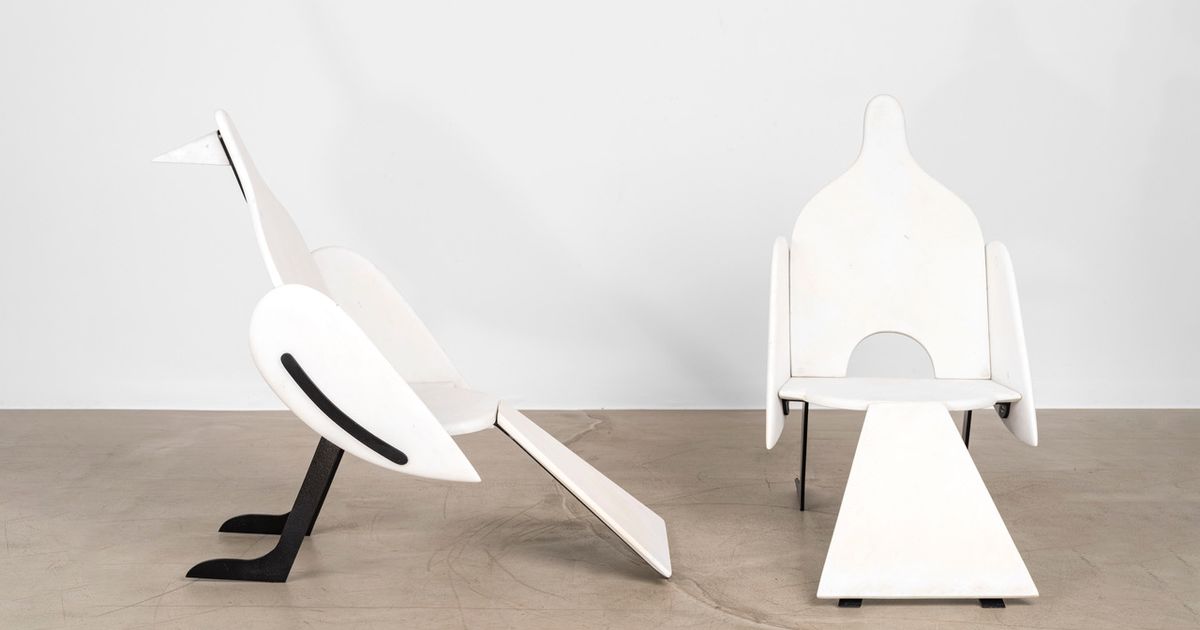
What does it mean to spend months carving a single object in an economy that measures productivity in sprints? At TEFAF New York this spring, Galerie Lefebvre presented two pairs of François-Xavier Lalanne's marble-bird chairs—works that operate at the intersection of zoomorphic furniture and tectonic sculpture. Only twelve of these large-scale pieces were ever produced, beginning with a 1974 commission from gallerist Alexander Iolas and refined around 1978 for Yves Saint Laurent. The surviving pairs are now among the rarest expressions of Lalanne's otherwise prolific menagerie.
Unlike his wool-upholstered sheep or his cast-bronze rhinoceros desk, the marble birds eschew mimetic detail. Instead, Lalanne deployed minimal gestural marks: a single incised dot for an eye, a cleanly cleaved line bisecting the beak. The restraint is architectural—each form reads as both functional seating and sculptural mass. When occupied, the chairs perform a strange ontological fusion: the sitter's head merges with the avian skull, creating what might be called an intra-bestial Janus. The effect is unsettling in the way good design often is—it destabilizes the boundary between user and object, animate and inert.
This predatory quality—the sense that the bird might take flight mid-sit—recalls Lalanne's 1973 Babouin, a cast-iron stove shaped as a primate. Both works traffic in a kind of marvelous menace, where utility coexists with latent threat.
Stone as Counterpoint to the Postmodern Material Palette
The marble birds arrived at TEFAF as a material argument. Over the past two decades, contemporary and postmodern design have been dominated by plastics, resins, chrome, steel, glass, and engineered wood—materials that privilege speed of production, scalability, and formal experimentation. Stone, by contrast, demands durability of focus. It cannot be 3D-printed or injection-molded. It resists the logic of the assembly line.
At World Archi Design, we've been tracking a quiet return to craft-intensive materials across high-end residential and institutional projects—hand-laid terra-cotta, lime-washed plaster, dry-stacked masonry. But stone carving occupies a different temporal register. A single acanthus-wrapped Roman column, like the second-century examples shown by Charles Ede at TEFAF, would require several uninterrupted months of skilled labor to replicate today. The leaves twist and unfurl with such delicacy that they read as textile rather than mineral—a kind of petrified silk.
This deceptive softness is central to stone's expressive range. The medium communicates both mass and fragility, permanence and vulnerability. The Lalanne birds leverage this duality: their slender proportions and sparse detailing make them feel almost too slight to support human weight, yet they are carved from one of the planet's most enduring materials.
Cycladic Precedents and the Archaeology of Minimalism
Lalanne's approach to stone has antecedents in the Cycladic figures of the Bronze Age—those enigmatic, attenuated human forms that feel like proto-modernist abstractions. Both the ancient figures and the 1970s marble birds transmit skill through economy of means. They prove that restraint, when executed with mastery, can carry as much formal intelligence as ornament.
This lineage was implicit in TEFAF's stone offerings, but it became explicit in Set in Stone, a concurrent exhibition at David Zwirner curated by art adviser Emma Kronman and antiques dealer Laura Kugel. The show drew conceptual scaffolding from the writings of Roger Caillois, the French geologist and essayist who treated stone as a site of scientific, artistic, spiritual, and metaphorical inquiry. Caillois understood that stone is not inert—it is a record of geological violence and regeneration, a material archive spanning millions of years.
Set in Stone juxtaposed contemporary works like Andra Ursuta's cast-glass Grande Odalisque with historical objects such as a 17th-century carved amber jug attributed to Jacob Heise and a first-century sardonyx amphora known as the Dashkov Vase. The vase, carved from a single piece of stone and encircled by two incised lines one-third up from its base, exemplifies the kind of technical audacity that ancient lapidaries achieved without motorized tools. Its broken arm, rather than diminishing its value, amplifies its fragility—a crack in the mineral sublime.
Material Memory and the Limits of Interpretation
What these objects share is not style but duration. They are slow objects in a fast discipline. Giorgio Morandi's still-life paintings of jugs, included in the Zwirner exhibition, operate in a similar temporal mode—quiet, iterative, resistant to spectacle. Placed beside a 1640–1660 agate casket, the Morandi canvases underscore how materiality and perception co-construct meaning over time.
This is where stone diverges from the ephemerality of much contemporary design. A resin chair or a powder-coated steel table announces its moment of production; it reads as of the 2020s or the 1990s. Stone, by contrast, carries geological time within its grain. It refuses to be periodized. The Lalanne birds were made in the 1970s, but their formal language could belong to antiquity or to a speculative future.
At World Archi Design, we've noted a growing interest in what might be called material anachronism—the deliberate deployment of ancient techniques within contemporary contexts. Projects like Peter Zumthor's Therme Vals or Rick Joy's rammed-earth Desert Nomad House use vernacular materials to collapse temporal distance. Stone carving, especially at the scale and refinement of the Lalanne chairs, performs a similar collapse.
The Endurance Question
How will these marble birds read to viewers a millennium from now? The question is unanswerable, and that irresolution is precisely what sustains engagement. Unlike digitally fabricated objects, which may become illegible once their software ecosystems obsolete, hand-carved stone retains phenomenological immediacy. You can still run your hand along a Cycladic figure and understand the gesture of the chisel.
This is not an argument for nostalgia or craft fetishism. It is an observation about the politics of time in design. In an era when fabrication is increasingly automated and design authorship is distributed across parametric algorithms, the Lalanne birds remind us that certain forms of knowledge can only be transmitted through the hand. The marble itself—millions of years in formation, hours in extraction, months in carving—embodies a duration that no rendering engine can simulate.
The chairs are sinister not because they are morbid, but because they confront us with our own temporal fragility. They will outlast us. They will outlast our design discourse. And in that outlasting, they perform a kind of quiet refusal: a refusal to be consumed, to be optimized, to be replaced by the next material trend. They simply are—elegant, sparse, predatory, and patient.
Save this story. A free account keeps your reading list and the 07:00 email in one place.
CREATE FREE ACCOUNT →SIGN IN