The Question Isn't Whether Books Belong in a Room—It's Whether the Room Belongs to the Books
Across the interiors we've covered this year, a pattern has emerged: the spaces that photograph best are rarely the ones people want to live in. Librarycore—a term that has migrated from niche corners of the internet into mainstream design discourse—offers a counterargument. It privileges accumulation over curation, warmth over polish, and the visible evidence of use over the appearance of control. The question isn't whether your home needs more books. It's whether you're willing to design around the idea that a room can look inhabited without looking compromised.
This is not about recreating the Bodleian. It's about understanding why certain spatial conditions—soft light, horizontal surfaces cluttered with intent, the proximity of seating to storage—produce a feeling of intellectual ease that no amount of minimalist rigor can replicate.
Light as Spatial Anchor: Why Overhead Fixtures Fail the Test
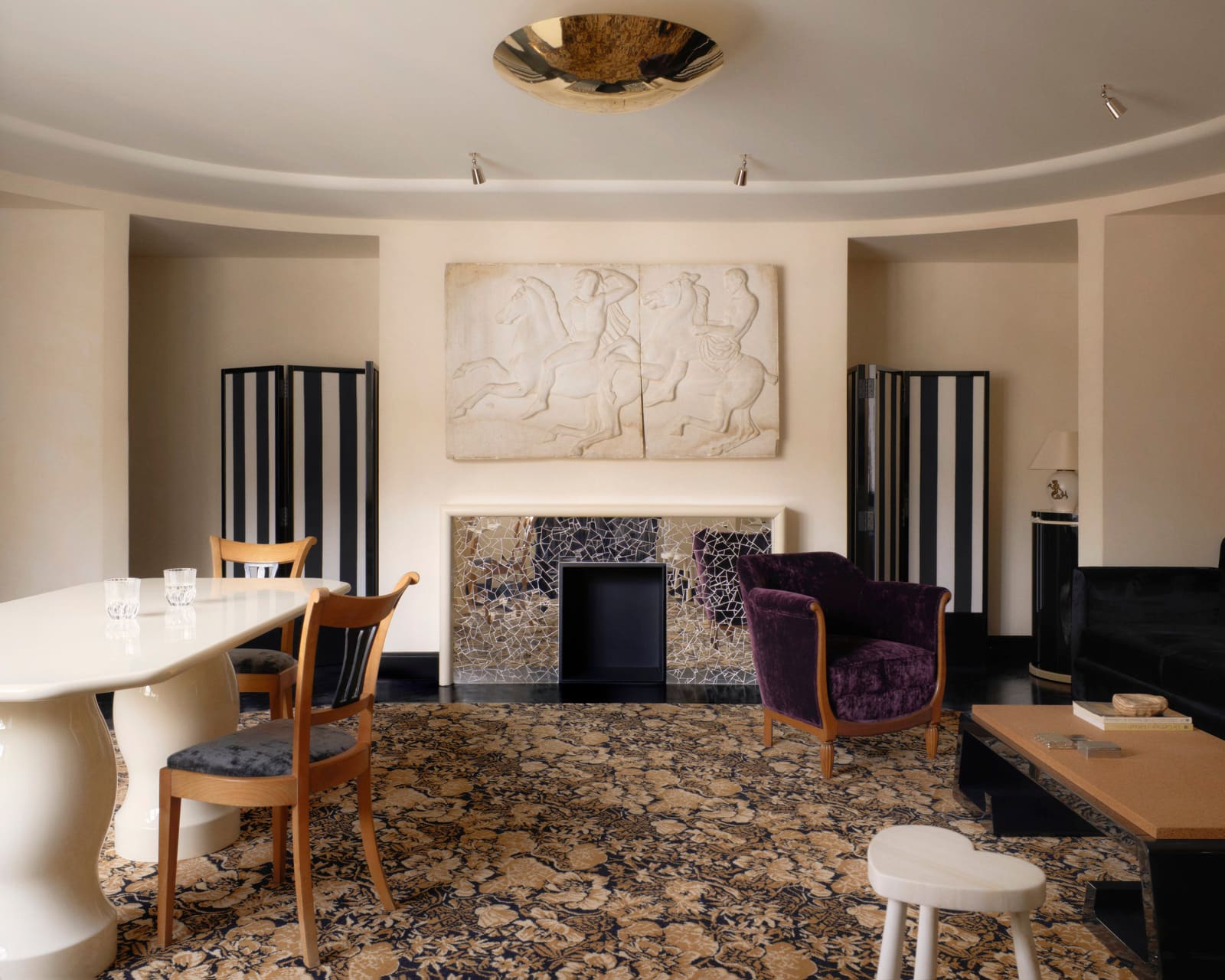
The single most diagnostic failure in residential interiors is the reliance on ceiling-mounted ambient lighting. Overhead sources flatten a room, eliminating the contrast gradients that give depth to inhabited space. Librarycore interiors work because they reject this logic entirely. Light becomes a tool for defining microzones: a floor lamp angled toward a reading chair, a clip-on fixture illuminating a shelf edge, a table lamp creating a pool of warmth on a sideboard.
This is not new. The reading rooms of the Bibliothèque Sainte-Geneviève in Paris, designed by Henri Labrouste in the 1850s, employed iron-framed glass ceilings to flood the space with diffuse daylight while maintaining individual carrels with task lighting. The principle holds: layered light creates the perception of choice. You are not lit by the room; you light the room through your presence in it.
In practical terms, this means repositioning existing fixtures rather than purchasing new ones. A floor lamp moved within arm's reach of a chair, even if it disrupts the symmetry of the plan, signals intentionality. A reading light clipped to a shelf transforms storage into stage.
The Curated Shelf as Cognitive Anchor: Why One Is Enough
The temptation in any book-heavy interior is to impose order on all visible surfaces. This is a mistake. The human eye does not parse an entire room at once; it builds a mental model from selective sampling. A single shelf, styled with deliberate restraint, becomes the reference point from which the rest of the space is inferred.
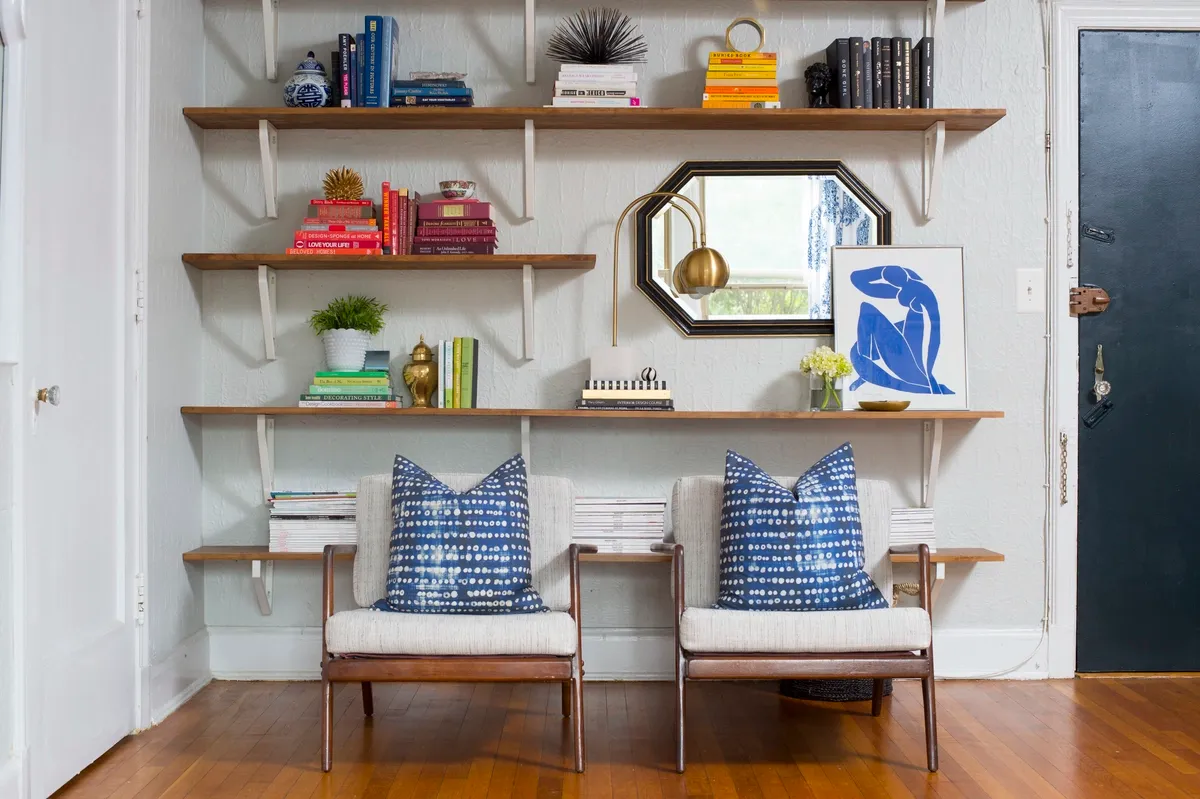
This is the principle of the parti applied to interior styling: identify the organizing idea, then let the rest follow. Stack three books horizontally. Place a small object—a ceramic bowl, a framed photograph, a candle—on top. Leave negative space. The shelf reads as intentional, and the viewer assumes the same logic governs the unseen.
We've observed this in the work of studios like 6a Architects, whose interiors for the Raven Row gallery in London treat shelving as a form of tectonic expression. Books are not decoration; they are the material substrate of the space. The shelf becomes a datum line, a horizon against which other objects register.
The Book as Surface: Covers, Typography, and the Politics of Display
Facing a book outward is not a styling trick—it's a spatial claim. A spine is passive; a cover is declarative. Typography, color, and graphic composition become the visual language of the shelf. This is why the resurgence of independent publishing, with its emphasis on tactile design and editorial voice, has coincided with the rise of librarycore. The book is no longer a container for text; it is an interface.
Consider the work of studios like Irma Boom, whose book designs for institutions like the Rijksmuseum treat the physical object as an artifact in its own right. The cover is not packaging; it is the first page. In a domestic context, this means that the decision to display a book is an editorial act. You are choosing what the room says about you.
Rotating displayed books seasonally is not indulgence—it's maintenance. A static shelf fossilizes. A dynamic one signals that the space is still in conversation with its inhabitant.
The Reading Nook as Microarchitecture: Proximity, Surface, and the Economics of Reach
A reading nook is not a chair. It is a spatial cluster defined by three conditions: seating, surface, and light. The chair provides the body's anchor. The surface—a side table, a stool, a stacked crate—provides the hand's anchor. The light provides the eye's anchor. Remove any one of these, and the nook dissolves into furniture.
This is the same logic that governs the design of monastic cells, library carrels, and railway compartments: the minimum viable enclosure for sustained focus. The reading nook is a microcosm of the larger space, a room within a room. It does not require architectural intervention. It requires only the recognition that adjacency matters.
Adding a pillow and a throw is not about comfort—it's about texture. A smooth chair in a smooth room offers no perceptual friction. A layered surface invites the hand. The stack of books on the adjacent surface is not clutter; it is evidence of intent. The nook is not staged; it is primed.
The Illusion of Built-Ins: Symmetry as Cognitive Shortcut
Built-in shelving is expensive because it is permanent. But the visual effect of built-ins—the sense of architectural integration—can be approximated through symmetry. The eye reads paired elements as intentional, even when they are not.
This is the principle behind the bibliothèques of 18th-century French interiors, where freestanding bookcases were designed to mimic the paneling of the walls. The furniture became architecture. In a contemporary context, this means grouping books by height on one side of a shelf, then mirroring the arrangement on the other. The middle remains loose, because perfect symmetry reads as rigidity.
We've seen this technique deployed in the work of Sergison Bates Architects, whose interiors for the Tate St Ives extension use modular shelving to create the appearance of permanence without the commitment. The shelf is furniture, but it behaves like a wall.
Texture as Spatial Softener: The Material Register of Cozy
A room that photographs well is often a room that feels flat. The absence of texture—no wrinkles, no folds, no visible wear—produces a visual field that is legible but uninhabitable. Librarycore works because it reintroduces material friction: a folded blanket on a chair arm, a woven basket holding paperbacks, a small rug defining the perimeter of the reading nook.
This is not decoration. It is the application of biophilic principles at the scale of the hand. Humans are haptic creatures; we navigate space through touch as much as sight. A room without texture is a room that does not invite engagement.
In the interiors of Alvar Aalto, texture was a counterpoint to the rationalism of modernist planning. The Villa Mairea, completed in 1939, combines white-painted walls with wood paneling, rattan screens, and wool textiles. The materials soften the geometry without undermining it. The same logic applies to the librarycore interior: texture is the register of warmth.
The Borrowed Book as Ritual: Use as the Measure of Success
The best librarycore interiors are not the ones that look the most impressive. They are the ones that show evidence of use. A stack of library books on a side table, rotated weekly, signals that the space is not static. The books are not props; they are active participants in the life of the room.
This is the same principle that governs the design of adaptive reuse projects: the best interventions are the ones that make the building more useful, not more beautiful. A home library that is never used is a stage set. A home library that is used weekly is a tool.
The Ten-Minute Reset: Maintenance as Design Act
The entropy of a lived-in space is not a failure—it is proof of habitation. But entropy requires management. The ten-minute reset is not about restoring perfection; it is about restoring legibility. Return ten books to their shelves. Face out one cover. Remove one object that no longer serves the space. Turn on one lamp.
This is the same logic that governs the maintenance of Japanese tea gardens, where the act of sweeping is not about cleanliness but about renewal. The space is not preserved; it is refreshed. The librarycore interior is not a finished project. It is a continuous practice.
At World Archi Design, we've come to understand that the spaces people love are rarely the ones they finish. They are the ones they tend.
Save this story. A free account keeps your reading list and the 07:00 email in one place.
CREATE FREE ACCOUNT →SIGN IN