Abstract
In the age of globalization and rapid urban development, cities face the challenge of expanding their infrastructure and economies without losing the cultural soul that gives them identity. Architecture - more than just the creation of buildings - becomes a guardian of memory, tradition, and place. This journal explores how iconic architectural projects in major cities serve as vessels of cultural preservation while adapting to contemporary needs. Through case studies from Asia and Europe, it examines the dynamic relationship between architecture and culture, analyzes the multifaceted role architecture plays in maintaining local identity, and distills design lessons for future urban development.
Introduction
The modern city is a paradox: it must constantly evolve to remain competitive, yet its authenticity and appeal often depend on its connection to the past. As skylines shift and glass towers rise, the risk of erasing centuries of cultural identity becomes all too real. In this environment, architecture serves as a critical mediator between tradition and innovation, offering not just functional spaces but also narratives that root communities in their history.
Architectural preservation in fast-changing cities is no longer limited to restoring old buildings. Instead, it often manifests through hybrid forms - projects that fuse traditional materials, patterns, and spatial logic with modern engineering and technology. These structures are not nostalgic recreations; they are forward-looking designs that reinterpret heritage in a way that resonates with contemporary life. In doing so, they ensure that local culture remains visible, tangible, and livable, even amid rapid transformation.
Iconic Projects That Preserve And Celebrate Local Culture
1. M+ Museum, Hong Kong - Herzog & de Meuron
Completed in 2021, M+ Museum is a cultural landmark in Hong Kong’s West Kowloon Cultural District that blends global modernism with local identity. Its T-shaped form - a horizontal podium and slender vertical tower - echoes the city’s industrial heritage while integrating public spaces that flow seamlessly from the surrounding streets.
The façade doubles as a massive LED screen, reflecting Hong Kong’s neon-lit culture, and interiors use materials like terrazzo and bamboo to reference local craftsmanship. Sightlines to Victoria Harbour and open, porous ground floors anchor the building in the city’s spatial traditions. Inside, the museum presents not only international contemporary art but also Hong Kong’s own visual culture, ensuring that local stories remain part of the city’s global narrative.
M+ shows that preserving cultural identity can mean reinterpreting, not replicating, tradition - merging familiar patterns and materials with a bold, contemporary form.

The M+ Museum fuses contemporary design with Hong Kong’s urban energy
2. National Kaohsiung Center for the Arts (Weiwuying), Taiwan - Mecanoo
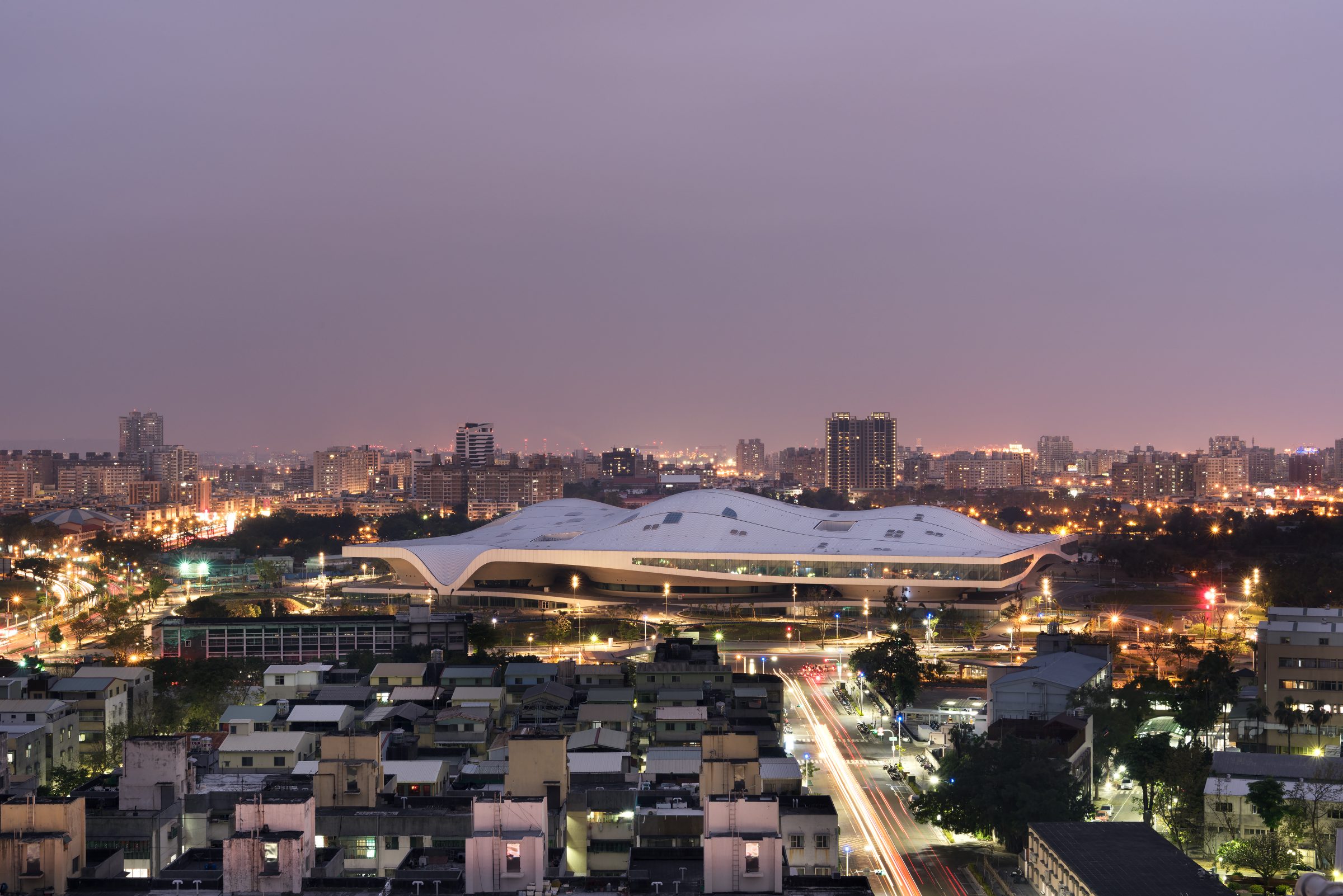
Spanning 9.9 hectares, Weiwuying is the world’s largest performing arts center under one roof and a powerful example of cultural preservation through architecture. Mecanoo’s wave-like design draws from the banyan trees that once covered the site, while its shaded plazas and open-air walkways echo Taiwan’s tradition of communal gathering in temple courtyards and village squares.
The building blurs the line between high culture and everyday life, inviting the public to pass through and inhabit its spaces freely - much like a bustling night market. Climate-conscious design, including vast overhangs and shaded courtyards, reflects the region’s subtropical heritage of passive cooling.
Weiwuying proves that globally significant architecture can remain rooted in place by aligning form, function, and climate response with local traditions - creating spaces that feel both contemporary and deeply familiar.

The sweeping canopy of Weiwuying embraces the park, blending world-class performance spaces with Taiwan’s southern landscape
3. Dongdaemun Design Plaza (DDP), Seoul, South Korea - Zaha Hadid Architects
Completed in 2014, the Dongdaemun Design Plaza is one of Seoul’s most recognizable architectural icons and a symbol of the city’s ambition to blend innovation with cultural continuity. Designed by the late Zaha Hadid in collaboration with Samoo Architects & Engineers, the DDP stands on the site of the former Dongdaemun Stadium, a place long associated with the city’s social life.
The plaza’s signature curves and seamless, metallic skin - comprising over 45,000 individually designed aluminum panels - create a futuristic form inspired by the movement of water and the topography of the site. Beneath its ultra-modern exterior, however, the DDP integrates heritage in a subtle yet meaningful way. Excavations during construction revealed sections of Seoul’s historic city wall, which have been preserved and woven into the design, creating a dialogue between past and present.
Housing exhibition halls, design labs, a museum, and public plazas open 24/7, the DDP serves as both a global design stage and a neighborhood gathering place, reinforcing the city’s culture of vibrant street life.
The DDP demonstrates that cultural preservation in a rapidly modernizing city does not always require traditional forms. By embedding historical fragments, maintaining public accessibility, and creating a program that bridges global and local design communities, architects can ensure that even the most futuristic projects remain rooted in their urban and cultural context.

Dongdaemun Design Plaza’s fluid curves weave past and future, redefining Seoul’s cultural skyline
4. Quang Ninh Museum and Library, Halong, Vietnam - Salvador Pérez Arroyo
Standing on the Halong Bay waterfront, the Quang Ninh Museum and Library is more than a civic building - it is a cultural manifesto. Designed by Spanish architect Salvador Pérez Arroyo and completed in 2013, the complex serves as both a repository of knowledge and a symbol of the province’s identity.
The design’s most striking feature is its black glass façade, inspired by the image of coal - the mineral resource that has long fueled Quang Ninh’s economy. This mirrored skin not only references industrial heritage but also reflects the ever-changing seascape of Halong Bay, blending built form with natural surroundings. Inside, the museum unfolds across multiple levels, each dedicated to a different facet of Quang Ninh’s history: prehistoric artifacts, ethnic minority cultures, coal mining heritage, and the biodiversity of Halong Bay. The adjoining library offers light-filled reading areas and public learning spaces, designed to encourage community engagement.
By translating local resources and geography into architectural form, Quang Ninh Museum and Library demonstrates how public buildings can become both a cultural archive and a civic icon. The project shows that identity-driven design can be bold and contemporary while still rooted in place, turning architecture into a medium of storytelling for future generations.

The black-glass façade of Quang Ninh Museum reflects Halong Bay, linking industrial heritage with natural beauty
5. The Reichstag Building, Berlin, Germany - Foster + Partners
Originally completed in 1894, the Reichstag has stood as a witness to Germany’s turbulent history - from imperial grandeur to war damage, division during the Cold War, and finally reunification. When Foster + Partners undertook its restoration in the 1990s, the goal was not merely to repair the building but to reframe it as a symbol of a new, transparent democracy.
The most striking addition is the modern glass dome, a lightweight structure of steel and glass that crowns the historic stone edifice. Visitors ascend a spiraling ramp inside the dome, gaining panoramic views over Berlin while also looking down into the parliamentary chamber below. This deliberate visual connection embodies political openness - citizens can literally see their government at work.
Technically, the dome is a feat of sustainable design. Its mirrored cone directs natural light into the chamber, while an integrated ventilation system regulates temperature, reducing the need for artificial lighting and mechanical cooling. This fusion of heritage conservation with advanced environmental engineering demonstrates that sustainability can be an intrinsic part of cultural preservation.
The Reichstag’s restoration balances respect for historical fabric with bold contemporary intervention. Rather than hiding the building’s scars, the design incorporates them into the narrative, allowing the structure to serve as both an archive of the past and a projection of democratic values into the future.

The Reichstag’s gleaming glass dome rises above Berlin, uniting historic legacy with a vision of openness
The Relationship Between Architecture and Culture
Architecture is both a product and a driver of culture. It reflects a society’s values, aesthetics, and priorities, while also shaping the daily rituals, social interactions, and sensory experiences of its inhabitants. Cultural identity manifests in multiple aspects of design: material choices rooted in local craft traditions, spatial layouts informed by social customs, and architectural forms that echo natural landscapes or historic landmarks.
In rapidly changing cities, this relationship takes on an even more urgent role. Urban spaces become battlegrounds where global design trends collide with regional character. Without deliberate intervention, architecture risks becoming placeless - beautiful, perhaps, but stripped of narrative meaning. Yet when architecture integrates cultural memory - be it through reinterpreted vernacular motifs, symbolic geometries, or community-centered functions - it acts as a vessel of continuity.
Crucially, culture is not static. Cities evolve, and so must architectural expressions of identity. The relationship between architecture and culture is therefore dialogic: buildings both preserve historical meaning and reinterpret it for the present, creating new layers of identity for future generations. This dynamic approach allows cities to retain their authenticity while adapting to modern needs.
Successful cultural preservation through architecture often involves:
+ Contextual Sensitivity: Understanding local traditions, climate, and social patterns.
+ Symbolic Translation: Reinterpreting rather than replicating heritage elements.
+ Adaptive Reuse: Transforming historic structures for modern functions while maintaining their cultural essence.
This symbiosis ensures that modernization doesn’t erase but instead renews cultural expression.
The Role of Architecture in Cultural Preservation
Architecture operates as both memory and medium, carrying the weight of history while shaping the spaces of tomorrow.
As memory, architecture serves as a physical archive of a community’s evolution - recording historical events, social customs, construction techniques, and aesthetic traditions in a tangible form. Each design element can hold narratives that are passed down through generations. These narratives are not just symbolic; they are embodied in the way people inhabit and navigate the built environment.
As medium, architecture translates these inherited elements into contemporary design, ensuring they remain functional, relevant, and meaningful. This might mean adapting vernacular forms to modern building technologies, reinterpreting cultural motifs in new materials, or integrating public rituals into urban programming.
In rapidly changing cities, where the pressure to modernize can erode distinctiveness, this dual role becomes a strategic tool for safeguarding identity:
+ Identity Anchoring - By rooting a city’s visual and spatial character in familiar cultural references - such as traditional rooflines, local materials, or indigenous urban patterns - architecture creates emotional anchors for communities, making cities more resilient against the homogenizing forces of global design trends.
+ Cultural Continuity - Built forms become the living thread between past and present, enabling intergenerational storytelling. A child walking past a restored colonial shophouse or a reimagined market hall connects, perhaps unconsciously, with the experiences of previous generations.
+ Public Symbolism - Landmark projects often transcend their physical function, becoming civic emblems. They serve as rallying points for civic pride, embodying shared values and aspirations - whether through a modern museum that preserves archaeological remains or a skyscraper whose design pays homage to a cultural icon.
In this way, architecture is not just a backdrop to cultural life but an active agent in preserving, adapting, and projecting it forward. The most enduring cities are those that recognize their buildings as both witnesses to history and instruments for shaping cultural futures.
Design Lessons For Culturally Rooted Urban Futures
The preservation of culture through architecture demands intentionality. Successful projects share several guiding principles:
+ Design as Storytelling: Buildings can embody and narrate the cultural history of a place, engaging both locals and outsiders in its heritage.
+ Contextual Sensitivity: Designs must emerge from a deep understanding of local history, climate, and cultural rituals. This goes beyond aesthetic mimicry; it requires engaging with the lived experience of communities.
+ Adaptive Reuse: Preserving heritage does not always mean freezing it in its original state. Creative reuse allows buildings to evolve in function while retaining their historical identity.
+ Material and Craft Integration: Using locally sourced materials and traditional craftsmanship not only supports local economies but also ensures a visual and tactile continuity with the past.
+ Public Engagement: Cultural preservation thrives when spaces are accessible and relevant to the public, transforming heritage into a lived and shared experience.
+ Hybrid Narratives: The most resonant works blend old and new, creating an architectural language that acknowledges historical continuity while reflecting contemporary innovation.
As cities expand, these lessons provide a framework for building environments that are not just efficient and visually striking, but also deeply meaningful. Architecture that preserves culture becomes more than shelter - it becomes a civic responsibility and a shared legacy.
Conclusion
In rapidly transforming cities, architecture becomes a potent tool for cultural preservation - not by freezing the past in time, but by weaving heritage into the fabric of contemporary urban life. The most successful projects embrace the tension between tradition and modernity, creating spaces that are at once locally grounded and globally relevant. As cities continue to grow, the challenge will be to ensure that their skylines do not become generic silhouettes, but rather remain rich, layered, and expressive of the cultures that inhabit them. In this sense, architecture is not just a witness to cultural change - it is an active agent shaping how that culture endures.
Save this story. A free account keeps your reading list and the 07:00 email in one place.
CREATE FREE ACCOUNT →SIGN IN