The Double Burden of Peripheral Neighborhoods
In cities built on steep topography, informal settlements often occupy the most precarious ground. Medellín's outer barrios exemplify this pattern: neighborhoods where families have limited access to safe play environments and where the absence of permeable surfaces compounds environmental hazards. The relationship between social infrastructure and ecological stability is rarely this visible. When children have nowhere to gather outdoors, the same impermeable hardscape that excludes recreation also accelerates runoff, destabilizes slopes, and traps heat.
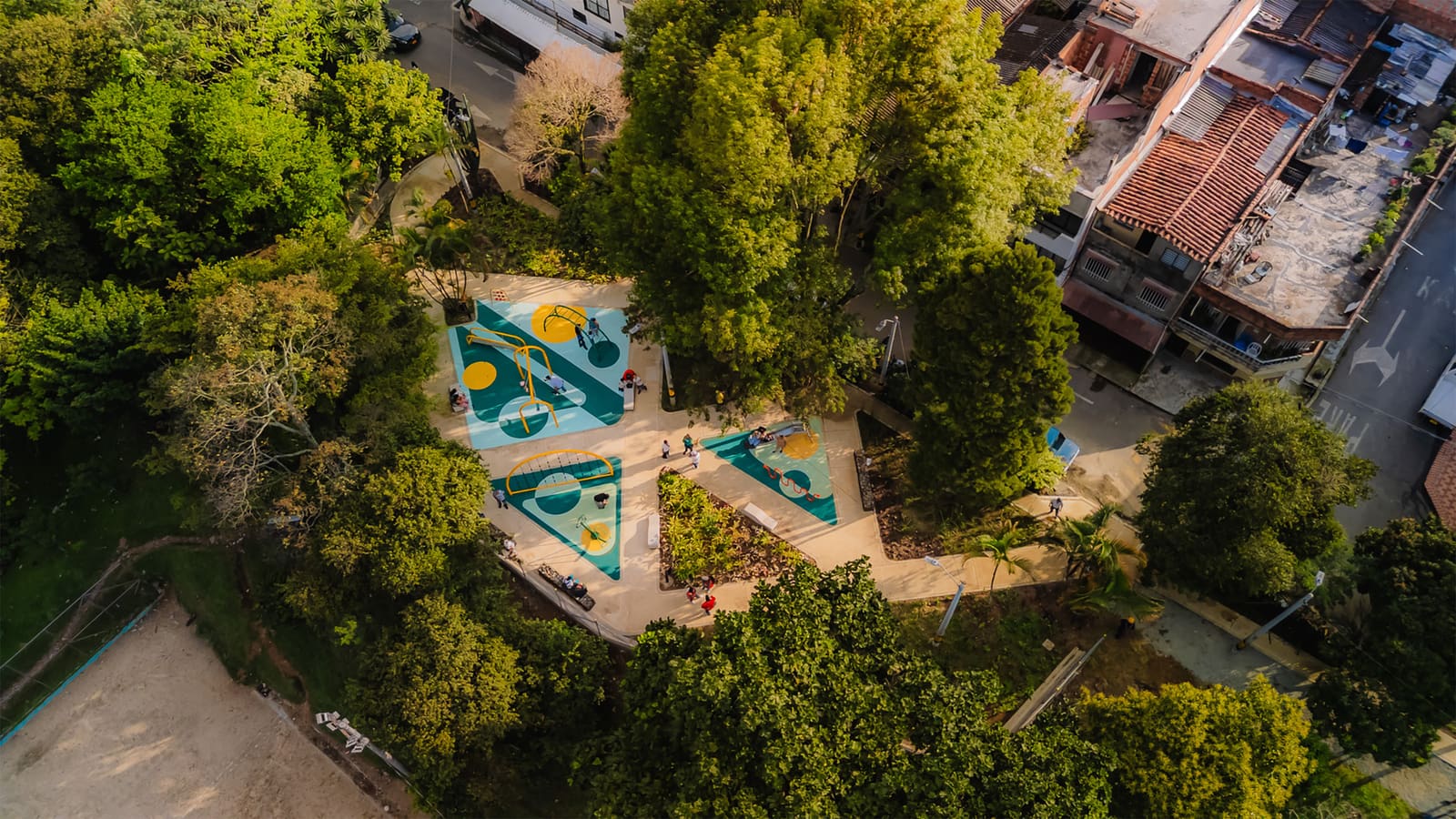
At World Archi Design, we've been tracking how municipalities respond when social equity and climate adaptation converge in a single design brief. The Tejiendo Hogares playground network, developed under Medellín's Office of the First Lady and executed by the Secretariat of Physical Infrastructure, offers a model worth examining: compact interventions, each approximately 48 square meters, distributed across neighborhoods that previously lacked dedicated play space.
Compact Typology, Distributed Strategy
The scale of each installation is deliberately modest. Rather than constructing a handful of large regional parks, the city chose to seed dozens of micro-playgrounds within walking distance of households in underserved areas. This approach mirrors tactics seen in participatory urbanism, from the acupuntura urbana experiments in Latin America to the pocket-park strategies pioneered in dense Asian cities. The logic is straightforward: frequency of access matters more than monumental scale when the goal is routine use by young children and their caregivers.
Each playground occupies a footprint small enough to fit within residual urban plots, vacant corners, or repurposed rights-of-way. The modular design, coordinated by a multidisciplinary team including architects, social workers, and audiovisual documentarians, allows rapid deployment without lengthy site-specific design phases. Standardization here is not aesthetic monotony but operational efficiency, a recognition that speed and ubiquity can be forms of equity.
Permeability as Infrastructure
Beyond providing play equipment, the network addresses a less visible urban crisis: the loss of natural ground cover. Hillside neighborhoods in Medellín have historically been paved or built over with little provision for stormwater infiltration. The resulting heat island effect is measurable, as is the heightened flood risk near creek basins during heavy rains. Impermeable surfaces channel runoff directly into drainage systems or, worse, into informal settlements downslope.
The playgrounds incorporate permeable paving and planted zones, small gestures that cumulatively restore some capacity for groundwater recharge and evaporative cooling. This is not landscape architecture as amenity but as climate infrastructure. The precedent is familiar to practitioners working in sponge city frameworks or green infrastructure retrofits, yet it remains underutilized in playground design, where rubber surfacing and concrete pads still dominate.
Material choice matters. The team specified locally available aggregates and vegetation adapted to Medellín's elevation and rainfall patterns. The planting palette prioritizes species that tolerate compacted urban soils and provide shade canopy within a few growing seasons. These are not showcase gardens but working landscapes, designed to perform under the wear of daily use.
Social Dimension and Co-Design
Medellín's playground initiative did not begin with architects at drafting tables. The social team, led by coordinators including Nancy Carillo and Soraya Caballero, conducted community consultations to identify priority sites and gather input on programming needs. This participatory layer is critical. Without it, even well-intentioned interventions risk irrelevance or, worse, displacement of existing informal uses.
The audiovisual documentation component, managed by Vanessa Tobón, Felipe Meneses, Israel Restrepo, Sebastián Restrepo, and Camilo Flórez, serves dual purposes: accountability and narrative. Residents see their input reflected in built outcomes, and the city gains a visual archive of incremental change across neighborhoods. Photography here is not promotional but evidentiary, a record of process as much as product.
This methodology aligns with best practices in participatory design, though it diverges from the slower, more consensus-driven models associated with co-design studios in Europe. The Medellín approach balances consultation with decisiveness, recognizing that prolonged planning cycles can themselves become barriers to equitable distribution of resources.
Fabrication and Logistics
Construction was executed by consortia including Dinamic Proyectos e Ingeniería, Consorcio Espublico Medellín Soluciones Civiles del Norte, and OYP Ingeniería y Consultoría. The logistics of simultaneous builds across dispersed sites are nontrivial. Coordinating material deliveries, labor schedules, and site access in neighborhoods with narrow streets and limited vehicle access demands planning that rarely appears in architecture journals but determines whether projects are completed on time and within budget.
The Department of Urban Planning and Architecture, under Alejandro Restrepo Montoya, provided oversight to ensure consistency with broader municipal development plans. This institutional coordination is often the weak link in distributed interventions. When playground installations align with transit upgrades, sanitation improvements, and housing regularization, their impact multiplies. When they proceed in isolation, they risk becoming symbolic gestures rather than structural shifts.
Precedents and Divergences
The Tejiendo Hogares network invites comparison with other playground initiatives in Latin American cities. Bogotá's Parques de Bolsillo, Lima's modular recreational units, and São Paulo's Praças Viárias share the logic of incremental, distributed intervention. What distinguishes the Medellín case is the explicit linkage between recreation and environmental resilience. The playgrounds are not merely social amenities but components of a larger climate adaptation strategy.
This dual function echoes principles articulated by landscape urbanists such as Kongjian Yu, whose sponge city work in China integrates flood management with public space, and the green infrastructure advocates in Philadelphia and Portland who retrofit schoolyards to capture stormwater. The scale differs, but the conceptual framework is consistent: urban surfaces can multitask.
Yet there are limits to what 48 square meters can achieve. These playgrounds will not solve Medellín's housing informality, its transit deficits, or the structural inequalities that concentrate risk in peripheral neighborhoods. They are incremental moves within a longer game. The question is whether they are part of a sustained investment trajectory or isolated interventions that satisfy political optics without altering underlying conditions.
Forward Questions
As cities worldwide confront overlapping crises of inequality, climate, and public health, the Medellín playground network offers a pragmatic template. It demonstrates that small-scale, distributed interventions can address multiple urban deficits simultaneously, provided they are conceived as systems rather than standalone projects.
The next phase will be instructive. Will the playgrounds be maintained, or will they degrade into disrepair as municipal budgets shift? Will the permeable surfaces continue to function as designed, or will compaction and neglect render them ineffective? Will the model be adapted by other Colombian cities, or will it remain a Medellín-specific experiment?
These are not rhetorical questions. The durability of participatory infrastructure depends on ongoing stewardship, which in turn depends on political will and community ownership. The architecture is the easy part. The harder work is ensuring that these spaces remain valued, used, and cared for in the years ahead.
Save this story. A free account keeps your reading list and the 07:00 email in one place.
CREATE FREE ACCOUNT →SIGN IN