Project Info
Project Name: Daguan
Location: Kunming, Yunnan, China
Designer: Aurora Design
In the heart of Kunming, Yunnan, China, tucked into the historic lanes of Nanqiang Street, a remarkable architectural transformation quietly celebrates the dialogue between past and present. Daguan, once a humble 1920s siheyuan - a traditional Chinese courtyard house - has been carefully reborn as a serene café, restaurant, and wine bar that honors its heritage while thoughtfully embracing contemporary design sensibilities.

The restored 1920s courtyard house sits quietly along Nanqiang Street, its timber façade and tiled roof preserving Kunming’s architectural memory
A Living Heritage Space
Nanqiang Street itself is a cultural tapestry rooted in centuries of history, from the legacy of the Yunjin Night Market to whispers of late Ming and early Qing dynasty life. Amidst this rich urban tapestry, Daguan stands as both a relic and a revelation. Originally a two-storey residence organized around a central courtyard - a definition of siheyuan typology - the house was restored first for structural integrity and then reimagined to support its new purpose as a public space.
Rather than overshadowing the building’s historic character, the design strategy by Aurora Design weaves old and new into a subtle but profound narrative. The original courtyard layout, with rooms flanking a sunlit open space, remains intact. This courtyard now acts not only as a spatial anchor but as a social hub where seating is thoughtfully arranged to invite both lingering and interaction.

A minimalist counter and linear pendant light introduce crisp modern geometry into the warmth of the preserved wooden structure

Historic timber detailing and contemporary café elements coexist in a space where tradition is carefully adapted for modern use
Material Poetry - Tradition Meets Modernity
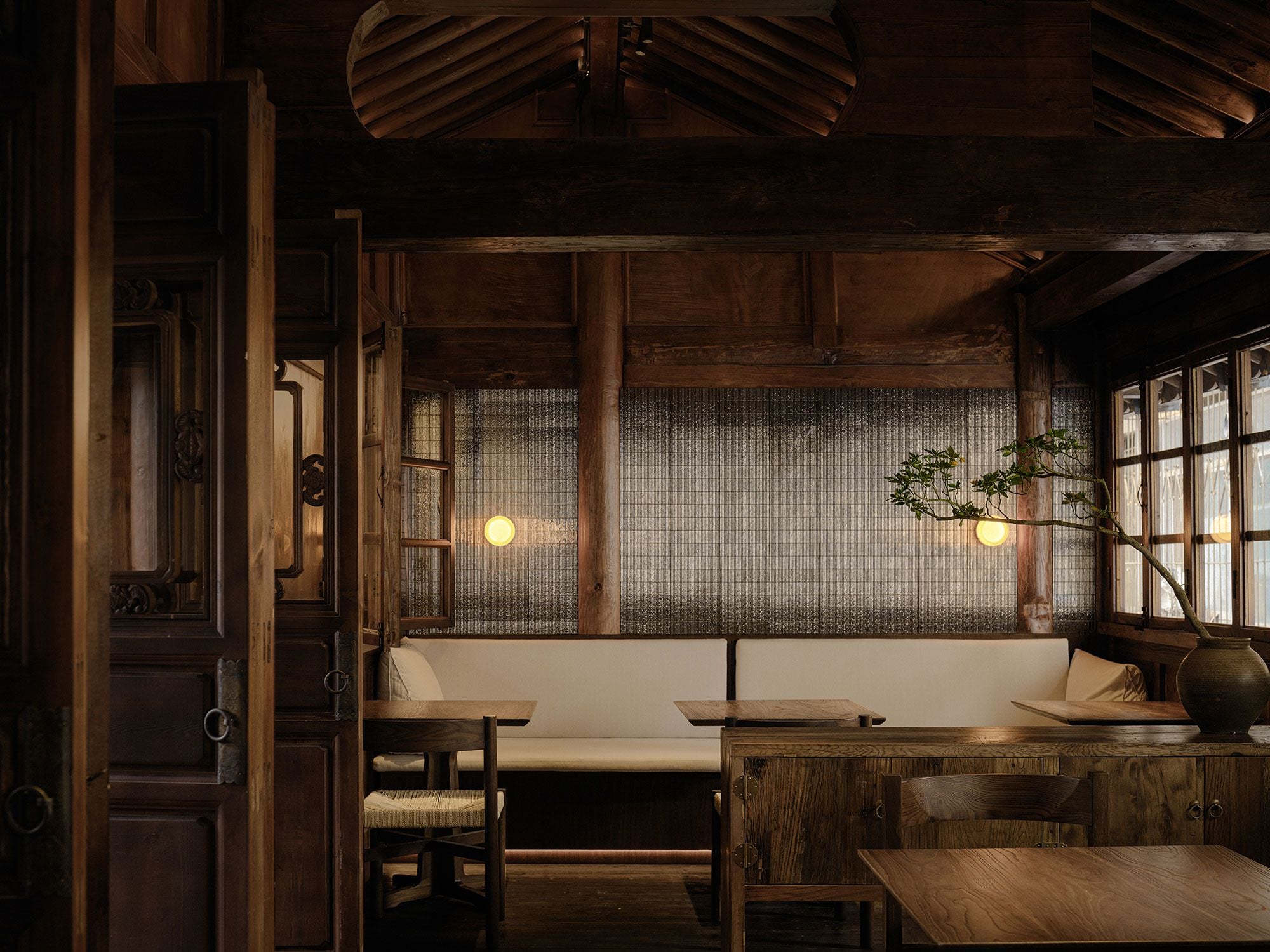
Walking through Daguan, visitors encounter materials and details that reflect its layered history. The exposed timber beams, hand-carved wooden doors, and aged brick surfaces speak to the artisanal craftsmanship of early 20th-century China, while minimalist furnishings, matte-black bar counters, and glossy ceramic tiles introduce a modern restraint. Wood remains the defining material throughout, its warmth grounding the space and allowing new elements to feel native rather than intrusive.

Exposed wooden beams and hand-carved doors reveal the tactile memory of early 20th-century craftsmanship

An intimate dining nook pairs sculpted wooden furniture and soft pendant lighting, preserving the domestic scale of the original courtyard house
On the ground floor, a compact bar nestled in the entrance hall caters to a quick coffee, while outdoor benches along the street invite passersby to pause. The main hall features a larger bar with clean silhouettes that contrast beautifully with the tactile warmth of the wooden frame. Upstairs, intimate lounges and slender loggias offer quiet retreats where one might sip a drink while gazing into the courtyard below.

A bar counter contrasts with aged timber beams, articulating a dialogue between contemporary restraint and heritage craft

Quiet lounges on the second floor reinterpret domestic rooms as contemplative retreats for wine and conversation

The upper-level loggia overlooks the courtyard, offering intimate seating wrapped in filtered daylight
Light, Atmosphere, and Urban Rhythm
Lighting at Daguan is a careful choreography of natural daylight and warm fixtures, rustic lanterns, sconces, and contemporary fittings merge to shape an ambiance that feels at once nostalgic and timeless. Sunlight filters through the courtyard by day, casting soft shadows across textured surfaces; as evening falls, warm glows define the space with calm intimacy.

Natural daylight drifts across timber frames by day
What emerges is not simply a restored building, but a space that acts as a physical and poetic bridge between eras. In a rapidly modernizing urban context, Daguan’s design illustrates a profound architectural lesson: that heritage can be activated, not erased, and that quiet dignity can be as compelling as bold reinvention.
The result is a café and gathering place where history isn’t just observed, it’s lived, felt, and savored in every beam, shadow, and sip of tea or wine.
PHOTO CREDIT: Na Xin from INSPACE
Save this story. A free account keeps your reading list and the 07:00 email in one place.
CREATE FREE ACCOUNT →SIGN IN