The Image Problem
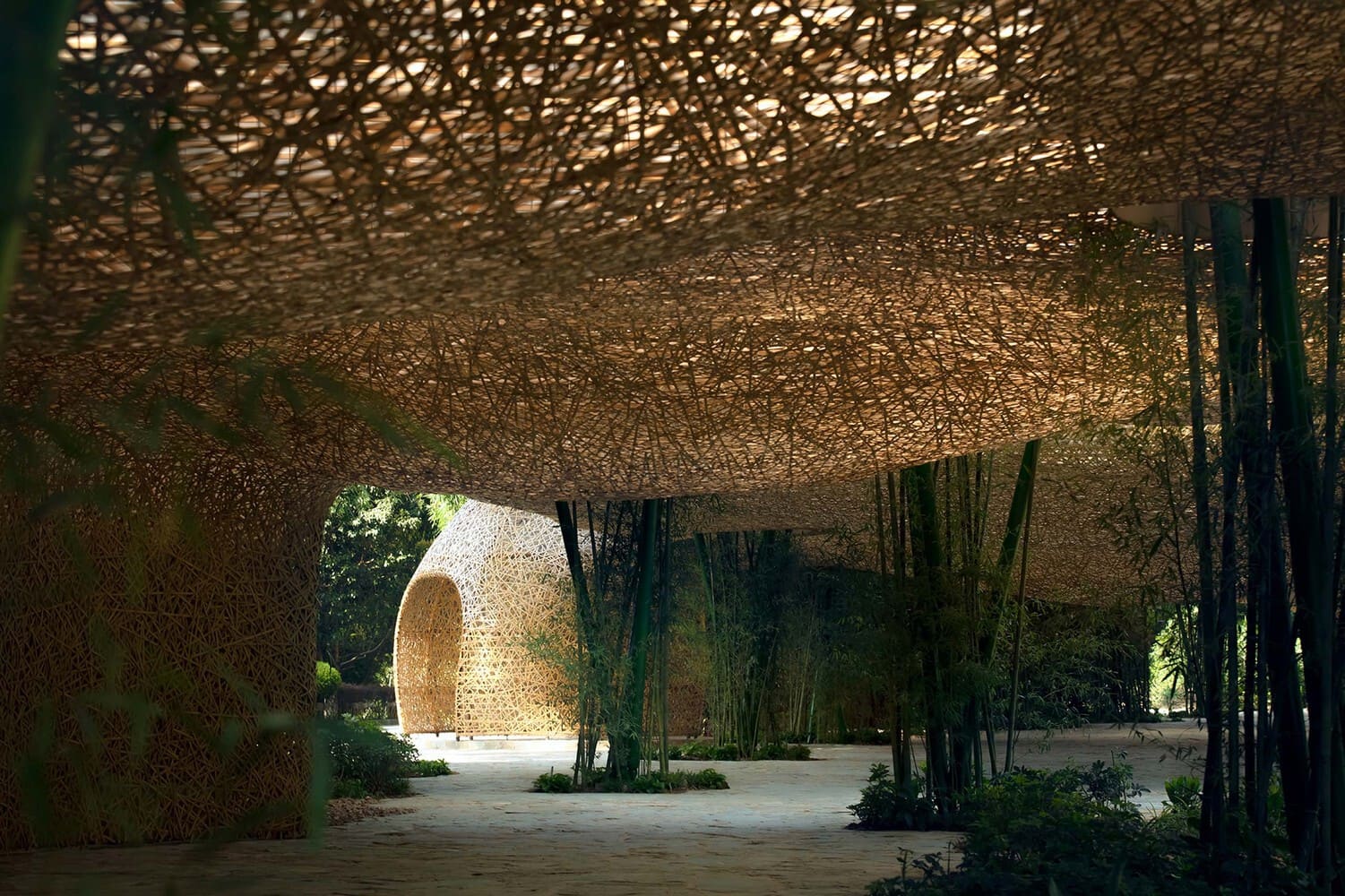
Walk through any architecture exhibition on climate or sustainability over the past decade, and you will likely encounter bamboo. It appears in pavilions, experimental canopies, and school projects, photographed against blue skies or dappled light. The visual message is immediate: here is a material that looks like nature, grows fast, and promises an exit from concrete's carbon burden.
Yet this visibility comes with a cost. When a material becomes too legible as a symbol, its actual conditions recede. Bamboo today is admired before it is interrogated. At World Archi Design, we have tracked this pattern across dozens of projects: the faster bamboo enters the mainstream sustainability conversation, the less attention is paid to what it actually demands from designers, contractors, and regulatory systems. The real question is not whether bamboo can help architecture become more ecological. It is whether the construction industry is willing to reorganize itself around the kinds of knowledge, maintenance schedules, and temporal frameworks that bamboo requires to function safely and responsibly.
This is not a technical problem that can be solved with better joinery details or moisture-resistant treatments. It is a political one. Bamboo forces architecture to confront how much control it expects over materials, whose expertise it recognizes as legitimate, and whether buildings can be designed for lives shorter than permanence without being dismissed as informal or provisional.
A Plant That Refuses Standardization
Contemporary construction operates through systems designed for predictability. Structural steel arrives with mill certificates. Concrete mixes are specified to the kilogram. Glass panels carry performance data for thermal transmission, impact resistance, and deflection. These materials have been absorbed into a regulatory and procurement apparatus that knows how to read them. They do not require interpretation on site.
Bamboo does not cooperate with this system. A culm harvested at three years will behave differently from one harvested at five. Wall thickness varies along the length. Moisture content shifts with climate. Node spacing, fiber density, and splitting behavior depend on species, soil, altitude, and season. Even after treatment and drying, the material continues to respond to humidity, insect activity, and mechanical stress. These are not defects to be engineered out. They are properties intrinsic to working with a living organism that has been cut, dried, and reassembled into structure.
The construction industry has developed sophisticated methods for managing variability in timber through grading systems, laminated products, and decades of testing data. Engineered wood now occupies a stable position within building codes and insurance frameworks. Bamboo has not yet achieved this status. Laminated bamboo boards and structural composites exist, and they allow the material to enter conventional procurement channels more easily. But they also require significant industrial processing, adhesives, energy, and quality control. The plant becomes legible to the industry only after it has been transformed into something closer to a manufactured product.
Neither approach is inherently wrong. Natural culms preserve material efficiency and cultural continuity but demand higher levels of skill and inspection. Engineered products offer consistency and regulatory acceptance but require infrastructure, capital, and energy inputs that may not align with bamboo's ecological promise. The tension here is not technical. It is about what architecture is willing to trust.
Who Knows the Material
In most contemporary projects, authority flows downward from drawings to specifications, from engineers to suppliers, from project managers to site workers. The material is expected to arrive as described and perform as calculated. Bamboo disrupts this hierarchy because much of its intelligence resides with people who do not hold engineering degrees or work within formal certification systems.
Scaffold workers in Hong Kong and Macau have been assembling multi-story bamboo frames for decades, using lashing techniques refined through repetition and risk. Treatment specialists in Southeast Asia understand which preservatives work in monsoon climates and which fail. Carpenters in rural Colombia and Indonesia know how to read a culm's fiber direction, predict splitting, and adjust joinery methods accordingly. This knowledge is not codified in manuals or standardized across borders. It is held in practice, transmitted through apprenticeship, and adapted to local conditions.
The problem is that the building industry often recognizes expertise only when it can be verified through credentials, testing protocols, or third-party certification. Craft knowledge, no matter how refined, tends to be categorized as informal or unregulated. This does not mean it is less rigorous. It means its rigor takes a different form: one based on judgment, material contact, and iterative learning rather than laboratory-derived formulas.
Bamboo's politics, then, is also a politics of whose intelligence counts. A more serious engagement with the material would require construction systems that can validate experiential knowledge without forcing it into the narrow frameworks of standardized testing. This is not about romanticizing tradition or rejecting engineering. It is about recognizing that material competence can exist outside the institutional structures that the industry has built to manage risk.
The Lifespan Mismatch
Steel and concrete promise durability. They carry the cultural weight of permanence, even when the programs they house are transient. Retail interiors are gutted and rebuilt every five years. Exhibition spaces are dismantled after months. Public pavilions are removed before their structural lifespan expires. In each case, the carbon embedded in long-lasting materials far exceeds the actual duration of use.
Bamboo offers a different proposition. Its rapid growth cycle, high strength-to-weight ratio, and relative ease of assembly make it well-suited for structures that expect change. It does not pretend that every architectural problem requires a solution designed to last fifty years. Instead, it suggests that some programs deserve materials calibrated to shorter, more flexible timescales: structures that can be repaired incrementally, adapted without demolition, or disassembled and rebuilt elsewhere.
This is not an argument for disposability. It is an argument for proportionality. When a building's material intensity exceeds its programmatic lifespan, the mismatch creates waste, embodied carbon that never gets compensated, and inflexibility in urban space. Bamboo's ecological value lies less in its renewability and more in its capacity to support architectures of change, repair, and cyclical renewal.
Yet building codes in most jurisdictions do not have robust categories for temporary construction that is also safe, well-designed, and publicly accessible. Temporary often means reduced oversight, lighter structural requirements, or exemption from inspection. This is a missed opportunity. Temporality should not mean informality. It should require a different kind of rigor: clear protocols for maintenance, defined replacement cycles, inspection schedules, and dismantling procedures. For bamboo, this distinction is essential. Its structural behavior depends on ongoing care. Without regulatory frameworks that can support safe forms of impermanence, bamboo will remain trapped between experimental pavilions and unregulated self-build.
What Bamboo Actually Demands
If bamboo is going to move beyond its symbolic role, architecture will need to confront what the material actually requires. This includes developing grading systems that can accommodate biological variation without eliminating it. It includes training programs that bridge craft knowledge and structural engineering. It includes building codes that distinguish between temporary and permanent construction without treating the former as inherently less serious. And it includes procurement and insurance systems that can assess risk in materials that change over time.
None of this is simple. Bamboo does not offer architecture an easy path to sustainability. It offers a harder one: a material that grows quickly but demands slower, more attentive construction practices. A material that is light and strong but requires continuous maintenance. A material that can reduce embodied carbon but only if the industry is willing to accept shorter lifespans, replaceable components, and a different relationship to control.
The projects we have covered over the past five years suggest that this shift is beginning. IBUKU's work in Bali has demonstrated that bamboo can support large-span structures with careful engineering and ongoing stewardship. llLab's pavilions in China have shown how natural culms can be used in public space with transparent structural logic. H&P Architects' floating houses in Vietnam have explored how bamboo can respond to seasonal flooding, creating architecture that adapts rather than resists. The Chinese University of Hong Kong's ZCB Pavilion has tested how bamboo can meet contemporary safety standards without abandoning material specificity.
Each of these projects operates at the intersection of craft, engineering, and policy. They do not treat bamboo as a substitute for steel or a return to vernacular purity. They treat it as a material that requires architecture to think differently about time, maintenance, and the distribution of knowledge.
Building for Repair
Bamboo's return to contemporary practice is less a material choice and more a challenge to the assumptions that organize construction. It asks whether every architectural problem deserves a permanent solution. It asks whose knowledge the industry is willing to recognize as legitimate. And it asks whether architecture can design for change without treating impermanence as failure.
These are not questions that bamboo alone can answer. But they are questions that bamboo makes unavoidable. Its value lies not in replacing industrial materials, but in exposing the gaps where those materials have been applied disproportionately: spaces that need flexibility more than fixity, programs that require repair more than replacement, and timescales that demand attention rather than assumption.
The politics of bamboo, then, is the politics of how architecture organizes itself around materials it cannot fully control. It is a question of whether the discipline can build systems that support variability, craft, maintenance, and time without abandoning rigor or safety. If bamboo remains only a symbol of sustainability, it will continue to appear in photographs and disappear from serious construction. If it becomes a material that architecture is willing to work with on its own terms, it may offer something more useful: a model for building that accepts change as a condition, not a compromise.
Photo: Arch-Exist
Save this story. A free account keeps your reading list and the 07:00 email in one place.
CREATE FREE ACCOUNT →SIGN IN